
Session 1 – Fiber optic sensing: New developments and instrumentation
GC14-FibreOptic-51 | Orals | Session 1
Frequency-dependent directivity of distributed acoustic sensing in ocean acousticsAngeliki Xenaki and Peter Gerstoft
Distributed acoustic sensing (DAS) turns fiber-optic cables into distributed, passive sensors suited for continuous, spatially extended ocean monitoring. Specifically, an optoelectronic interrogator injects laser pulses into the fiber and measures the phase modulation of Rayleigh backscattered light, which is caused by external acoustic wavefields inducing elastic strain over a gauge length. A DAS sensor (channel) is commonly considered a point sensor for signal processing, i.e., introduces no spatial coherence to the measured signal. However, DAS sensors have a non-negligible spatial extent due to the transfer function between the measured optical signal and the external acoustic field. The transfer function between optical and acoustic quantities is factorized into four terms, describing the filtering effect of the acquisition gauge window and the spatial averaging window, and of the acoustic wavenumber and direction of arrival. The resulting sensitivity as a function of frequency and angular direction of individual DAS sensors is related to the sensor’s equivalent spatial aperture. The spatial shape of an individual DAS sensor is derived theoretically, and is quantified in common array signal processing terms, such as equivalent spatial aperture, directivity, and beampattern. The shape of the spatial aperture determines the spatial coherence of DAS measurements in a diffuse acoustic wavefield, as demonstrated on publicly available data. The corresponding spatial coherence predicts the statistical characteristics of the speckle pattern in DAS.
How to cite: Xenaki, A. and Gerstoft, P.: Frequency-dependent directivity of distributed acoustic sensing in ocean acoustics, Galileo conference: Fibre Optic Sensing in Geosciences, Aussois, France, 31 Aug–4 Sep 2026, GC14-FibreOptic-51, 2026.
Distributed acoustic sensing (DAS) turns fiber-optic cables into distributed, passive sensors suited for continuous, spatially extended ocean monitoring. Specifically, an optoelectronic interrogator injects laser pulses into the fiber and measures the phase modulation of Rayleigh backscattered light, which is caused by external acoustic wavefields inducing elastic strain over a gauge length. A DAS sensor (channel) is commonly considered a point sensor for signal processing, i.e., introduces no spatial coherence to the measured signal. However, DAS sensors have a non-negligible spatial extent due to the transfer function between the measured optical signal and the external acoustic field. The transfer function between optical and acoustic quantities is factorized into four terms, describing the filtering effect of the acquisition gauge window and the spatial averaging window, and of the acoustic wavenumber and direction of arrival. The resulting sensitivity as a function of frequency and angular direction of individual DAS sensors is related to the sensor’s equivalent spatial aperture. The spatial shape of an individual DAS sensor is derived theoretically, and is quantified in common array signal processing terms, such as equivalent spatial aperture, directivity, and beampattern. The shape of the spatial aperture determines the spatial coherence of DAS measurements in a diffuse acoustic wavefield, as demonstrated on publicly available data. The corresponding spatial coherence predicts the statistical characteristics of the speckle pattern in DAS.
How to cite: Xenaki, A. and Gerstoft, P.: Frequency-dependent directivity of distributed acoustic sensing in ocean acoustics, Galileo conference: Fibre Optic Sensing in Geosciences, Aussois, France, 31 Aug–4 Sep 2026, GC14-FibreOptic-51, 2026.
GC14-FibreOptic-48 | ECS | Posters | Session 1
FoBench: A Python toolbox for Fibre Optic Sensing signal processing and data handling.Sergio Diaz-Meza, Jonas Pätzel, Chirstopher Wollin, Johannes Hart, and Laura Hillmann
Over the past decade, studies involving fibre optic sensing (FOS) have increased substantially, and consequentialy, optical fibres have become a prominent option for seismo-acoustic data acquisition. FOS can leverage existing telecom infrastructure in locations where installing conventional seismic stations is difficult, while providing dense measurements at high spatial and temporal sampling rates. However, replacing conventional sensor workflows with fibre optic sensing introduces major practical challenges such as: very large data volumes, heterogeneous native formats, high computational demand for fast processing and visualisation, and the need for intuitive yet flexible programming interfaces.
Several open-source tools such as DASPy, DASCore and Xdas already address parts of these challenges. Here we present FoBench as a complementary architecture focused on practical, reproducible end-to-end workflows for FOS data handling and baseline signal processing. FoBench is designed to ease transition from conventional seismo-acoustic workflows by adopting usage patterns familiar to ObsPy and Pyrocko users. It supports native formats (I/O) from multiple interrogator manufacturers, provides high-speed interactive plotting for seamless data inspection, and organises campaign-scale archives through a structured Project-Unit-Dataset model.
FoBench also targets operational scalability. It includes discontinuity-aware dataset handling, configurable processing pipelines, and memory-efficient greater-than-memory workflows via chunked outputs, with four interchangeable parallel wrappers (multiprocessing, MPI, Dask, and Process Pools). In addition, FoBench’s architecture is aligned with the in-development Geo-INQUIRE proposed metadata scheme to improve consistency and interoperability across archives.
We present the design principles of FoBench, illustrate representative processing workflows on seismo-acoustic FOS datasets, and discuss benchmark comparisons against available toolboxes. Our goal is not to replace existing ecosystems, but to provide a lightweight, interoperable, and user-oriented framework that bridges the gap between raw FOS files and reproducible scientific products.
How to cite: Diaz-Meza, S., Pätzel, J., Wollin, C., Hart, J., and Hillmann, L.: FoBench: A Python toolbox for Fibre Optic Sensing signal processing and data handling., Galileo conference: Fibre Optic Sensing in Geosciences, Aussois, France, 31 Aug–4 Sep 2026, GC14-FibreOptic-48, 2026.
Over the past decade, studies involving fibre optic sensing (FOS) have increased substantially, and consequentialy, optical fibres have become a prominent option for seismo-acoustic data acquisition. FOS can leverage existing telecom infrastructure in locations where installing conventional seismic stations is difficult, while providing dense measurements at high spatial and temporal sampling rates. However, replacing conventional sensor workflows with fibre optic sensing introduces major practical challenges such as: very large data volumes, heterogeneous native formats, high computational demand for fast processing and visualisation, and the need for intuitive yet flexible programming interfaces.
Several open-source tools such as DASPy, DASCore and Xdas already address parts of these challenges. Here we present FoBench as a complementary architecture focused on practical, reproducible end-to-end workflows for FOS data handling and baseline signal processing. FoBench is designed to ease transition from conventional seismo-acoustic workflows by adopting usage patterns familiar to ObsPy and Pyrocko users. It supports native formats (I/O) from multiple interrogator manufacturers, provides high-speed interactive plotting for seamless data inspection, and organises campaign-scale archives through a structured Project-Unit-Dataset model.
FoBench also targets operational scalability. It includes discontinuity-aware dataset handling, configurable processing pipelines, and memory-efficient greater-than-memory workflows via chunked outputs, with four interchangeable parallel wrappers (multiprocessing, MPI, Dask, and Process Pools). In addition, FoBench’s architecture is aligned with the in-development Geo-INQUIRE proposed metadata scheme to improve consistency and interoperability across archives.
We present the design principles of FoBench, illustrate representative processing workflows on seismo-acoustic FOS datasets, and discuss benchmark comparisons against available toolboxes. Our goal is not to replace existing ecosystems, but to provide a lightweight, interoperable, and user-oriented framework that bridges the gap between raw FOS files and reproducible scientific products.
How to cite: Diaz-Meza, S., Pätzel, J., Wollin, C., Hart, J., and Hillmann, L.: FoBench: A Python toolbox for Fibre Optic Sensing signal processing and data handling., Galileo conference: Fibre Optic Sensing in Geosciences, Aussois, France, 31 Aug–4 Sep 2026, GC14-FibreOptic-48, 2026.
GC14-FibreOptic-68 | ECS | Posters | Session 1
Joint phase and birefringence estimation in MIMO-DAS for dynamic strain anisotropy discrimination and static fiber characterizationDiane Prato, Renaud Gabet, and Élie Awwad
Optical fiber sensing has become increasingly important to provide continuous monitoring of optical fiber cables as well as their surrounding environment. In this context, Distributed Acoustic Sensing (DAS), based on Rayleigh scattering, has gained momentum and is now widely used to detect vibrational events for infrastructure monitoring and security, characterization of geophysical phenomena, or industrial process monitoring in energy, oil and gas, and smart city environments…
Our work focuses on multi-parameter estimation to detect and characterize a wider range of perturbations and gain knowledge about their nature. Using a coded-interrogation Multiple-Input-Multiple-Output Distributed Acoustic Sensing (MIMO-DAS) architecture, we estimate the Jones matrices describing the round-trip propagation along the optical fiber. From these matrices, we extract through post-processing two parameters of interest for each fiber section of 1.3m on average, independently of adjacent sections. These quantities are the common or polarization-averaged differential phase, representing the phase delay introduced by the fiber section and common to both polarization tributaries, and the retardance, corresponding to the phase shift between the two eigenpolarizations introduced by the fiber section, proportional to the effective birefringence magnitude.
Compared to conventional differential phase Optical Time-Domain Reflectometry (ΔΦ-OTDR) that focuses solely on differential phase estimation or Polarization Optical Time-Domain Reflectometry (P-OTDR) that considers polarization-related properties only, our approach aims at providing further information on environmental events by allowing a joint estimation of phase and polarization effects. Moreover, the coded-interrogation scheme eliminates the need to send several input State of Polarization (SOPs) and enables the coexistence of sensing and data transmission.
First, we demonstrate the detection and localization of dynamic strain events of frequency up to 3 kHz on standard single-mode fibers with a mean spatial resolution of 1.3m, and show the ability to discriminate between purely axisymmetric strains and anisotropic strains. Indeed, while the differential phase is sensitive to both kinds of events, the retardance is only responsive to perturbations that break cylindrical symmetry. Second, we validate our model through experiments in two scenarios: in the presence of longitudinal strain and anisotropic transverse strain. In addition, we use our system to estimate the effective birefringence magnitude along the fiber length in static conditions, providing insights into the fiber characteristics and its surrounding environment. In the future, we foresee exploring the advantages of our technique over various field-deployed fiber cable configurations.
How to cite: Prato, D., Gabet, R., and Awwad, É.: Joint phase and birefringence estimation in MIMO-DAS for dynamic strain anisotropy discrimination and static fiber characterization, Galileo conference: Fibre Optic Sensing in Geosciences, Aussois, France, 31 Aug–4 Sep 2026, GC14-FibreOptic-68, 2026.
Optical fiber sensing has become increasingly important to provide continuous monitoring of optical fiber cables as well as their surrounding environment. In this context, Distributed Acoustic Sensing (DAS), based on Rayleigh scattering, has gained momentum and is now widely used to detect vibrational events for infrastructure monitoring and security, characterization of geophysical phenomena, or industrial process monitoring in energy, oil and gas, and smart city environments…
Our work focuses on multi-parameter estimation to detect and characterize a wider range of perturbations and gain knowledge about their nature. Using a coded-interrogation Multiple-Input-Multiple-Output Distributed Acoustic Sensing (MIMO-DAS) architecture, we estimate the Jones matrices describing the round-trip propagation along the optical fiber. From these matrices, we extract through post-processing two parameters of interest for each fiber section of 1.3m on average, independently of adjacent sections. These quantities are the common or polarization-averaged differential phase, representing the phase delay introduced by the fiber section and common to both polarization tributaries, and the retardance, corresponding to the phase shift between the two eigenpolarizations introduced by the fiber section, proportional to the effective birefringence magnitude.
Compared to conventional differential phase Optical Time-Domain Reflectometry (ΔΦ-OTDR) that focuses solely on differential phase estimation or Polarization Optical Time-Domain Reflectometry (P-OTDR) that considers polarization-related properties only, our approach aims at providing further information on environmental events by allowing a joint estimation of phase and polarization effects. Moreover, the coded-interrogation scheme eliminates the need to send several input State of Polarization (SOPs) and enables the coexistence of sensing and data transmission.
First, we demonstrate the detection and localization of dynamic strain events of frequency up to 3 kHz on standard single-mode fibers with a mean spatial resolution of 1.3m, and show the ability to discriminate between purely axisymmetric strains and anisotropic strains. Indeed, while the differential phase is sensitive to both kinds of events, the retardance is only responsive to perturbations that break cylindrical symmetry. Second, we validate our model through experiments in two scenarios: in the presence of longitudinal strain and anisotropic transverse strain. In addition, we use our system to estimate the effective birefringence magnitude along the fiber length in static conditions, providing insights into the fiber characteristics and its surrounding environment. In the future, we foresee exploring the advantages of our technique over various field-deployed fiber cable configurations.
How to cite: Prato, D., Gabet, R., and Awwad, É.: Joint phase and birefringence estimation in MIMO-DAS for dynamic strain anisotropy discrimination and static fiber characterization, Galileo conference: Fibre Optic Sensing in Geosciences, Aussois, France, 31 Aug–4 Sep 2026, GC14-FibreOptic-68, 2026.
GC14-FibreOptic-40 | Orals | Session 1
NORFOX: A Fibre-Sensing Testbed for Seismo-Acoustic MonitoringAndreas Wuestefeld, Alan Baird, and Antoine Turquet
The strength of Distributed Acoustic Sensing (DAS) for vibration monitoring is the use of existing (telecom) fibre infrastructure. However, these cable geometries are typically not optimal for event localisation and beam-forming methods. Also, deployment (and thus ground coupling) is outside the control of geoscientists. To overcome these issues we designed and constructed the NORFOX array (NORwegian Fibre Optic eXperimental array) as a dedicated fibre-optic sensing testbed. NORFOX thus allows to investigate the opportunities DAS offers for both (array) processing and system-level characterization. The array comprises five fibre arms (~18 km total length, ~3 km aperture) and is co-located with the NORES seismic- and infrasound-array, enabling direct benchmarking against conventional instrumentation.
A key objective of NORFOX is to exploit DAS as a dense, continuous array for beamforming. Treating the fibre as thousands of spatially distributed channels, we demonstrate that DAS can retrieve coherent wavefield properties such as slowness and back-azimuth. The array geometry is specifically designed to balance directional sensitivity, robustness, and optical budget, providing improved azimuthal coverage compared to linear deployments. The design of NORFOX can be considered as best case scenario, and we can also simulate the impact of sub-optimal designs by reducing the geometry to various combinations of the 5 arms.
NORFOX also serves as a platform to calibrate fibre sensitivity. The installation includes both standard telecom fibres and enhanced backscatter cables, either directly buried in the ground or deployed inside a protective plastic conduit. This allows direct comparison of sensitivity, attenuation, and noise performance. In addition, multiple interrogators operating at different wavelengths (e.g., within the C- and L-bands) are tested, highlighting trade-offs between optical loss, backscatter efficiency, and signal-to-noise ratio. These comparisons are critical for understanding how hardware choices influence DAS data quality and array performance.
At the same time, NORFOX exposes key challenges in DAS. Cable-to-ground coupling strongly controls signal fidelity and varies with soil conditions and installation, leading to spatially heterogeneous noise. This variation occurs over both short-term (intra-day) and long-term (seasonal) timescales, leading to spatially heterogeneous noise conditions. DAS measurements are inherently directional and single-component, complicating beamforming and requiring adapted processing strategies. NORFOX records continuously with 250 Hz, 4 m spacing, and 20m gauge length, equivalent of about 4400 channels, and generating 93 GB data each day. It is possible to choose a secondary data-stream with different settings, or perform parallel measurements with other interrogators on additional. We present our considerations of for data management, data reduction, edge computing, and (long-term) storage.
By combining controlled array design, mixed fibre infrastructure, and multi-interrogator testing, NORFOX provides a unique experimental platform to investigate the full DAS sensing from fibre and interrogator physics to processing and interpretation. We here highlight the potential of fibre-optic arrays as next-generation sensing systems, while directly addressing the instrumental and methodological challenges limiting broader adoption.
How to cite: Wuestefeld, A., Baird, A., and Turquet, A.: NORFOX: A Fibre-Sensing Testbed for Seismo-Acoustic Monitoring, Galileo conference: Fibre Optic Sensing in Geosciences, Aussois, France, 31 Aug–4 Sep 2026, GC14-FibreOptic-40, 2026.
The strength of Distributed Acoustic Sensing (DAS) for vibration monitoring is the use of existing (telecom) fibre infrastructure. However, these cable geometries are typically not optimal for event localisation and beam-forming methods. Also, deployment (and thus ground coupling) is outside the control of geoscientists. To overcome these issues we designed and constructed the NORFOX array (NORwegian Fibre Optic eXperimental array) as a dedicated fibre-optic sensing testbed. NORFOX thus allows to investigate the opportunities DAS offers for both (array) processing and system-level characterization. The array comprises five fibre arms (~18 km total length, ~3 km aperture) and is co-located with the NORES seismic- and infrasound-array, enabling direct benchmarking against conventional instrumentation.
A key objective of NORFOX is to exploit DAS as a dense, continuous array for beamforming. Treating the fibre as thousands of spatially distributed channels, we demonstrate that DAS can retrieve coherent wavefield properties such as slowness and back-azimuth. The array geometry is specifically designed to balance directional sensitivity, robustness, and optical budget, providing improved azimuthal coverage compared to linear deployments. The design of NORFOX can be considered as best case scenario, and we can also simulate the impact of sub-optimal designs by reducing the geometry to various combinations of the 5 arms.
NORFOX also serves as a platform to calibrate fibre sensitivity. The installation includes both standard telecom fibres and enhanced backscatter cables, either directly buried in the ground or deployed inside a protective plastic conduit. This allows direct comparison of sensitivity, attenuation, and noise performance. In addition, multiple interrogators operating at different wavelengths (e.g., within the C- and L-bands) are tested, highlighting trade-offs between optical loss, backscatter efficiency, and signal-to-noise ratio. These comparisons are critical for understanding how hardware choices influence DAS data quality and array performance.
At the same time, NORFOX exposes key challenges in DAS. Cable-to-ground coupling strongly controls signal fidelity and varies with soil conditions and installation, leading to spatially heterogeneous noise. This variation occurs over both short-term (intra-day) and long-term (seasonal) timescales, leading to spatially heterogeneous noise conditions. DAS measurements are inherently directional and single-component, complicating beamforming and requiring adapted processing strategies. NORFOX records continuously with 250 Hz, 4 m spacing, and 20m gauge length, equivalent of about 4400 channels, and generating 93 GB data each day. It is possible to choose a secondary data-stream with different settings, or perform parallel measurements with other interrogators on additional. We present our considerations of for data management, data reduction, edge computing, and (long-term) storage.
By combining controlled array design, mixed fibre infrastructure, and multi-interrogator testing, NORFOX provides a unique experimental platform to investigate the full DAS sensing from fibre and interrogator physics to processing and interpretation. We here highlight the potential of fibre-optic arrays as next-generation sensing systems, while directly addressing the instrumental and methodological challenges limiting broader adoption.
How to cite: Wuestefeld, A., Baird, A., and Turquet, A.: NORFOX: A Fibre-Sensing Testbed for Seismo-Acoustic Monitoring, Galileo conference: Fibre Optic Sensing in Geosciences, Aussois, France, 31 Aug–4 Sep 2026, GC14-FibreOptic-40, 2026.
GC14-FibreOptic-24 | ECS | Orals | Session 1
Comparison of Fiber-Optic Cable Deployment Strategies inside a Geothermal Borehole using Active DAS VSPRoxane Chauvet, Destin Nziengui Bâ, and Florian Duret
Distributed Acoustic Sensing (DAS) has become a key technology for downhole seismic monitoring over the past decade, owing to its dense spatial sampling, operational simplicity, and cost efficiency. By converting fibre‑optic cables into continuous seismic sensors, DAS enables full‑depth borehole measurements that significantly exceed the spatial coverage of conventional geophone arrays. However, the quality of DAS measurements is highly dependent on fibre–formation coupling, which in turn is controlled by the method used to deploy the fibre within the borehole.
This study investigates the impact of different fibre‑optic deployment strategies on the quality and detectability of active DAS signals in a geothermal context. Experiments were conducted at a newly developed geothermal test site in Pau, France, equipped with six shallow (130 m) boreholes supplying a heating and cooling system. Two deployment methods were tested during probe installation: fibre cemented alongside the geothermal probe and fibre installed inside the geothermal probe tube. Multiple fibre‑optic cables (Single‑Mode and Multi‑Mode) were deployed, with this study focusing on three wells instrumented with different cable types and geometries (cemented looped, cemented single‑pass, and retrievable looped inside the probe).
An active seismic Vertical Seismic Profiling (VSP) survey was conducted in September 2025 using a weight‑drop source, with 43 repeated shots stacked to enhance signal‑to‑noise ratio. DAS data were acquired with a 5 m gauge length, 1 kHz sampling rate, and 2.4 m spatial sampling, yielding over 500 measurement channels along a continuous 1.2 km fibre. Despite ongoing geothermal circulation during the experiment, coherent seismic energy was detected along all boreholes down to 130 m depth.
Preliminary analysis of the stacked DAS data reveals coherent seismic arrivals in all instrumented boreholes, with detectable signals down to 130 m depth. Two main wave types are observed across all configurations: a fast first‑arrival wave (~2,270 m/s) and a slower guided mode (~550 m/s). Qualitative comparisons between boreholes suggest that signal amplitude and continuity vary with fibre deployment configuration. Cemented fibres generally display clearer first arrivals, while fibres installed inside the HDPE probe show localized attenuation and reduced amplitudes, potentially linked to bending and coupling conditions. Further analysis will include wavefield separation and time-lapse analysis to help quantify the effects of fibre coupling and geothermal operations
How to cite: Chauvet, R., Nziengui Bâ, D., and Duret, F.: Comparison of Fiber-Optic Cable Deployment Strategies inside a Geothermal Borehole using Active DAS VSP , Galileo conference: Fibre Optic Sensing in Geosciences, Aussois, France, 31 Aug–4 Sep 2026, GC14-FibreOptic-24, 2026.
Distributed Acoustic Sensing (DAS) has become a key technology for downhole seismic monitoring over the past decade, owing to its dense spatial sampling, operational simplicity, and cost efficiency. By converting fibre‑optic cables into continuous seismic sensors, DAS enables full‑depth borehole measurements that significantly exceed the spatial coverage of conventional geophone arrays. However, the quality of DAS measurements is highly dependent on fibre–formation coupling, which in turn is controlled by the method used to deploy the fibre within the borehole.
This study investigates the impact of different fibre‑optic deployment strategies on the quality and detectability of active DAS signals in a geothermal context. Experiments were conducted at a newly developed geothermal test site in Pau, France, equipped with six shallow (130 m) boreholes supplying a heating and cooling system. Two deployment methods were tested during probe installation: fibre cemented alongside the geothermal probe and fibre installed inside the geothermal probe tube. Multiple fibre‑optic cables (Single‑Mode and Multi‑Mode) were deployed, with this study focusing on three wells instrumented with different cable types and geometries (cemented looped, cemented single‑pass, and retrievable looped inside the probe).
An active seismic Vertical Seismic Profiling (VSP) survey was conducted in September 2025 using a weight‑drop source, with 43 repeated shots stacked to enhance signal‑to‑noise ratio. DAS data were acquired with a 5 m gauge length, 1 kHz sampling rate, and 2.4 m spatial sampling, yielding over 500 measurement channels along a continuous 1.2 km fibre. Despite ongoing geothermal circulation during the experiment, coherent seismic energy was detected along all boreholes down to 130 m depth.
Preliminary analysis of the stacked DAS data reveals coherent seismic arrivals in all instrumented boreholes, with detectable signals down to 130 m depth. Two main wave types are observed across all configurations: a fast first‑arrival wave (~2,270 m/s) and a slower guided mode (~550 m/s). Qualitative comparisons between boreholes suggest that signal amplitude and continuity vary with fibre deployment configuration. Cemented fibres generally display clearer first arrivals, while fibres installed inside the HDPE probe show localized attenuation and reduced amplitudes, potentially linked to bending and coupling conditions. Further analysis will include wavefield separation and time-lapse analysis to help quantify the effects of fibre coupling and geothermal operations
How to cite: Chauvet, R., Nziengui Bâ, D., and Duret, F.: Comparison of Fiber-Optic Cable Deployment Strategies inside a Geothermal Borehole using Active DAS VSP , Galileo conference: Fibre Optic Sensing in Geosciences, Aussois, France, 31 Aug–4 Sep 2026, GC14-FibreOptic-24, 2026.
GC14-FibreOptic-95 | Posters | Session 1
Long range Coherent-Optical Frequency Domain Reflectometry for large scale fibre sensingAdèle Hilico, Debanjan Show, Biplab Dutta, Olivier Lopez, Anne Amy-Klein, Christian Chardonnet, Paul-Eric Pottie, and Etienne Cantin
In recent years, significant technological progress has demonstrated the feasibility of using the long distance fiber optic links as large-scale distributed networks for environmental sensing [1]. The French national research infrastructure REFIMEVE [2] currently distributes an ultra-stable optical frequency reference (ultranarrow linewidth laser referenced to a metrological source at 1542 nm) across more than 9000 km of fibre links connecting laboratories throughout France and Europe. The optical reference is transferred through RENATER fibre network using bi-directional optical amplifiers and regeneration laser stations [3]. The light propagates back and forth in the same fiber enabling to maximize the cancellation of the noise induced by the optical link. The infrastructure has demonstrated strong potential for geophysical studies [4] as the cancelled noises are linked to the seismic noise integrated along the fibers. In this context, the European project SENSEI (Smart European Networks for Sensing the Environment and Internet Quality) [5] aims to harness this potential by developing the next generation photonic technologies for detecting both natural phenomena, such as earthquakes, volcano activity, and anthropogenic events including construction activity or vehicular traffic.
Within this framework, one of our objectives is to develop a coherent optical frequency domain reflectometry (C-OFDR) [6] sensing device based on a low noise laser in order to extend the sensing range of existing setups and add location capability to our previous result. In our setup, the output of a low noise laser is frequency modulated and a fibre under test is measured in a Michelson interferometer configuration. By analysing the Rayleigh backscattered signal along the fibre, the system enables detailed diagnostics of the fibre. As a first demonstration, we tested a prototype over a long-range fibre link extending up to 410 km. The system successfully identified the location of the optical amplifier and a PC connector placed at the end of the fibre with km scale spatial resolution. In future work, we plan to implement a transportable acquisition setup and deploy the C-OFDR system on an operational fiber network to evaluate its performance under real field conditions.
References:
[1] G. Marra et al., Science 361 (2018), https://doi.org/10.1126/science.aat4458
[2] REFIMEVE, https://www.refimeve.fr/en/homepage/
[3] O. Lopez et al., Opt. Express 20, 23518-23526 (2012) https://doi.org/10.1364/OE.20.023518
[4] M. B. K. Tønnes, Thesis (2022), https://hal.science/tel-03984045v1
[5] SENSEI, https://senseiproject.eu/
[6] C. Liang et al., IEEE Access. 9 (2021), DOI : 10.1109/ACCESS.2021.3061250
How to cite: Hilico, A., Show, D., Dutta, B., Lopez, O., Amy-Klein, A., Chardonnet, C., Pottie, P.-E., and Cantin, E.: Long range Coherent-Optical Frequency Domain Reflectometry for large scale fibre sensing, Galileo conference: Fibre Optic Sensing in Geosciences, Aussois, France, 31 Aug–4 Sep 2026, GC14-FibreOptic-95, 2026.
In recent years, significant technological progress has demonstrated the feasibility of using the long distance fiber optic links as large-scale distributed networks for environmental sensing [1]. The French national research infrastructure REFIMEVE [2] currently distributes an ultra-stable optical frequency reference (ultranarrow linewidth laser referenced to a metrological source at 1542 nm) across more than 9000 km of fibre links connecting laboratories throughout France and Europe. The optical reference is transferred through RENATER fibre network using bi-directional optical amplifiers and regeneration laser stations [3]. The light propagates back and forth in the same fiber enabling to maximize the cancellation of the noise induced by the optical link. The infrastructure has demonstrated strong potential for geophysical studies [4] as the cancelled noises are linked to the seismic noise integrated along the fibers. In this context, the European project SENSEI (Smart European Networks for Sensing the Environment and Internet Quality) [5] aims to harness this potential by developing the next generation photonic technologies for detecting both natural phenomena, such as earthquakes, volcano activity, and anthropogenic events including construction activity or vehicular traffic.
Within this framework, one of our objectives is to develop a coherent optical frequency domain reflectometry (C-OFDR) [6] sensing device based on a low noise laser in order to extend the sensing range of existing setups and add location capability to our previous result. In our setup, the output of a low noise laser is frequency modulated and a fibre under test is measured in a Michelson interferometer configuration. By analysing the Rayleigh backscattered signal along the fibre, the system enables detailed diagnostics of the fibre. As a first demonstration, we tested a prototype over a long-range fibre link extending up to 410 km. The system successfully identified the location of the optical amplifier and a PC connector placed at the end of the fibre with km scale spatial resolution. In future work, we plan to implement a transportable acquisition setup and deploy the C-OFDR system on an operational fiber network to evaluate its performance under real field conditions.
References:
[1] G. Marra et al., Science 361 (2018), https://doi.org/10.1126/science.aat4458
[2] REFIMEVE, https://www.refimeve.fr/en/homepage/
[3] O. Lopez et al., Opt. Express 20, 23518-23526 (2012) https://doi.org/10.1364/OE.20.023518
[4] M. B. K. Tønnes, Thesis (2022), https://hal.science/tel-03984045v1
[5] SENSEI, https://senseiproject.eu/
[6] C. Liang et al., IEEE Access. 9 (2021), DOI : 10.1109/ACCESS.2021.3061250
How to cite: Hilico, A., Show, D., Dutta, B., Lopez, O., Amy-Klein, A., Chardonnet, C., Pottie, P.-E., and Cantin, E.: Long range Coherent-Optical Frequency Domain Reflectometry for large scale fibre sensing, Galileo conference: Fibre Optic Sensing in Geosciences, Aussois, France, 31 Aug–4 Sep 2026, GC14-FibreOptic-95, 2026.
GC14-FibreOptic-94 | ECS | Orals | Session 1
Low-Tech State of Polarization Seismic Monitoring over Production FTTH Cable in Campi FlegreiEmanuele Virgillito, Federico Notarstefano, Andre' Herrero, Gilda Currenti, Francesca Bianco, Miriana Corsaro, Michele Prestifilippo, Rudi Bratovich, Raffaele Corsini, Simone Donadello, Cecilia Clivati, Francesco Di Lena, Davide Calonico, Marianna Hovsepyan, Francesco Carpentieri, and Vittorio Curri
Fibre-optic telecommunication networks are increasingly emerging as pervasive sensing infrastructures for geophysical and environmental monitoring. Beyond their primary role in data transmission, optical fibres are intrinsically sensitive to external perturbations: mechanical strain induced by seismic waves modifies both the optical phase and the state of polarization of the propagating light. This property enables existing fibre networks to act as large-scale distributed or integrated sensors, offering a promising complement to conventional seismic instrumentation. In highly active volcanic and seismic areas, such as Campi Flegrei, dense and continuous monitoring is particularly relevant for improving event detection, risk assessment and early response. However, established fibre-sensing techniques often rely on dedicated fibres, specialized interrogators or highly stable laser sources, which may limit scalability and increase deployment costs. For this reason, low-complexity sensing approaches that can operate over in-service telecom infrastructure are of strong interest.
In this work, we present a multi-technology fibre-sensing testbed deployed over operational and production fibre infrastructure owned by the italian operator Open Fiber in the Campi Flegrei area. The testbed combines three complementary techniques: state-of-polarization (SOP) sensing, distributed acoustic sensing based on ϕ-OTDR, and interferometric phase sensing. As shown in figure, the SOP and phase measurements are implemented over FTTH links departing from the same point of presence and reaching street cabinets in Agnano and Posillipo, while the DAS reference is acquired over another 22 km FTTH dark fibre owned by another italian operator (Fibercop). The SOP system uses a low-tech polarization-beam-splitter-based receiver that measures the normalized difference between two orthogonal polarization components of an intensity-modulated telecom signal. This architecture avoids coherent receivers and ultrastable lasers, and it can operate by tapping only a small portion of the optical power, preserving compatibility with live data transmission.
The experimental campaign demonstrates that the low-tech SOP approach can detect local seismic events down to magnitude 1.9. Earthquakes recorded in November 2025 were analysed and compared against independent reference measurements from DAS, interferometric phase sensing when available, and INGV seismic stations. The SOP traces clearly capture seismic signatures associated with P- and S-wave arrivals, with waveform features and spectral content consistent with the established fibre-sensing techniques. In particular, consecutive M1.9 and M3.0 events were detected by the SOP system and validated against DAS and INGV seismic-station data, while an M3.3 event was jointly observed by SOP, interferometric phase sensing, DAS and the INGV seismic network. These results show that simple SOP monitoring over in-service FTTH links can provide reliable seismic information while significantly reducing system complexity and cost, paving the way for scalable and minimally invasive seismic monitoring using existing telecom networks.
How to cite: Virgillito, E., Notarstefano, F., Herrero, A., Currenti, G., Bianco, F., Corsaro, M., Prestifilippo, M., Bratovich, R., Corsini, R., Donadello, S., Clivati, C., Di Lena, F., Calonico, D., Hovsepyan, M., Carpentieri, F., and Curri, V.: Low-Tech State of Polarization Seismic Monitoring over Production FTTH Cable in Campi Flegrei, Galileo conference: Fibre Optic Sensing in Geosciences, Aussois, France, 31 Aug–4 Sep 2026, GC14-FibreOptic-94, 2026.
Fibre-optic telecommunication networks are increasingly emerging as pervasive sensing infrastructures for geophysical and environmental monitoring. Beyond their primary role in data transmission, optical fibres are intrinsically sensitive to external perturbations: mechanical strain induced by seismic waves modifies both the optical phase and the state of polarization of the propagating light. This property enables existing fibre networks to act as large-scale distributed or integrated sensors, offering a promising complement to conventional seismic instrumentation. In highly active volcanic and seismic areas, such as Campi Flegrei, dense and continuous monitoring is particularly relevant for improving event detection, risk assessment and early response. However, established fibre-sensing techniques often rely on dedicated fibres, specialized interrogators or highly stable laser sources, which may limit scalability and increase deployment costs. For this reason, low-complexity sensing approaches that can operate over in-service telecom infrastructure are of strong interest.
In this work, we present a multi-technology fibre-sensing testbed deployed over operational and production fibre infrastructure owned by the italian operator Open Fiber in the Campi Flegrei area. The testbed combines three complementary techniques: state-of-polarization (SOP) sensing, distributed acoustic sensing based on ϕ-OTDR, and interferometric phase sensing. As shown in figure, the SOP and phase measurements are implemented over FTTH links departing from the same point of presence and reaching street cabinets in Agnano and Posillipo, while the DAS reference is acquired over another 22 km FTTH dark fibre owned by another italian operator (Fibercop). The SOP system uses a low-tech polarization-beam-splitter-based receiver that measures the normalized difference between two orthogonal polarization components of an intensity-modulated telecom signal. This architecture avoids coherent receivers and ultrastable lasers, and it can operate by tapping only a small portion of the optical power, preserving compatibility with live data transmission.
The experimental campaign demonstrates that the low-tech SOP approach can detect local seismic events down to magnitude 1.9. Earthquakes recorded in November 2025 were analysed and compared against independent reference measurements from DAS, interferometric phase sensing when available, and INGV seismic stations. The SOP traces clearly capture seismic signatures associated with P- and S-wave arrivals, with waveform features and spectral content consistent with the established fibre-sensing techniques. In particular, consecutive M1.9 and M3.0 events were detected by the SOP system and validated against DAS and INGV seismic-station data, while an M3.3 event was jointly observed by SOP, interferometric phase sensing, DAS and the INGV seismic network. These results show that simple SOP monitoring over in-service FTTH links can provide reliable seismic information while significantly reducing system complexity and cost, paving the way for scalable and minimally invasive seismic monitoring using existing telecom networks.
How to cite: Virgillito, E., Notarstefano, F., Herrero, A., Currenti, G., Bianco, F., Corsaro, M., Prestifilippo, M., Bratovich, R., Corsini, R., Donadello, S., Clivati, C., Di Lena, F., Calonico, D., Hovsepyan, M., Carpentieri, F., and Curri, V.: Low-Tech State of Polarization Seismic Monitoring over Production FTTH Cable in Campi Flegrei, Galileo conference: Fibre Optic Sensing in Geosciences, Aussois, France, 31 Aug–4 Sep 2026, GC14-FibreOptic-94, 2026.
GC14-FibreOptic-105 | Posters | Session 1
Development of Photonic Instrumentation for Long-Range Fiber Sensing on Ultra-Stable Optical Frequency NetworksGrégoire Coget, Cédric Majek, Bruno Desruelle, and Paul-Eric Pottie
The deployment of ultra-stable optical frequency dissemination networks over existing telecommunication infrastructure opens new perspectives for large-scale fiber sensing. In France, the REFIMEVE network distributes ultra-stable optical reference signals through more than 5000 km of actively operated telecom fibers. Initially developed for frequency metrology applications, such infrastructures also provide an opportunity to investigate fiber-based environmental sensing at unprecedented spatial scales. The objective is to exploit existing permanent telecommunication infrastructures as large-scale environmental sensing systems for geophysical applications.
The originality of our approach relies on the use of ultra-stable optical carriers exhibiting sub-hertz linewidths and coherence lengths exceeding terrestrial scales. These properties enable highly coherent interferometric measurements over very long distances. These motivate the development of new photonic instrumentation dedicated to long-range sensing, potentially extending from continental to transoceanic links.
Previous experiments performed on REFIMEVE demonstrated the capability of the network to detect large seismic events (magnitude > 5) through phase perturbations accumulated along the optical path. However, these first demonstrations relied on integrated measurements with sampling times on the order of one second, limiting temporal resolution and hence event localization capabilities. In contrast with conventional distributed dynamic fiber sensing (DDFS) techniques, the measured signal corresponds to the integrated phase noise of the entire optical link, preventing direct spatial discrimination of perturbations.
Within the European project SENSEI, we investigate new coherent sensing architectures intended to combine long-range operation with improved spatial resolution. In this work, we present ongoing developments of a photonic sensing instrument based on repeater laser stations, capable of phase-locking onto the disseminated ultra-stable optical carrier. Once locked, the repeater station can introduce controlled phase modulation onto the transmitted optical field using a phase modulator. The sensing information is retrieved through coherent demodulation at the laser station (for backscattered light). We discuss the main principles underlying the proposed architecture, including modulation and demodulation strategies compatible with long-haul coherent propagation on active telecom networks.
Particular attention is given to polarization-related effects. We discuss approaches under investigation to mitigate polarization diversity and associated fading mechanisms. In addition, we examine the possibility of exploiting the evolution of the optical state of polarization itself as an additional sensing observable in such systems, potentially providing complementary information on environmental perturbations affecting the fiber link and complementary to the observations made in coherent telecommunication networks.
How to cite: Coget, G., Majek, C., Desruelle, B., and Pottie, P.-E.: Development of Photonic Instrumentation for Long-Range Fiber Sensing on Ultra-Stable Optical Frequency Networks, Galileo conference: Fibre Optic Sensing in Geosciences, Aussois, France, 31 Aug–4 Sep 2026, GC14-FibreOptic-105, 2026.
The deployment of ultra-stable optical frequency dissemination networks over existing telecommunication infrastructure opens new perspectives for large-scale fiber sensing. In France, the REFIMEVE network distributes ultra-stable optical reference signals through more than 5000 km of actively operated telecom fibers. Initially developed for frequency metrology applications, such infrastructures also provide an opportunity to investigate fiber-based environmental sensing at unprecedented spatial scales. The objective is to exploit existing permanent telecommunication infrastructures as large-scale environmental sensing systems for geophysical applications.
The originality of our approach relies on the use of ultra-stable optical carriers exhibiting sub-hertz linewidths and coherence lengths exceeding terrestrial scales. These properties enable highly coherent interferometric measurements over very long distances. These motivate the development of new photonic instrumentation dedicated to long-range sensing, potentially extending from continental to transoceanic links.
Previous experiments performed on REFIMEVE demonstrated the capability of the network to detect large seismic events (magnitude > 5) through phase perturbations accumulated along the optical path. However, these first demonstrations relied on integrated measurements with sampling times on the order of one second, limiting temporal resolution and hence event localization capabilities. In contrast with conventional distributed dynamic fiber sensing (DDFS) techniques, the measured signal corresponds to the integrated phase noise of the entire optical link, preventing direct spatial discrimination of perturbations.
Within the European project SENSEI, we investigate new coherent sensing architectures intended to combine long-range operation with improved spatial resolution. In this work, we present ongoing developments of a photonic sensing instrument based on repeater laser stations, capable of phase-locking onto the disseminated ultra-stable optical carrier. Once locked, the repeater station can introduce controlled phase modulation onto the transmitted optical field using a phase modulator. The sensing information is retrieved through coherent demodulation at the laser station (for backscattered light). We discuss the main principles underlying the proposed architecture, including modulation and demodulation strategies compatible with long-haul coherent propagation on active telecom networks.
Particular attention is given to polarization-related effects. We discuss approaches under investigation to mitigate polarization diversity and associated fading mechanisms. In addition, we examine the possibility of exploiting the evolution of the optical state of polarization itself as an additional sensing observable in such systems, potentially providing complementary information on environmental perturbations affecting the fiber link and complementary to the observations made in coherent telecommunication networks.
How to cite: Coget, G., Majek, C., Desruelle, B., and Pottie, P.-E.: Development of Photonic Instrumentation for Long-Range Fiber Sensing on Ultra-Stable Optical Frequency Networks, Galileo conference: Fibre Optic Sensing in Geosciences, Aussois, France, 31 Aug–4 Sep 2026, GC14-FibreOptic-105, 2026.
GC14-FibreOptic-72 | Posters | Session 1
How Do Ground Conditions Shape DAS Signals? An Experimental Study with Telecom Fibers and Machine Learning.Jiawei Luo, Pierre Pruvost, Ekhine Irurozki, Yves Jaouën, and Élie Awwad
Deployed telecommunication fiber optic cables and distributed acoustic sensing (DAS) are increasingly emerging as a versatile sensing platform in geosciences, offering high-resolution dynamic environmental monitoring across large areas. However, in practical deployments, the measured DAS signals are not entirely determined by the event source. Variations in geological conditions, fiber optic cable installation, and fiber-medium coupling can significantly alter the recorded waveform, complicating the interpretation of vibration signals.
This study aims to investigate the differences in DAS signals under different ground conditions during the same controlled impact event. We analyzed repeated-impact experiments using ∆ϕ-OTDR (Differential Phase Optical Time Domain Reflectometry) measurements acquired from deployed telecommunication fiber optic cables under three different ground conditions. By integrating time-domain and frequency-domain features, we extract discriminative patterns from raw signal fluctuations. We employed metrics such as Euclidean distance, dynamic time warping, and Area Under the Receiver Operating Characteristic Curve (AUC-ROC) to compare these differences. Based on these distance metrics, we present preliminary classification attempts for ground type configuration by applying a K-Nearest Neighbors (KNN) algorithm.
While these initial classification attempts show promise, extracting physically meaningful features from DAS data remains a challenge. We propose a novel feature extraction method that leverages the spatio-temporal coherence of DAS signals through correlation matrices used in a previous work to identify fiber layout. Here, we use it for a new target: identification of the ground configuration. This proposed approach effectively demonstrates the ability to locate known impact events and reveals unique wave propagation patterns across different ground configurations.
This preliminary study highlights the potential of coherence-based feature extraction for DAS signal analysis under different ground configurations. Future work will focus on expanding datasets, optimizing feature extraction pipelines, and integrating further machine-learning techniques for classification.
How to cite: Luo, J., Pruvost, P., Irurozki, E., Jaouën, Y., and Awwad, É.: How Do Ground Conditions Shape DAS Signals? An Experimental Study with Telecom Fibers and Machine Learning., Galileo conference: Fibre Optic Sensing in Geosciences, Aussois, France, 31 Aug–4 Sep 2026, GC14-FibreOptic-72, 2026.
Deployed telecommunication fiber optic cables and distributed acoustic sensing (DAS) are increasingly emerging as a versatile sensing platform in geosciences, offering high-resolution dynamic environmental monitoring across large areas. However, in practical deployments, the measured DAS signals are not entirely determined by the event source. Variations in geological conditions, fiber optic cable installation, and fiber-medium coupling can significantly alter the recorded waveform, complicating the interpretation of vibration signals.
This study aims to investigate the differences in DAS signals under different ground conditions during the same controlled impact event. We analyzed repeated-impact experiments using ∆ϕ-OTDR (Differential Phase Optical Time Domain Reflectometry) measurements acquired from deployed telecommunication fiber optic cables under three different ground conditions. By integrating time-domain and frequency-domain features, we extract discriminative patterns from raw signal fluctuations. We employed metrics such as Euclidean distance, dynamic time warping, and Area Under the Receiver Operating Characteristic Curve (AUC-ROC) to compare these differences. Based on these distance metrics, we present preliminary classification attempts for ground type configuration by applying a K-Nearest Neighbors (KNN) algorithm.
While these initial classification attempts show promise, extracting physically meaningful features from DAS data remains a challenge. We propose a novel feature extraction method that leverages the spatio-temporal coherence of DAS signals through correlation matrices used in a previous work to identify fiber layout. Here, we use it for a new target: identification of the ground configuration. This proposed approach effectively demonstrates the ability to locate known impact events and reveals unique wave propagation patterns across different ground configurations.
This preliminary study highlights the potential of coherence-based feature extraction for DAS signal analysis under different ground configurations. Future work will focus on expanding datasets, optimizing feature extraction pipelines, and integrating further machine-learning techniques for classification.
How to cite: Luo, J., Pruvost, P., Irurozki, E., Jaouën, Y., and Awwad, É.: How Do Ground Conditions Shape DAS Signals? An Experimental Study with Telecom Fibers and Machine Learning., Galileo conference: Fibre Optic Sensing in Geosciences, Aussois, France, 31 Aug–4 Sep 2026, GC14-FibreOptic-72, 2026.
GC14-FibreOptic-61 | ECS | Orals | Session 1
Quantifying the influence of cable orientation on groundwater flux estimates from Active-Distributed Temperature SensingAlice Sai Louie, Corentin Moullec, Benjamin Belfort, Hugo Reiller, Anthony Julien, Stephane Mace, and Olivier Bour
Traditional groundwater monitoring techniques lack the capabilities to measure groundwater fluxes at high spatial resolution over large distances. Breakthrough work by Simon et al. (2021) enabled the quantification of groundwater fluxes at high spatiotemporal resolution using actively heated fibre optic Distributed Temperature Sensing (A-DTS), establishing this as a promising hydrogeophysical method. However, current A-DTS interpretation methods, such as the analytical solution used to process A-DTS data, assume that groundwater flux is perpendicular to the cable. Yet, many field-based applications of A-DTS violate this assumption due to the multi-dimensional nature of groundwater flow. This study aims to characterise the effect of fibre optic cable orientation on the interpretation of groundwater fluxes, and determine the minimum angle for which the method remains applicable.
This study presents methodological advancements to A-DTS by characterising how cable orientation relative to flow direction affects groundwater flux estimates in a controlled environment. Estimating groundwater fluxes from A-DTS relies on the Moving Analytical Line Source (MILS) analytical model describing heat dissipation. A key assumption of the MILS model is that the flow is perpendicular to the cable angle, a condition frequently violated in field applications. To establish critical angle thresholds for reliable groundwater flux estimation, a large-scale experiment was conducted at the Site Contrôlé Expérimental de Recherche pour la réhabilitation des Eaux et des Sols (SCERES) platform in Strasbourg, France. This 25×12×3 m experimental tank represents an ~1000 m3 artificial porous aquifer designed to reduce potential boundary effects. This study allowed us to test some of the assumptions underlying the A-DTS method. A hybrid cable containing fibre optic strands and a steel armour for heating, was installed in a configuration with five sections at different orientations relative to the flow direction though the horizontal plane. The cable was buried within the saturated porous medium and different flux rates were imposed to establish the critical angle thresholds for reliable groundwater flux estimation. We will discuss the advantages and limitations of A-DTS for high-resolution groundwater flux monitoring under controlled yet field-representative conditions.
How to cite: Sai Louie, A., Moullec, C., Belfort, B., Reiller, H., Julien, A., Mace, S., and Bour, O.: Quantifying the influence of cable orientation on groundwater flux estimates from Active-Distributed Temperature Sensing, Galileo conference: Fibre Optic Sensing in Geosciences, Aussois, France, 31 Aug–4 Sep 2026, GC14-FibreOptic-61, 2026.
Traditional groundwater monitoring techniques lack the capabilities to measure groundwater fluxes at high spatial resolution over large distances. Breakthrough work by Simon et al. (2021) enabled the quantification of groundwater fluxes at high spatiotemporal resolution using actively heated fibre optic Distributed Temperature Sensing (A-DTS), establishing this as a promising hydrogeophysical method. However, current A-DTS interpretation methods, such as the analytical solution used to process A-DTS data, assume that groundwater flux is perpendicular to the cable. Yet, many field-based applications of A-DTS violate this assumption due to the multi-dimensional nature of groundwater flow. This study aims to characterise the effect of fibre optic cable orientation on the interpretation of groundwater fluxes, and determine the minimum angle for which the method remains applicable.
This study presents methodological advancements to A-DTS by characterising how cable orientation relative to flow direction affects groundwater flux estimates in a controlled environment. Estimating groundwater fluxes from A-DTS relies on the Moving Analytical Line Source (MILS) analytical model describing heat dissipation. A key assumption of the MILS model is that the flow is perpendicular to the cable angle, a condition frequently violated in field applications. To establish critical angle thresholds for reliable groundwater flux estimation, a large-scale experiment was conducted at the Site Contrôlé Expérimental de Recherche pour la réhabilitation des Eaux et des Sols (SCERES) platform in Strasbourg, France. This 25×12×3 m experimental tank represents an ~1000 m3 artificial porous aquifer designed to reduce potential boundary effects. This study allowed us to test some of the assumptions underlying the A-DTS method. A hybrid cable containing fibre optic strands and a steel armour for heating, was installed in a configuration with five sections at different orientations relative to the flow direction though the horizontal plane. The cable was buried within the saturated porous medium and different flux rates were imposed to establish the critical angle thresholds for reliable groundwater flux estimation. We will discuss the advantages and limitations of A-DTS for high-resolution groundwater flux monitoring under controlled yet field-representative conditions.
How to cite: Sai Louie, A., Moullec, C., Belfort, B., Reiller, H., Julien, A., Mace, S., and Bour, O.: Quantifying the influence of cable orientation on groundwater flux estimates from Active-Distributed Temperature Sensing, Galileo conference: Fibre Optic Sensing in Geosciences, Aussois, France, 31 Aug–4 Sep 2026, GC14-FibreOptic-61, 2026.
GC14-FibreOptic-73 | Posters | Session 1
Characterizing the Surrounding Medium of an Optical Fiber Network Using Distributed Acoustic Sensing (DAS)Pierre Pruvost, Yves Jaouën, and Élie Awwad
Optical fiber sensing method, such as Distributed Acoustic Sensing (DAS), are increasingly emerging as a versatile sensing platform in geosciences, offering high-resolution, continuous monitoring across large areas. Leveraging existing deployed fibers from telecommunication networks provides a cost-effective solution for large-scale applications, ranging from seismic monitoring and environmental surveillance to structural health assessment.
However, when utilizing pre-existing near-surface fiber infrastructure, the mechanical coupling between the fiber cable and the surrounding medium is highly variable and completely uncontrolled. This fluctuating coupling strongly influences the detected signal amplitude and frequency domain response. While it presents a challenge for quantization of amplitude analysis, assessing these local variations also offers a unique opportunity to probe and characterize the immediate shallow surroundings of the cable.
In this study, we investigate the impact of local environmental conditions on DAS signal using an urban telecommunication fiber network. Controlled surface seismic experiments were conducted across various deployment configurations, including sections buried in sand, passing through technical chambers (manholes), and embedded beneath asphalt. The acquired active-source data were analyzed in both the time and frequency domains to isolate the signatures of each distinct environment and extract the specific acoustic response of the cable’s surroundings.
Our preliminary results demonstrate that different deployment media introduce distinct spectral fingerprints and attenuation patterns in the DAS records. This analysis provides valuable insights into how unconstrained coupling filters the seismic wavefield. Ongoing and future work will focus on expanding the dataset, refining the transfer functions between the soil and the cable, and decoupling the intrinsic cable properties from the medium response to improve the reliability of urban DAS ambient noise and event monitoring.
How to cite: Pruvost, P., Jaouën, Y., and Awwad, É.: Characterizing the Surrounding Medium of an Optical Fiber Network Using Distributed Acoustic Sensing (DAS), Galileo conference: Fibre Optic Sensing in Geosciences, Aussois, France, 31 Aug–4 Sep 2026, GC14-FibreOptic-73, 2026.
Optical fiber sensing method, such as Distributed Acoustic Sensing (DAS), are increasingly emerging as a versatile sensing platform in geosciences, offering high-resolution, continuous monitoring across large areas. Leveraging existing deployed fibers from telecommunication networks provides a cost-effective solution for large-scale applications, ranging from seismic monitoring and environmental surveillance to structural health assessment.
However, when utilizing pre-existing near-surface fiber infrastructure, the mechanical coupling between the fiber cable and the surrounding medium is highly variable and completely uncontrolled. This fluctuating coupling strongly influences the detected signal amplitude and frequency domain response. While it presents a challenge for quantization of amplitude analysis, assessing these local variations also offers a unique opportunity to probe and characterize the immediate shallow surroundings of the cable.
In this study, we investigate the impact of local environmental conditions on DAS signal using an urban telecommunication fiber network. Controlled surface seismic experiments were conducted across various deployment configurations, including sections buried in sand, passing through technical chambers (manholes), and embedded beneath asphalt. The acquired active-source data were analyzed in both the time and frequency domains to isolate the signatures of each distinct environment and extract the specific acoustic response of the cable’s surroundings.
Our preliminary results demonstrate that different deployment media introduce distinct spectral fingerprints and attenuation patterns in the DAS records. This analysis provides valuable insights into how unconstrained coupling filters the seismic wavefield. Ongoing and future work will focus on expanding the dataset, refining the transfer functions between the soil and the cable, and decoupling the intrinsic cable properties from the medium response to improve the reliability of urban DAS ambient noise and event monitoring.
How to cite: Pruvost, P., Jaouën, Y., and Awwad, É.: Characterizing the Surrounding Medium of an Optical Fiber Network Using Distributed Acoustic Sensing (DAS), Galileo conference: Fibre Optic Sensing in Geosciences, Aussois, France, 31 Aug–4 Sep 2026, GC14-FibreOptic-73, 2026.
GC14-FibreOptic-15 | Orals | Session 1
Locating sub-wavelength heterogeneities with DASYann Capdeville, Kota Mukumoto, Donatienne Leparoux, Tatsunori Ikeda, Ryohei Naruse, and Takeshi Tsuji
Distributed Acoustic Sensing (DAS), a photonic technology that converts a fibre-optic cable into a long (tens of kilometres), high–linear-density (with measurements every few metres) array of seismo-acoustic sensors, can provide high-density, high-resolution strain measurements along the entire cable. The potential of such distributed measurements has gained increasing attention in the seismological community for a wide range of applications.
It has been shown that DAS exhibits sub-wavelength sensitivity to heterogeneities near the fibre-optic cable. This sensitivity is related to the fact that DAS measures deformation, as opposed to the displacements measured by conventional seismometers. However, this sensitivity can also create difficulties for many DAS applications, such as source location or imaging at depth. Nevertheless, it can be advantageous for retrieving information about the subsurface in the immediate vicinity of the cable.
Here, we present a method to locate small heterogeneities near a fibre-optic cable by inverting an indicator of small-scale heterogeneities: the homogenised first-order corrector. We show that this first-order corrector can be used to locate heterogeneities near the fibre-optic cable with a precision on the order of the gauge length, independently of the wavelength.
We will first briefly present the homogenisation theory, making it possible to explain and interpret the link between small-scale heterogeneities and DAS data. We will then present the proposed method to retrieve information about small scales from DAS data, followed by several numerical and field-data application examples.
How to cite: Capdeville, Y., Mukumoto, K., Leparoux, D., Ikeda, T., Naruse, R., and Tsuji, T.: Locating sub-wavelength heterogeneities with DAS, Galileo conference: Fibre Optic Sensing in Geosciences, Aussois, France, 31 Aug–4 Sep 2026, GC14-FibreOptic-15, 2026.
Distributed Acoustic Sensing (DAS), a photonic technology that converts a fibre-optic cable into a long (tens of kilometres), high–linear-density (with measurements every few metres) array of seismo-acoustic sensors, can provide high-density, high-resolution strain measurements along the entire cable. The potential of such distributed measurements has gained increasing attention in the seismological community for a wide range of applications.
It has been shown that DAS exhibits sub-wavelength sensitivity to heterogeneities near the fibre-optic cable. This sensitivity is related to the fact that DAS measures deformation, as opposed to the displacements measured by conventional seismometers. However, this sensitivity can also create difficulties for many DAS applications, such as source location or imaging at depth. Nevertheless, it can be advantageous for retrieving information about the subsurface in the immediate vicinity of the cable.
Here, we present a method to locate small heterogeneities near a fibre-optic cable by inverting an indicator of small-scale heterogeneities: the homogenised first-order corrector. We show that this first-order corrector can be used to locate heterogeneities near the fibre-optic cable with a precision on the order of the gauge length, independently of the wavelength.
We will first briefly present the homogenisation theory, making it possible to explain and interpret the link between small-scale heterogeneities and DAS data. We will then present the proposed method to retrieve information about small scales from DAS data, followed by several numerical and field-data application examples.
How to cite: Capdeville, Y., Mukumoto, K., Leparoux, D., Ikeda, T., Naruse, R., and Tsuji, T.: Locating sub-wavelength heterogeneities with DAS, Galileo conference: Fibre Optic Sensing in Geosciences, Aussois, France, 31 Aug–4 Sep 2026, GC14-FibreOptic-15, 2026.
GC14-FibreOptic-121 | Posters | Session 1
Time and Frequency analysis of DAS in cemented fibers: Insights from the Black Forest Observatory test-bedJaime Ramirez, Javier Preciado-Garbayo, Thomas Forbriger, Jorge Canudo, Diego Gella, Jmg del Ponzo, Hugo Martins, and Miguel Gonzalez-Herraez
Distributed Acoustic Sensing (DAS) has established itself as a robust technology for detecting thermal and mechanical variations along fiber-optic cables. Historically, DAS applications have predominantly targeted dynamic processes above 1 Hz, such as anthropogenic noise (e.g., traffic, railway monitoring, or structural health engineering) and high-frequency seismic waves from earthquakes. Conversely, many critical geophysical phenomena that characteristically manifest at frequencies well below 1 Hz —including volcanic magma migration, tidal fluctuations, ocean infra-gravity waves, and slow crustal deformation— can also be measured by DAS. Consequently, there is a growing scientific interest in exploring this ultra-low frequency spectrum, an area that remains largely understudied in distributed sensing frameworks.
Commercial DAS interrogators utilize diverse optical principles to quantify strain. Within phase-sensitive optical time-domain reflectometry (φ-OTDR), some systems extract the raw optical phase to calculate deformation, while alternative approaches, such as chirped-pulse DAS (CP-DAS), derive strain by tracking local spectral shifts in the fiber's backscattered response. Recent literature highlights the distinct metrological advantages of CP-DAS, particularly its wider dynamic range, uniform longitudinal sensitivity, and localized measurement principle. These features minimize the need for frequent reference updates and significantly enhance instrument stability at lower frequencies.
To evaluate these capabilities under optimal low-frequency conditions, a specialized experimental setup was deployed at the Black Forest Observatory (BFO). Here, eight single-mode patch fibers were rigidly coupled to the surrounding medium by cementing them into a 250-meter-long groove excavated directly into the gallery's concrete floor. The utilized cables comprise a standard 9 um core, 125 mm cladding, 250 mm coating, and a 900 mm tight buffer, resulting in a total outer diameter of 0.9 mm. This high-rigidity installation ensures near-ideal strain transfer from the host rock to the fiber core. Operating as a controlled geophysical test-bed, this layout allows for a cross-comparison between the DAS channels and BFO’s permanent Invar-wire strainmeter array, facilitating a precise evaluation of signal fidelity.
In this work, we present a comprehensive time- and frequency-domain intercomparison between a commercial CP DAS interrogator platform and the reference strainmeter array during periods of microseismic activity and teleseismic wave arrivals. Our experimental results demonstrate highly equivalent performance across both domains, validating the quantitative reliability of the distributed optical approach for broadband geophysical monitoring.
How to cite: Ramirez, J., Preciado-Garbayo, J., Forbriger, T., Canudo, J., Gella, D., del Ponzo, J., Martins, H., and Gonzalez-Herraez, M.: Time and Frequency analysis of DAS in cemented fibers: Insights from the Black Forest Observatory test-bed, Galileo conference: Fibre Optic Sensing in Geosciences, Aussois, France, 31 Aug–4 Sep 2026, GC14-FibreOptic-121, 2026.
Distributed Acoustic Sensing (DAS) has established itself as a robust technology for detecting thermal and mechanical variations along fiber-optic cables. Historically, DAS applications have predominantly targeted dynamic processes above 1 Hz, such as anthropogenic noise (e.g., traffic, railway monitoring, or structural health engineering) and high-frequency seismic waves from earthquakes. Conversely, many critical geophysical phenomena that characteristically manifest at frequencies well below 1 Hz —including volcanic magma migration, tidal fluctuations, ocean infra-gravity waves, and slow crustal deformation— can also be measured by DAS. Consequently, there is a growing scientific interest in exploring this ultra-low frequency spectrum, an area that remains largely understudied in distributed sensing frameworks.
Commercial DAS interrogators utilize diverse optical principles to quantify strain. Within phase-sensitive optical time-domain reflectometry (φ-OTDR), some systems extract the raw optical phase to calculate deformation, while alternative approaches, such as chirped-pulse DAS (CP-DAS), derive strain by tracking local spectral shifts in the fiber's backscattered response. Recent literature highlights the distinct metrological advantages of CP-DAS, particularly its wider dynamic range, uniform longitudinal sensitivity, and localized measurement principle. These features minimize the need for frequent reference updates and significantly enhance instrument stability at lower frequencies.
To evaluate these capabilities under optimal low-frequency conditions, a specialized experimental setup was deployed at the Black Forest Observatory (BFO). Here, eight single-mode patch fibers were rigidly coupled to the surrounding medium by cementing them into a 250-meter-long groove excavated directly into the gallery's concrete floor. The utilized cables comprise a standard 9 um core, 125 mm cladding, 250 mm coating, and a 900 mm tight buffer, resulting in a total outer diameter of 0.9 mm. This high-rigidity installation ensures near-ideal strain transfer from the host rock to the fiber core. Operating as a controlled geophysical test-bed, this layout allows for a cross-comparison between the DAS channels and BFO’s permanent Invar-wire strainmeter array, facilitating a precise evaluation of signal fidelity.
In this work, we present a comprehensive time- and frequency-domain intercomparison between a commercial CP DAS interrogator platform and the reference strainmeter array during periods of microseismic activity and teleseismic wave arrivals. Our experimental results demonstrate highly equivalent performance across both domains, validating the quantitative reliability of the distributed optical approach for broadband geophysical monitoring.
How to cite: Ramirez, J., Preciado-Garbayo, J., Forbriger, T., Canudo, J., Gella, D., del Ponzo, J., Martins, H., and Gonzalez-Herraez, M.: Time and Frequency analysis of DAS in cemented fibers: Insights from the Black Forest Observatory test-bed, Galileo conference: Fibre Optic Sensing in Geosciences, Aussois, France, 31 Aug–4 Sep 2026, GC14-FibreOptic-121, 2026.
GC14-FibreOptic-50 | Orals | Session 1
Resolving seismic wavefield components using combined distributed strain and rotational measurementsGizem Izgi, Gilda Currenti, Eva P.S. Eibl, Daniel Vollmer, Daniele Pellegrino, Mario Pulvirenti, Salvatore Alparone, Graziano Larocca, and Philippe Jousset
Distributed dynamic strain sensing (DDSS) enables dense observations of seismic wavefields in complex environments such as active volcanoes, but records only axial strain along the fibre and therefore captures a limited projection of the full wavefield. Co-located rotational ground-motion measurements provide complementary constraints on wavefield geometry, propagation direction, and wave type.
We investigate the December 2025–January 2026 eruptive activity of Mount Etna using a combined dataset of distributed acoustic sensing and broadband rotational measurements at the Serra La Nave observatory. The work has been performed in the frame of ROTATIONAL-NIGHT project, a Transnational Access to the Eastern Sicily testbed supported by the EU project Geo-INQUIRE. Geo-INQUIRE is funded by the European Commission under project number 101058518 within the HORIZON-INFRA-2021-SERV-01 call.
The DDSS system comprises a ~300 m fibre-optic cable (10 m gauge length, 2 m channel spacing, 500 Hz sampling), complemented by a BlueSeis-3A rotational sensor. The dataset spans multiple eruptive phases, including pre-activation, escalating unrest, and the 27 December paroxysmal episode.
We track the evolving seismic wavefield by integrating spatially distributed strain observations with rotational constraints. Frequency–wavenumber (FK) analysis along the fibre resolves tremor propagation and apparent phase velocities, while rotational polarization analysis constrains dominant propagation directions and wavefield composition. Together, these measurements enable robust characterization of temporal changes in the wavefield during eruptive activity.
In addition, we analyze local volcano-tectonic (VT) events to investigate attenuation processes. By combining spatially distributed strain amplitudes with rotational constraints on propagation geometry, we explore the separation of intrinsic and scattering attenuation through frequency-dependent energy decay and wavefield characteristics.
Preliminarily results demonstrate that combining distributed strain sensing with rotational ground motion extends the observable seismic wavefield beyond the limitations of individual techniques, providing a pathway toward resolving source, path, and site effects within a unified framework.
How to cite: Izgi, G., Currenti, G., Eibl, E. P. S., Vollmer, D., Pellegrino, D., Pulvirenti, M., Alparone, S., Larocca, G., and Jousset, P.: Resolving seismic wavefield components using combined distributed strain and rotational measurements, Galileo conference: Fibre Optic Sensing in Geosciences, Aussois, France, 31 Aug–4 Sep 2026, GC14-FibreOptic-50, 2026.
Distributed dynamic strain sensing (DDSS) enables dense observations of seismic wavefields in complex environments such as active volcanoes, but records only axial strain along the fibre and therefore captures a limited projection of the full wavefield. Co-located rotational ground-motion measurements provide complementary constraints on wavefield geometry, propagation direction, and wave type.
We investigate the December 2025–January 2026 eruptive activity of Mount Etna using a combined dataset of distributed acoustic sensing and broadband rotational measurements at the Serra La Nave observatory. The work has been performed in the frame of ROTATIONAL-NIGHT project, a Transnational Access to the Eastern Sicily testbed supported by the EU project Geo-INQUIRE. Geo-INQUIRE is funded by the European Commission under project number 101058518 within the HORIZON-INFRA-2021-SERV-01 call.
The DDSS system comprises a ~300 m fibre-optic cable (10 m gauge length, 2 m channel spacing, 500 Hz sampling), complemented by a BlueSeis-3A rotational sensor. The dataset spans multiple eruptive phases, including pre-activation, escalating unrest, and the 27 December paroxysmal episode.
We track the evolving seismic wavefield by integrating spatially distributed strain observations with rotational constraints. Frequency–wavenumber (FK) analysis along the fibre resolves tremor propagation and apparent phase velocities, while rotational polarization analysis constrains dominant propagation directions and wavefield composition. Together, these measurements enable robust characterization of temporal changes in the wavefield during eruptive activity.
In addition, we analyze local volcano-tectonic (VT) events to investigate attenuation processes. By combining spatially distributed strain amplitudes with rotational constraints on propagation geometry, we explore the separation of intrinsic and scattering attenuation through frequency-dependent energy decay and wavefield characteristics.
Preliminarily results demonstrate that combining distributed strain sensing with rotational ground motion extends the observable seismic wavefield beyond the limitations of individual techniques, providing a pathway toward resolving source, path, and site effects within a unified framework.
How to cite: Izgi, G., Currenti, G., Eibl, E. P. S., Vollmer, D., Pellegrino, D., Pulvirenti, M., Alparone, S., Larocca, G., and Jousset, P.: Resolving seismic wavefield components using combined distributed strain and rotational measurements, Galileo conference: Fibre Optic Sensing in Geosciences, Aussois, France, 31 Aug–4 Sep 2026, GC14-FibreOptic-50, 2026.
GC14-FibreOptic-110 | ECS | Orals | Session 1
Quantitative comparison of DAS and point seismic sensors at Svelvik CO2 Field LabMarcin Duda, Szymon Długosz, Zbigniew Wilczyński, Elisa Ligas, Giovanni Pantaleo, Fabio Meneghini, and Benedikt Mithassel
Time-lapse monitoring is one of the main requirements for Carbon Capture and Storage sites. Seismic monitoring, the most used geophysical method for such purpose, is central to tracking subsurface changes during CO2 injection. However, as CCS deployment scales up, monitoring technologies must balance data quality, operational practicality, repeatability, and long-term cost-effectiveness. Distributed Acoustic Sensing (DAS) offers a viable alternative to conventional sensors for permanent installation and monitoring of large-scale CCS sites. However, as DAS is still considered an emergingtechnology, its performance must be evaluated against established instruments under controlled field conditions.
DAS provides many advantages, including requirement for electrical power only at one fibre end, dense spatial sampling, and the ability to record many channels over large coverage from a single interrogator. At the same time, DAS measurements can be affected by higher noise levels, directional sensitivity, gauge-length and pulse-width effects, and variable coupling between the fiber and the surrounding medium.
Here, we present a comparative study of surface and borehole fiber-optic seismic sensing during a CO₂ injection experiment at the Svelvik CO₂ Field Lab in May 2026. Injection was conducted in a central 65 m deep borehole, surrounded by four 100 m deep monitoring boreholes located 9–16 m from the injection well and instrumented with cemented fiber-optic cables. During the survey, a P-wave sparker source was deployed in the monitoring boreholes and on a surface in a prototype seismic source. The DAS system included straight and helically wound borehole fibers cemented outside of the monitoring wells, together with a prototype fiber optic surface sensor coupled to the ground with adjustable fluid mass loading. The entire fiber layout was interrogated simultaneously with an ASN OptoDAS interrogator. The DAS data are compared with measurements from borehole hydrophone strings, surface geophones, standalone seismic nodes, and a prototype of a optical MEMS-based accelerometer, allowing direct comparison of multiple sensors under identical field conditions.
We evaluate signal-to-noise ratio, repeatability metrics, stacking performance, quantitative signal attributes, and time-lapse response. The study provides a field-based assessment of how DAS-based seismic data can complement conventional and novel point seismic sensors for high-resolution monitoring of CO₂ injection and other shallow subsurface processes.
How to cite: Duda, M., Długosz, S., Wilczyński, Z., Ligas, E., Pantaleo, G., Meneghini, F., and Mithassel, B.: Quantitative comparison of DAS and point seismic sensors at Svelvik CO2 Field Lab , Galileo conference: Fibre Optic Sensing in Geosciences, Aussois, France, 31 Aug–4 Sep 2026, GC14-FibreOptic-110, 2026.
Time-lapse monitoring is one of the main requirements for Carbon Capture and Storage sites. Seismic monitoring, the most used geophysical method for such purpose, is central to tracking subsurface changes during CO2 injection. However, as CCS deployment scales up, monitoring technologies must balance data quality, operational practicality, repeatability, and long-term cost-effectiveness. Distributed Acoustic Sensing (DAS) offers a viable alternative to conventional sensors for permanent installation and monitoring of large-scale CCS sites. However, as DAS is still considered an emergingtechnology, its performance must be evaluated against established instruments under controlled field conditions.
DAS provides many advantages, including requirement for electrical power only at one fibre end, dense spatial sampling, and the ability to record many channels over large coverage from a single interrogator. At the same time, DAS measurements can be affected by higher noise levels, directional sensitivity, gauge-length and pulse-width effects, and variable coupling between the fiber and the surrounding medium.
Here, we present a comparative study of surface and borehole fiber-optic seismic sensing during a CO₂ injection experiment at the Svelvik CO₂ Field Lab in May 2026. Injection was conducted in a central 65 m deep borehole, surrounded by four 100 m deep monitoring boreholes located 9–16 m from the injection well and instrumented with cemented fiber-optic cables. During the survey, a P-wave sparker source was deployed in the monitoring boreholes and on a surface in a prototype seismic source. The DAS system included straight and helically wound borehole fibers cemented outside of the monitoring wells, together with a prototype fiber optic surface sensor coupled to the ground with adjustable fluid mass loading. The entire fiber layout was interrogated simultaneously with an ASN OptoDAS interrogator. The DAS data are compared with measurements from borehole hydrophone strings, surface geophones, standalone seismic nodes, and a prototype of a optical MEMS-based accelerometer, allowing direct comparison of multiple sensors under identical field conditions.
We evaluate signal-to-noise ratio, repeatability metrics, stacking performance, quantitative signal attributes, and time-lapse response. The study provides a field-based assessment of how DAS-based seismic data can complement conventional and novel point seismic sensors for high-resolution monitoring of CO₂ injection and other shallow subsurface processes.
How to cite: Duda, M., Długosz, S., Wilczyński, Z., Ligas, E., Pantaleo, G., Meneghini, F., and Mithassel, B.: Quantitative comparison of DAS and point seismic sensors at Svelvik CO2 Field Lab , Galileo conference: Fibre Optic Sensing in Geosciences, Aussois, France, 31 Aug–4 Sep 2026, GC14-FibreOptic-110, 2026.
GC14-FibreOptic-115 | Orals | Session 1
Comparative Study of Ultra-Precise Optical Displacement Sensing Techniques: From Planetary Seismology to Geosciences ApplicationsIlyes Daddi Hammou, Mathieu Feuilloy, Philippe Menard, Alban Leleux, Tanguy Nébut, Guilhem Pagès, Olivier Robert, Sébastien Ménigot, Vincent Leray, Sébastien de Raucourt, and Frédéric Guattari
Optical sensing technologies are increasingly pivotal in geosciences and planetary exploration, where ultra-precise displacement measurements are essential for understanding seismic activity, subsurface dynamics, and environmental monitoring. This work presents a comparative analysis of two advanced optical measurement techniques developed in parallel by MAAGM: the LOKI optical interrogator — enabling all-optical, remote interrogation of electronics-free sensors based on a technology transfer from ESEO — and a planetary seismometer developed in collaboration with IPGP and funded by CNES. Both systems rely on optical distance measurements but employ distinct modulation schemes: phase modulation within an interferometer for the planetary seismometer, and optical frequency modulation upstream of the interferometer for LOKI. These approaches are positioned within the broader landscape of state-of-the-art optical displacement sensing, with emphasis on their respective interrogation architectures, sensitivity, robustness, and adaptability to harsh or remote environments — attributes directly relevant to next-generation fiber optic interrogator design.
The core of this study is an experimental campaign designed to cross-calibrate and compare the performance of these two optical methods. This work reflects a unique interdisciplinary collaboration between MAAGM, IPGP — a leader in planetary seismology — and ESEO, renowned for its expertise in optical sensing technologies. A single mechanical oscillator, originally developed by IPGP for planetary seismology, was instrumented with two phase-based optical sensors and one wavelength-based optical sensor, alongside a reference STS-2 seismometer. This setup enabled direct comparison of intrinsic noise levels and sensitivity, with particular focus on meeting the stringent requirements of lunar missions, where ambient noise is significantly lower than on Earth. The target sensitivity for such applications is 10⁻¹¹ m·s⁻²/√Hz at 0.1 Hz, necessitating exceptionally low self-noise instrumentation (cf. EGU26-13434).
Preliminary results demonstrate the noise performance of each interrogation method under controlled conditions, providing quantitative insights into their suitability for both planetary and terrestrial applications. Beyond planetology, these optical interrogation techniques show strong potential for instrumenting diverse geophysical transducers — including pressiometers, borehole seismometers, strainmeters, and rotational seismometers (cf. EGU26-18427) — thereby broadening the scope of retrievable observables in distributed and point optical sensing systems. The findings contribute to informing the design of next-generation optical interrogators optimized for deployment across a wide range of geoscience sensing contexts.
How to cite: Daddi Hammou, I., Feuilloy, M., Menard, P., Leleux, A., Nébut, T., Pagès, G., Robert, O., Ménigot, S., Leray, V., de Raucourt, S., and Guattari, F.: Comparative Study of Ultra-Precise Optical Displacement Sensing Techniques: From Planetary Seismology to Geosciences Applications, Galileo conference: Fibre Optic Sensing in Geosciences, Aussois, France, 31 Aug–4 Sep 2026, GC14-FibreOptic-115, 2026.
Optical sensing technologies are increasingly pivotal in geosciences and planetary exploration, where ultra-precise displacement measurements are essential for understanding seismic activity, subsurface dynamics, and environmental monitoring. This work presents a comparative analysis of two advanced optical measurement techniques developed in parallel by MAAGM: the LOKI optical interrogator — enabling all-optical, remote interrogation of electronics-free sensors based on a technology transfer from ESEO — and a planetary seismometer developed in collaboration with IPGP and funded by CNES. Both systems rely on optical distance measurements but employ distinct modulation schemes: phase modulation within an interferometer for the planetary seismometer, and optical frequency modulation upstream of the interferometer for LOKI. These approaches are positioned within the broader landscape of state-of-the-art optical displacement sensing, with emphasis on their respective interrogation architectures, sensitivity, robustness, and adaptability to harsh or remote environments — attributes directly relevant to next-generation fiber optic interrogator design.
The core of this study is an experimental campaign designed to cross-calibrate and compare the performance of these two optical methods. This work reflects a unique interdisciplinary collaboration between MAAGM, IPGP — a leader in planetary seismology — and ESEO, renowned for its expertise in optical sensing technologies. A single mechanical oscillator, originally developed by IPGP for planetary seismology, was instrumented with two phase-based optical sensors and one wavelength-based optical sensor, alongside a reference STS-2 seismometer. This setup enabled direct comparison of intrinsic noise levels and sensitivity, with particular focus on meeting the stringent requirements of lunar missions, where ambient noise is significantly lower than on Earth. The target sensitivity for such applications is 10⁻¹¹ m·s⁻²/√Hz at 0.1 Hz, necessitating exceptionally low self-noise instrumentation (cf. EGU26-13434).
Preliminary results demonstrate the noise performance of each interrogation method under controlled conditions, providing quantitative insights into their suitability for both planetary and terrestrial applications. Beyond planetology, these optical interrogation techniques show strong potential for instrumenting diverse geophysical transducers — including pressiometers, borehole seismometers, strainmeters, and rotational seismometers (cf. EGU26-18427) — thereby broadening the scope of retrievable observables in distributed and point optical sensing systems. The findings contribute to informing the design of next-generation optical interrogators optimized for deployment across a wide range of geoscience sensing contexts.
How to cite: Daddi Hammou, I., Feuilloy, M., Menard, P., Leleux, A., Nébut, T., Pagès, G., Robert, O., Ménigot, S., Leray, V., de Raucourt, S., and Guattari, F.: Comparative Study of Ultra-Precise Optical Displacement Sensing Techniques: From Planetary Seismology to Geosciences Applications, Galileo conference: Fibre Optic Sensing in Geosciences, Aussois, France, 31 Aug–4 Sep 2026, GC14-FibreOptic-115, 2026.
GC14-FibreOptic-58 | ECS | Orals | Session 1
Unlocking the low frequency band in DAS measurements: a chirped-pulse DAS with < 10-9 ε/√Hz sensitivity in the milli-Hertz bandJavier Preciado-Garbayo, Jorge Canudo, Diego Gella, Jose Maria Garcia, Jaime A. Ramirez, Hugo F. Martins, and Miguel Gonzalez-Herraez
Distributed Acoustic Sensing (DAS) has emerged as a powerful tool for monitoring strain and temperature variations along fiber cables. Up to now, DAS has been most often used to track processes with frequencies above 1 Hz, originating either from anthropogenic sources (such as railway lines or highways, water and power distribution lines, vibrational modes of large civil infrastructures, etc.) or strain waves triggered by natural events such as earthquakes. However, many natural processes of interest (such as magma migrations in volcanoes, tidal or infra-gravity waves, tsunamis, slow ground motions, etc.) present relevant features at frequencies well below 1 Hz. As such, there is an increasing interest in monitoring this range of very low frequencies, which so far has been rather scarcely explored in DAS measurements.
In this very low-frequency range, the sensitivity of DAS systems is largely dominated by 1/f noise. This noise emerges as a fundamental limitation linked not only to laser instability but also to the inherently differential (relative) measurement principle of DAS. Phase or strain is not measured in DAS in an absolute sense; instead, it is continuously estimated with respect to a dynamically updated reference. This repeated referencing introduces cumulative error because each update step carries residual uncertainty arising from both system noise and environmental perturbations. Over time, these small errors integrate, producing a noise spectrum that increases toward low frequencies, leading to the characteristic 1/f behavior of strain noise in DAS measurements. In other words, the relative nature of DAS effectively is at the heart of this dominant low-frequency noise floor. Addressing 1/f noise in DAS therefore requires not only reducing underlying hardware noise sources but also rethinking referencing schemes.
Different DAS technologies on the market employ distinct methodologies to measure strain and temperature variations. Focusing on optical time-domain reflectometry-based DAS, some techniques measure the optical phase to infer strain, whereas others, such as chirped-pulse DAS (CP-DAS), measure strain by estimating the local spectral shift in the fiber response. In recent years, the performance advantages of CP-DAS have been well-documented, its primary advantages being related to larger strain dynamic range and uniform response along the fiber. The larger strain dynamic range and local nature of the measurement given by CP-DAS also lead to less frequent reference updating and superior performance at low frequencies. Strategies to almost completely cancel reference updates in CP-DAS have been explored in the literature.
In this work, we experimentally demonstrate a commercial platform with a strain sensitivity of < 10-9 ε/√Hz (and down to pε/√Hz for ~1 Hz and the upper band), essentially limited by ambient noise, across the entire millihertz band on a conventional fiber. The common phase DAS system tested shows a strain sensitivity performance in this band ~2 orders of magnitude worse in equivalent conditions. To the best of our knowledge, this represents the highest sensitivity reported to date in this frequency range. Such performance specifications demonstrate the significant potential of CP-DAS for integration into advanced early warning systems as well as monitoring a wide range of environmental phenomena.
How to cite: Preciado-Garbayo, J., Canudo, J., Gella, D., Garcia, J. M., Ramirez, J. A., Martins, H. F., and Gonzalez-Herraez, M.: Unlocking the low frequency band in DAS measurements: a chirped-pulse DAS with < 10-9 ε/√Hz sensitivity in the milli-Hertz band, Galileo conference: Fibre Optic Sensing in Geosciences, Aussois, France, 31 Aug–4 Sep 2026, GC14-FibreOptic-58, 2026.
Distributed Acoustic Sensing (DAS) has emerged as a powerful tool for monitoring strain and temperature variations along fiber cables. Up to now, DAS has been most often used to track processes with frequencies above 1 Hz, originating either from anthropogenic sources (such as railway lines or highways, water and power distribution lines, vibrational modes of large civil infrastructures, etc.) or strain waves triggered by natural events such as earthquakes. However, many natural processes of interest (such as magma migrations in volcanoes, tidal or infra-gravity waves, tsunamis, slow ground motions, etc.) present relevant features at frequencies well below 1 Hz. As such, there is an increasing interest in monitoring this range of very low frequencies, which so far has been rather scarcely explored in DAS measurements.
In this very low-frequency range, the sensitivity of DAS systems is largely dominated by 1/f noise. This noise emerges as a fundamental limitation linked not only to laser instability but also to the inherently differential (relative) measurement principle of DAS. Phase or strain is not measured in DAS in an absolute sense; instead, it is continuously estimated with respect to a dynamically updated reference. This repeated referencing introduces cumulative error because each update step carries residual uncertainty arising from both system noise and environmental perturbations. Over time, these small errors integrate, producing a noise spectrum that increases toward low frequencies, leading to the characteristic 1/f behavior of strain noise in DAS measurements. In other words, the relative nature of DAS effectively is at the heart of this dominant low-frequency noise floor. Addressing 1/f noise in DAS therefore requires not only reducing underlying hardware noise sources but also rethinking referencing schemes.
Different DAS technologies on the market employ distinct methodologies to measure strain and temperature variations. Focusing on optical time-domain reflectometry-based DAS, some techniques measure the optical phase to infer strain, whereas others, such as chirped-pulse DAS (CP-DAS), measure strain by estimating the local spectral shift in the fiber response. In recent years, the performance advantages of CP-DAS have been well-documented, its primary advantages being related to larger strain dynamic range and uniform response along the fiber. The larger strain dynamic range and local nature of the measurement given by CP-DAS also lead to less frequent reference updating and superior performance at low frequencies. Strategies to almost completely cancel reference updates in CP-DAS have been explored in the literature.
In this work, we experimentally demonstrate a commercial platform with a strain sensitivity of < 10-9 ε/√Hz (and down to pε/√Hz for ~1 Hz and the upper band), essentially limited by ambient noise, across the entire millihertz band on a conventional fiber. The common phase DAS system tested shows a strain sensitivity performance in this band ~2 orders of magnitude worse in equivalent conditions. To the best of our knowledge, this represents the highest sensitivity reported to date in this frequency range. Such performance specifications demonstrate the significant potential of CP-DAS for integration into advanced early warning systems as well as monitoring a wide range of environmental phenomena.
How to cite: Preciado-Garbayo, J., Canudo, J., Gella, D., Garcia, J. M., Ramirez, J. A., Martins, H. F., and Gonzalez-Herraez, M.: Unlocking the low frequency band in DAS measurements: a chirped-pulse DAS with < 10-9 ε/√Hz sensitivity in the milli-Hertz band, Galileo conference: Fibre Optic Sensing in Geosciences, Aussois, France, 31 Aug–4 Sep 2026, GC14-FibreOptic-58, 2026.
GC14-FibreOptic-35 | ECS | Orals | Session 1
Microwave-Frequency OTDR for Distributed Sensing of Large Strain-Rate PerturbationsYan Ren, María R. Fernández-Ruiz, Sonia Martin-Lopez, Luis Costa, Zhongwen Zhan, and Miguel Gonzalez-Herraez
We present a microwave-frequency optical time-domain reflectometry (MF-OTDR) scheme for distributed acoustic sensing (DAS) of large strain-rate mechanical perturbations, supported by both theoretical analysis and experimental demonstration. The system employs microwave-modulated optical probe pulses injected into the fiber, where large external mechanical perturbations induce localized phase changes on the backscattered signal at the microwave frequency, and the resulting beat encodes group delay variations from which strain signals are efficiently recovered through phase demodulation, even under large strain-rate conditions.
The performance is validated by both theoretical analysis and proof-of-concept experiments, demonstrating high-fidelity recovery of strain amplitudes up to the microstrain level, reaching 1.8 microstrains, and dynamic frequencies up to the kilohertz range over multi-kilometer distances, currently demonstrated over 4 km. Compared with conventional phase-demodulation DAS, the proposed scheme extends the measurable strain range by up to four orders of magnitude at the same spatial resolution. In particular, direct detection enables linear strain quantification up to 1000-fold the saturation limit of conventional DAS under identical performance conditions. Meanwhile, the proposed scheme has a system architecture and hardware requirements highly similar to existing phase-sensitive OTDR configurations, making the two approaches complementary for constructing a sensing system that simultaneously offers high sensitivity and high dynamic range.
Such an experimentally verified increase in saturation level is especially important for earthquake early warning (EEW), where near-field strong motions may generate extremely large strain-rate signals. Peak ground strain rate is known to scale approximately exponentially with earthquake magnitude, implying that a three- to four-order-of-magnitude increase in measurable strain-rate amplitude can correspond to an increase of several magnitude units. In practical terms, while conventional DAS systems may saturate for events on the order of M3 at distances of ~10 km, the enhanced dynamic range demonstrated here could in principle extend measurable conditions toward much larger-magnitude events, thereby substantially reducing signal saturation in near-field strong-motion scenarios. The proposed MF-OTDR scheme is therefore a promising solution for distributed sensing of large strain-rate dynamic events, including strong ground motions in EEW scenarios.
To enable such performance under large strain-rate conditions, a key challenge must also be addressed: direct detection of the microwave beat introduces phase distortion within the perturbed region, as well as amplitude fluctuations and phase deviations after the perturbation, including irregular π phase jumps. The underlying mechanism of this issue is theoretically analyzed, and a corresponding data processing strategy is developed, which is experimentally implemented and addressed by a dedicated processing procedure involving phase-jump correction and smoothing to suppress amplitude anomalies. This ensures accurate phase demodulation and strain reconstruction.
How to cite: Ren, Y., Fernández-Ruiz, M. R., Martin-Lopez, S., Costa, L., Zhan, Z., and Gonzalez-Herraez, M.: Microwave-Frequency OTDR for Distributed Sensing of Large Strain-Rate Perturbations, Galileo conference: Fibre Optic Sensing in Geosciences, Aussois, France, 31 Aug–4 Sep 2026, GC14-FibreOptic-35, 2026.
We present a microwave-frequency optical time-domain reflectometry (MF-OTDR) scheme for distributed acoustic sensing (DAS) of large strain-rate mechanical perturbations, supported by both theoretical analysis and experimental demonstration. The system employs microwave-modulated optical probe pulses injected into the fiber, where large external mechanical perturbations induce localized phase changes on the backscattered signal at the microwave frequency, and the resulting beat encodes group delay variations from which strain signals are efficiently recovered through phase demodulation, even under large strain-rate conditions.
The performance is validated by both theoretical analysis and proof-of-concept experiments, demonstrating high-fidelity recovery of strain amplitudes up to the microstrain level, reaching 1.8 microstrains, and dynamic frequencies up to the kilohertz range over multi-kilometer distances, currently demonstrated over 4 km. Compared with conventional phase-demodulation DAS, the proposed scheme extends the measurable strain range by up to four orders of magnitude at the same spatial resolution. In particular, direct detection enables linear strain quantification up to 1000-fold the saturation limit of conventional DAS under identical performance conditions. Meanwhile, the proposed scheme has a system architecture and hardware requirements highly similar to existing phase-sensitive OTDR configurations, making the two approaches complementary for constructing a sensing system that simultaneously offers high sensitivity and high dynamic range.
Such an experimentally verified increase in saturation level is especially important for earthquake early warning (EEW), where near-field strong motions may generate extremely large strain-rate signals. Peak ground strain rate is known to scale approximately exponentially with earthquake magnitude, implying that a three- to four-order-of-magnitude increase in measurable strain-rate amplitude can correspond to an increase of several magnitude units. In practical terms, while conventional DAS systems may saturate for events on the order of M3 at distances of ~10 km, the enhanced dynamic range demonstrated here could in principle extend measurable conditions toward much larger-magnitude events, thereby substantially reducing signal saturation in near-field strong-motion scenarios. The proposed MF-OTDR scheme is therefore a promising solution for distributed sensing of large strain-rate dynamic events, including strong ground motions in EEW scenarios.
To enable such performance under large strain-rate conditions, a key challenge must also be addressed: direct detection of the microwave beat introduces phase distortion within the perturbed region, as well as amplitude fluctuations and phase deviations after the perturbation, including irregular π phase jumps. The underlying mechanism of this issue is theoretically analyzed, and a corresponding data processing strategy is developed, which is experimentally implemented and addressed by a dedicated processing procedure involving phase-jump correction and smoothing to suppress amplitude anomalies. This ensures accurate phase demodulation and strain reconstruction.
How to cite: Ren, Y., Fernández-Ruiz, M. R., Martin-Lopez, S., Costa, L., Zhan, Z., and Gonzalez-Herraez, M.: Microwave-Frequency OTDR for Distributed Sensing of Large Strain-Rate Perturbations, Galileo conference: Fibre Optic Sensing in Geosciences, Aussois, France, 31 Aug–4 Sep 2026, GC14-FibreOptic-35, 2026.
As in many scientific fields, seismologists have a long history of developing and distributing domain-specific software. Some of the earliest packages were written in C and Fortran and were primarily used via the command line or through shell scripting. The emergence of a new generation of programming languages, such as Python, R, MATLAB, and Julia, has led to a growing ecosystem of seismological software, lowering the barrier to conducting research and improving interoperability with the broader scientific community. Python, in particular, has become especially popular among seismologists, and several foundational DAS packages have emerged, each with distinct strengths and feature sets. However, compatibility between these packages is not guaranteed. In this talk, I compare the design and capabilities of the existing libraries and provide guidance for researchers and package developers to help reduce ecosystem fragmentation. I also highlight key gaps and opportunities for future contributions within the nascent open-source DAS ecosystem. Finally, I explore the implications of emerging, highly capable coding agents and how they may reshape seismic research and software development. To demonstrate, I present several new experimental projects that illustrate both the dramatic increase in development velocity and the enhanced capabilities enabled by this new generation of tools.
How to cite: Chambers, D.: The Open-Source DAS Python Ecosystem, Galileo conference: Fibre Optic Sensing in Geosciences, Aussois, France, 31 Aug–4 Sep 2026, GC14-FibreOptic-9, 2026.
As in many scientific fields, seismologists have a long history of developing and distributing domain-specific software. Some of the earliest packages were written in C and Fortran and were primarily used via the command line or through shell scripting. The emergence of a new generation of programming languages, such as Python, R, MATLAB, and Julia, has led to a growing ecosystem of seismological software, lowering the barrier to conducting research and improving interoperability with the broader scientific community. Python, in particular, has become especially popular among seismologists, and several foundational DAS packages have emerged, each with distinct strengths and feature sets. However, compatibility between these packages is not guaranteed. In this talk, I compare the design and capabilities of the existing libraries and provide guidance for researchers and package developers to help reduce ecosystem fragmentation. I also highlight key gaps and opportunities for future contributions within the nascent open-source DAS ecosystem. Finally, I explore the implications of emerging, highly capable coding agents and how they may reshape seismic research and software development. To demonstrate, I present several new experimental projects that illustrate both the dramatic increase in development velocity and the enhanced capabilities enabled by this new generation of tools.
How to cite: Chambers, D.: The Open-Source DAS Python Ecosystem, Galileo conference: Fibre Optic Sensing in Geosciences, Aussois, France, 31 Aug–4 Sep 2026, GC14-FibreOptic-9, 2026.
GC14-FibreOptic-69 | Orals | Session 1
The GAIA Data Platform for Fiber Optic Distributed Acoustic Sensing Data Discovery and ProcessingMargaux Mouchené, Gwenaël Caer, Jean-Philippe Malet, Clément Hibert, Karim Ramage, Erwan Boderé, Antoine Cunin, and Emmanuel Chaljub
Massive Fiber-Optic Distributed Acoustic Sensing (FO-DAS) data streams pose major challenges in archiving, dissemination, and exploitation due to their enormous volumes and high spatio-temporal resolution. Efficient storage is constrained by bandwidth, cost, and metadata standardization, while dissemination is limited by network capacity, data discoverability and data format diversity. Scientific exploitation is further hindered by the need for scalable preprocessing, real-time analytics, and robust noise characterization to extract actionable signals from petabyte-scale, heterogeneous datasets.
This contribution showcases the DATA TERRA (FormaTerre, Odatis, THEIA) approach to describe, store, disseminate and exploit massive FO-DAS datasets, through the GAIA-Data distributed data and computing infrastructure. Key infrastructure aspects are presented allowing to construct a national/european and analysis-ready FO-DAS dataspace. This infrastructure allows easy and interactive discovery and exploitation of massive FO-DAS data for various applications in all domains of the Earth exploration (e.g. seismological source identification, event characterization and seismic parameter estimation generalizing across volcanoes, glaciers, fault zones, landslides, and urban areas).
Examples of resource-intensive processing on HPC infra and AI-ready workspaces are presented. FO-DAS bottlenecks are addressed via AI-driven compression (e.g. variational autoencoders), selective archiving, and data augmentation to ensure scalable monitoring. Integration of the dataspace in the DATA TERRA EOSC node will ensure interoperability with other national (NFDI4DEarth) and European research infrastructures (EPOS, EMSO, eLTER).
How to cite: Mouchené, M., Caer, G., Malet, J.-P., Hibert, C., Ramage, K., Boderé, E., Cunin, A., and Chaljub, E.: The GAIA Data Platform for Fiber Optic Distributed Acoustic Sensing Data Discovery and Processing, Galileo conference: Fibre Optic Sensing in Geosciences, Aussois, France, 31 Aug–4 Sep 2026, GC14-FibreOptic-69, 2026.
Massive Fiber-Optic Distributed Acoustic Sensing (FO-DAS) data streams pose major challenges in archiving, dissemination, and exploitation due to their enormous volumes and high spatio-temporal resolution. Efficient storage is constrained by bandwidth, cost, and metadata standardization, while dissemination is limited by network capacity, data discoverability and data format diversity. Scientific exploitation is further hindered by the need for scalable preprocessing, real-time analytics, and robust noise characterization to extract actionable signals from petabyte-scale, heterogeneous datasets.
This contribution showcases the DATA TERRA (FormaTerre, Odatis, THEIA) approach to describe, store, disseminate and exploit massive FO-DAS datasets, through the GAIA-Data distributed data and computing infrastructure. Key infrastructure aspects are presented allowing to construct a national/european and analysis-ready FO-DAS dataspace. This infrastructure allows easy and interactive discovery and exploitation of massive FO-DAS data for various applications in all domains of the Earth exploration (e.g. seismological source identification, event characterization and seismic parameter estimation generalizing across volcanoes, glaciers, fault zones, landslides, and urban areas).
Examples of resource-intensive processing on HPC infra and AI-ready workspaces are presented. FO-DAS bottlenecks are addressed via AI-driven compression (e.g. variational autoencoders), selective archiving, and data augmentation to ensure scalable monitoring. Integration of the dataspace in the DATA TERRA EOSC node will ensure interoperability with other national (NFDI4DEarth) and European research infrastructures (EPOS, EMSO, eLTER).
How to cite: Mouchené, M., Caer, G., Malet, J.-P., Hibert, C., Ramage, K., Boderé, E., Cunin, A., and Chaljub, E.: The GAIA Data Platform for Fiber Optic Distributed Acoustic Sensing Data Discovery and Processing, Galileo conference: Fibre Optic Sensing in Geosciences, Aussois, France, 31 Aug–4 Sep 2026, GC14-FibreOptic-69, 2026.
GC14-FibreOptic-43 | Orals | Session 1
DAS full-resolution cable networks in seismologyJan Petter Morten and Jan Kristoffer Brenne
The rapid adoption of distributed acoustic sensing (DAS) retrofitted on submarine cables has enabled sensor coverage for seismology applications over vast oceanic regions that were previously lacking real-time sensors. The data integration into operational use in seismic networks often involves significant data downsampling and independent processing of single-cable data streams. However, a sparse set of pre-processed measurements from virtual seismic stations along the cable can be very valuable for earthquake early warning and location. Going forward, significantly scaling up data coverage and density is possible with recently introduced DAS technologies. Real-time DAS data from full-resolution cable networks will greatly enhance measurement geometries to improve location accuracy, and advance advanced processing and analysis making use of amplitude information.
When instrumenting multiple cables and jointly processing the data, the limitations of linear cable routing can be overcome to improve location accuracy. This is supported by DAS multiplexing that allows a single instrument to connect to fibres from multiple cables that may be available at a cable landing station. Further range extension of the DAS system will also contribute to geometrical coverage, in particular when reaching the non-straight routing segments tracking seabed topologies off the continental shelf. We will discuss the implications for seismology of recently introduced DAS technologies that extend the spatial coverage.
Scaling up DAS coverage to cable networks and transferring full-resolution data significantly increases requirements to bandwidth capacity and transmission protocols for high-datarate streaming. Users of DAS technologies in the energy sector have faced this challenge and suitable implementations can be adapted for seismology applications. These capacity expansions will support centralized processing at data centres for events recorded on multiple cables, even involving disparate interrogator locations. We describe how the requirements to timing concurrency and data contract management is supported.
While advanced protocols and increased network bandwidth are important enabling technologies for full-resolution DAS monitoring on cable networks, the significant increase in data volumes must also be tackled by developing edge processing techniques that can compute compact pre-processed data products. Recently introduced techniques for sub-array beamforming on pre-defined linear segments of the cable can considerably compress the data. These data products are then used for earthquake location processing at a centralized computing facility with access to the data from all cables in the DAS cable network. We discuss numerically efficient implementations of such edge processing techniques and the potential for relieving data transmission requirements.
How to cite: Morten, J. P. and Brenne, J. K.: DAS full-resolution cable networks in seismology, Galileo conference: Fibre Optic Sensing in Geosciences, Aussois, France, 31 Aug–4 Sep 2026, GC14-FibreOptic-43, 2026.
The rapid adoption of distributed acoustic sensing (DAS) retrofitted on submarine cables has enabled sensor coverage for seismology applications over vast oceanic regions that were previously lacking real-time sensors. The data integration into operational use in seismic networks often involves significant data downsampling and independent processing of single-cable data streams. However, a sparse set of pre-processed measurements from virtual seismic stations along the cable can be very valuable for earthquake early warning and location. Going forward, significantly scaling up data coverage and density is possible with recently introduced DAS technologies. Real-time DAS data from full-resolution cable networks will greatly enhance measurement geometries to improve location accuracy, and advance advanced processing and analysis making use of amplitude information.
When instrumenting multiple cables and jointly processing the data, the limitations of linear cable routing can be overcome to improve location accuracy. This is supported by DAS multiplexing that allows a single instrument to connect to fibres from multiple cables that may be available at a cable landing station. Further range extension of the DAS system will also contribute to geometrical coverage, in particular when reaching the non-straight routing segments tracking seabed topologies off the continental shelf. We will discuss the implications for seismology of recently introduced DAS technologies that extend the spatial coverage.
Scaling up DAS coverage to cable networks and transferring full-resolution data significantly increases requirements to bandwidth capacity and transmission protocols for high-datarate streaming. Users of DAS technologies in the energy sector have faced this challenge and suitable implementations can be adapted for seismology applications. These capacity expansions will support centralized processing at data centres for events recorded on multiple cables, even involving disparate interrogator locations. We describe how the requirements to timing concurrency and data contract management is supported.
While advanced protocols and increased network bandwidth are important enabling technologies for full-resolution DAS monitoring on cable networks, the significant increase in data volumes must also be tackled by developing edge processing techniques that can compute compact pre-processed data products. Recently introduced techniques for sub-array beamforming on pre-defined linear segments of the cable can considerably compress the data. These data products are then used for earthquake location processing at a centralized computing facility with access to the data from all cables in the DAS cable network. We discuss numerically efficient implementations of such edge processing techniques and the potential for relieving data transmission requirements.
How to cite: Morten, J. P. and Brenne, J. K.: DAS full-resolution cable networks in seismology, Galileo conference: Fibre Optic Sensing in Geosciences, Aussois, France, 31 Aug–4 Sep 2026, GC14-FibreOptic-43, 2026.
GC14-FibreOptic-96 | Orals | Session 1
Survey Design, Processing Workflows, and Operational Best Practice for Distributed Acoustic Sensing in Geoscience ApplicationsAthena Chalari and Andy Clarke
Distributed Acoustic Sensing (DAS) has rapidly evolved from an experimental sensing approach into a practical operational technology for seismic imaging and reservoir monitoring in geoscience applications due to its ability to transform fibre optic infrastructure into dense arrays of seismic receivers. DAS systems enable high-resolution measurements in boreholes, trenches, and subsea environments, supporting applications such as vertical seismic profiling (VSP), 3D and 4D reservoir monitoring, and near-surface imaging. As DAS deployments continue to scale, the efficient management of large distributed datasets and the automation of acquisition and processing workflows have become increasingly important for reliable field operations and timely geophysical interpretation.
This presentation provides a practical overview of operational best practices for DAS-based geoscience surveys, focusing on automated processing workflows, real-time quality control, and scalable acquisition architectures. The discussion covers the end-to-end operational workflow from survey planning and equipment preparation through acquisition, data handling, processing, visualization, and delivery. Workflows for both active and passive acoustic monitoring are presented, including continuous recording, triggered acquisition, automated event and shot extraction, and real-time operational QC.
Particular emphasis is placed on the DAS interrogators, auxiliary acquisition systems, networking infrastructure, and real-time processing environments to support efficient field deployment and remote operations. Practical quality control methodologies are also discussed, including automated monitoring of acquisition health, timing synchronization, data integrity, signal consistency, and operational performance throughout survey execution.
In addition, the presentation explores the growing role of edge-based processing and intelligent data handling within DAS acquisition systems. Real-time visualization, data reduction workflows, and remote operational support are discussed as emerging requirements for modern fibre optic sensing deployments, particularly where large data volumes and several distrusted systems are involved.
By consolidating operational experience from a range of DAS deployments, this work demonstrates how robust acquisition design, automated processing workflows, and scalable operational architectures can improve acquisition reliability and maximize the value of fibre optic sensing technologies for geoscience applications.
How to cite: Chalari, A. and Clarke, A.: Survey Design, Processing Workflows, and Operational Best Practice for Distributed Acoustic Sensing in Geoscience Applications, Galileo conference: Fibre Optic Sensing in Geosciences, Aussois, France, 31 Aug–4 Sep 2026, GC14-FibreOptic-96, 2026.
Distributed Acoustic Sensing (DAS) has rapidly evolved from an experimental sensing approach into a practical operational technology for seismic imaging and reservoir monitoring in geoscience applications due to its ability to transform fibre optic infrastructure into dense arrays of seismic receivers. DAS systems enable high-resolution measurements in boreholes, trenches, and subsea environments, supporting applications such as vertical seismic profiling (VSP), 3D and 4D reservoir monitoring, and near-surface imaging. As DAS deployments continue to scale, the efficient management of large distributed datasets and the automation of acquisition and processing workflows have become increasingly important for reliable field operations and timely geophysical interpretation.
This presentation provides a practical overview of operational best practices for DAS-based geoscience surveys, focusing on automated processing workflows, real-time quality control, and scalable acquisition architectures. The discussion covers the end-to-end operational workflow from survey planning and equipment preparation through acquisition, data handling, processing, visualization, and delivery. Workflows for both active and passive acoustic monitoring are presented, including continuous recording, triggered acquisition, automated event and shot extraction, and real-time operational QC.
Particular emphasis is placed on the DAS interrogators, auxiliary acquisition systems, networking infrastructure, and real-time processing environments to support efficient field deployment and remote operations. Practical quality control methodologies are also discussed, including automated monitoring of acquisition health, timing synchronization, data integrity, signal consistency, and operational performance throughout survey execution.
In addition, the presentation explores the growing role of edge-based processing and intelligent data handling within DAS acquisition systems. Real-time visualization, data reduction workflows, and remote operational support are discussed as emerging requirements for modern fibre optic sensing deployments, particularly where large data volumes and several distrusted systems are involved.
By consolidating operational experience from a range of DAS deployments, this work demonstrates how robust acquisition design, automated processing workflows, and scalable operational architectures can improve acquisition reliability and maximize the value of fibre optic sensing technologies for geoscience applications.
How to cite: Chalari, A. and Clarke, A.: Survey Design, Processing Workflows, and Operational Best Practice for Distributed Acoustic Sensing in Geoscience Applications, Galileo conference: Fibre Optic Sensing in Geosciences, Aussois, France, 31 Aug–4 Sep 2026, GC14-FibreOptic-96, 2026.
Session 2 – Toward real-time monitoring
GC14-FibreOptic-37 | Orals | Session 2
DAS Recording of a Transoceanic Tsunami on Submarine Cables in Chile and its Implications for Tsunami Early WarningDiane Rivet, Yuqing Xie, Anthony Sladen, Martijn van den Ende, Trabattoni Alister, Ampuero Jean-Paul, and Sergio Barrientos
The tsunami generated by the 2025 Mw 8.8 Kamchatka earthquake was recorded by a 450-km-long distributed acoustic sensing (DAS) array leveraging telecom cables offshore Chilean coasts. Tsunami waves of ~2 cm amplitude induced measurable strain on the cable despite the low-frequency sensitivity limitations of DAS. From the conversion of the cable distributed strain-rate to water elevations considering compliance and Poisson effects, we evaluate the potential contribution to tsunami warning systems. We estimate coastal tsunami arrival times and amplitudes based on assimilation alone of the DAS data recorded at distances ranging from 10 to 30 km off the coast. We find that warning can potentially provide 3 to 15 minutes of lead time before the tsunami waves reach the coast. We also show through synthetic waveform tests that the accuracy of both arrival-time and amplitude estimates improves as longer portions of the DAS record become available. This DAS-based approach highlights the potential of leveraging existing telecommunication cables as a cost-effective and complementary tsunami warning system in many exposed regions of the world.
How to cite: Rivet, D., Xie, Y., Sladen, A., van den Ende, M., Alister, T., Jean-Paul, A., and Barrientos, S.: DAS Recording of a Transoceanic Tsunami on Submarine Cables in Chile and its Implications for Tsunami Early Warning, Galileo conference: Fibre Optic Sensing in Geosciences, Aussois, France, 31 Aug–4 Sep 2026, GC14-FibreOptic-37, 2026.
The tsunami generated by the 2025 Mw 8.8 Kamchatka earthquake was recorded by a 450-km-long distributed acoustic sensing (DAS) array leveraging telecom cables offshore Chilean coasts. Tsunami waves of ~2 cm amplitude induced measurable strain on the cable despite the low-frequency sensitivity limitations of DAS. From the conversion of the cable distributed strain-rate to water elevations considering compliance and Poisson effects, we evaluate the potential contribution to tsunami warning systems. We estimate coastal tsunami arrival times and amplitudes based on assimilation alone of the DAS data recorded at distances ranging from 10 to 30 km off the coast. We find that warning can potentially provide 3 to 15 minutes of lead time before the tsunami waves reach the coast. We also show through synthetic waveform tests that the accuracy of both arrival-time and amplitude estimates improves as longer portions of the DAS record become available. This DAS-based approach highlights the potential of leveraging existing telecommunication cables as a cost-effective and complementary tsunami warning system in many exposed regions of the world.
How to cite: Rivet, D., Xie, Y., Sladen, A., van den Ende, M., Alister, T., Jean-Paul, A., and Barrientos, S.: DAS Recording of a Transoceanic Tsunami on Submarine Cables in Chile and its Implications for Tsunami Early Warning, Galileo conference: Fibre Optic Sensing in Geosciences, Aussois, France, 31 Aug–4 Sep 2026, GC14-FibreOptic-37, 2026.
GC14-FibreOptic-55 | ECS | Posters | Session 2
Complementary Use of DAS and Seismometers for Seismo-Volcanic Event Classification at Mt.EtnaGiuseppe Christian Altana, Gilda Currenti, Carmelo Cassisi, Marco Aliotta, Michele Prestifilippo, Alfredo Pulvirenti, Miriana Corsaro, and Martina Allegra
Seismic monitoring in volcanic environments is crucial for hazard assessment and eruption forecasting. In this context, the use of Distributed Acoustic Sensing (DAS) as a complementary acquisition system to conventional seismometers represents a promising approach for seismo-volcanic event analysis and classification.
During the summer of 2019, Etna exhibited a variety of seismo-volcanic signals that were simultaneously recorded by two different acquisition systems: a broadband array of 26 sensors deployed at Piano delle Concazze and a 1.5 km-long fiber-optic cable interrogated by a DAS device installed in the Pizzi Deneri Observatory. The recorded dataset includes different types of events, such as volcano-tectonic (VT) earthquakes, as well as long-period (LP), very-long-period (VLP) events, and volcanic explosions.
In this study, we present a comparative analysis between conventional seismic data and DAS recordings, with the aim of evaluating the consistency and reliability of event classification between the two systems. While traditional seismometers offer greater accuracy in signal fidelity, DAS measurements provide high spatial resolution, allowing for detailed observation of signal variability along the fiber.
The analysis focuses on the comparison of waveform characteristics and frequency content across the two datasets.
Event classification provides key insights into underlying physical processes, such as rock fracturing and fluid migration within the volcano edifice, and enables tracking of the temporal evolution of volcanic activity, basically contributing to improved hazard assessment and monitoring strategies.
How to cite: Altana, G. C., Currenti, G., Cassisi, C., Aliotta, M., Prestifilippo, M., Pulvirenti, A., Corsaro, M., and Allegra, M.: Complementary Use of DAS and Seismometers for Seismo-Volcanic Event Classification at Mt.Etna, Galileo conference: Fibre Optic Sensing in Geosciences, Aussois, France, 31 Aug–4 Sep 2026, GC14-FibreOptic-55, 2026.
Seismic monitoring in volcanic environments is crucial for hazard assessment and eruption forecasting. In this context, the use of Distributed Acoustic Sensing (DAS) as a complementary acquisition system to conventional seismometers represents a promising approach for seismo-volcanic event analysis and classification.
During the summer of 2019, Etna exhibited a variety of seismo-volcanic signals that were simultaneously recorded by two different acquisition systems: a broadband array of 26 sensors deployed at Piano delle Concazze and a 1.5 km-long fiber-optic cable interrogated by a DAS device installed in the Pizzi Deneri Observatory. The recorded dataset includes different types of events, such as volcano-tectonic (VT) earthquakes, as well as long-period (LP), very-long-period (VLP) events, and volcanic explosions.
In this study, we present a comparative analysis between conventional seismic data and DAS recordings, with the aim of evaluating the consistency and reliability of event classification between the two systems. While traditional seismometers offer greater accuracy in signal fidelity, DAS measurements provide high spatial resolution, allowing for detailed observation of signal variability along the fiber.
The analysis focuses on the comparison of waveform characteristics and frequency content across the two datasets.
Event classification provides key insights into underlying physical processes, such as rock fracturing and fluid migration within the volcano edifice, and enables tracking of the temporal evolution of volcanic activity, basically contributing to improved hazard assessment and monitoring strategies.
How to cite: Altana, G. C., Currenti, G., Cassisi, C., Aliotta, M., Prestifilippo, M., Pulvirenti, A., Corsaro, M., and Allegra, M.: Complementary Use of DAS and Seismometers for Seismo-Volcanic Event Classification at Mt.Etna, Galileo conference: Fibre Optic Sensing in Geosciences, Aussois, France, 31 Aug–4 Sep 2026, GC14-FibreOptic-55, 2026.
GC14-FibreOptic-59 | Posters | Session 2
Leveraging deep learning for denoising DAS recordings in urban volcanic areasMartina Allegra, Flavio Cannavò, Gilda Currenti, Miriana Corsaro, Philippe Jousset, Concetto Spampinato, and Simone Palazzo
Distributed Acoustic Sensing (DAS) has emerged as a transformative technology in the field of geophysics. Among its notable advantages stands out the ability to leverage existing fibre-optic telecommunications infrastructure to obtain high-quality seismic recordings with unprecedented spatial and temporal resolution. This feature makes the DAS system particularly well-suited to densely populated urban areas, where the deployment of traditional seismic arrays is often hindered by prohibitive costs and logistical complexities. However, the proximity of commercial cables to human activity introduces significant challenges, as anthropogenic noise—arising from transportation, industrial, and construction activities—frequently masks target seismic-volcanic signals, severely degrading the signal-to-noise ratio.
With the purpose of cleaning the DAS signal, we propose a deep learning-based approach for denoising of DAS data. We have developed a specialized neural network architecture and an ad-hoc training strategy designed in order to remove man-induced interference while preserving the essential characteristics of the seismic-volcanic signal waveforms.
The findings demonstrate the efficacy of the proposed model in enhancing signal clarity, underscoring its potential as a robust pre-processing tool to facilitate and refine subsequent DAS signal analysis in complex, noise-rich environments.
How to cite: Allegra, M., Cannavò, F., Currenti, G., Corsaro, M., Jousset, P., Spampinato, C., and Palazzo, S.: Leveraging deep learning for denoising DAS recordings in urban volcanic areas, Galileo conference: Fibre Optic Sensing in Geosciences, Aussois, France, 31 Aug–4 Sep 2026, GC14-FibreOptic-59, 2026.
Distributed Acoustic Sensing (DAS) has emerged as a transformative technology in the field of geophysics. Among its notable advantages stands out the ability to leverage existing fibre-optic telecommunications infrastructure to obtain high-quality seismic recordings with unprecedented spatial and temporal resolution. This feature makes the DAS system particularly well-suited to densely populated urban areas, where the deployment of traditional seismic arrays is often hindered by prohibitive costs and logistical complexities. However, the proximity of commercial cables to human activity introduces significant challenges, as anthropogenic noise—arising from transportation, industrial, and construction activities—frequently masks target seismic-volcanic signals, severely degrading the signal-to-noise ratio.
With the purpose of cleaning the DAS signal, we propose a deep learning-based approach for denoising of DAS data. We have developed a specialized neural network architecture and an ad-hoc training strategy designed in order to remove man-induced interference while preserving the essential characteristics of the seismic-volcanic signal waveforms.
The findings demonstrate the efficacy of the proposed model in enhancing signal clarity, underscoring its potential as a robust pre-processing tool to facilitate and refine subsequent DAS signal analysis in complex, noise-rich environments.
How to cite: Allegra, M., Cannavò, F., Currenti, G., Corsaro, M., Jousset, P., Spampinato, C., and Palazzo, S.: Leveraging deep learning for denoising DAS recordings in urban volcanic areas, Galileo conference: Fibre Optic Sensing in Geosciences, Aussois, France, 31 Aug–4 Sep 2026, GC14-FibreOptic-59, 2026.
GC14-FibreOptic-27 | Orals | Session 2
Developing Operational Tsunami Detection with DAS: Bridging Theory and ObservationCarlos Becerril, Anthony Sladen, Jean-Paul Ampuero, Miguel Gonzalez-Herraez, Fabian Kutschera, and Alice Agnes-Gabriel
Although observations of tsunami waves using Distributed Acoustic Sensing (DAS) remain relatively scarce, examples do exist, confirming the feasibility of direct detection of tsunami-induced signals on submarine cables (e.g., Xiao et al., 2024; Tonegawa & Araki, 2024, 2026). These observations, however, also highlight practical limitations including low signal-to-noise ratios at long periods, challenges in discriminating tsunami signals from environmental and oceanographic background noise, directional sensitivity of the recorded strain field, and complexities introduced by bathymetry and seafloor coupling. These studies emphasize that while direct detection is feasible, robust and reliable operational deployment requires further refinement in both instrumentation and signal processing.
Beyond observational evidence, an analytical framework has been developed to quantify the coupling between tsunami-induced pressure fields and the strain recorded by submarine cables. Becerril et al. (2026) demonstrate that hydrostatic pressure perturbations associated with tsunami waves induce measurable horizontal strain through both, the effects of cable elasticity (via Poisson’s response) and seafloor compliance, with additional contributions from shear stresses induced by horizontal fluid motion in shallow depths. This formulation provides a quantitative basis for interpreting DAS observations and assessing expected signal amplitudes relative to instrumental noise levels.
Taken together, these analytical and observational advances underscore the potential of DAS as an ancillary sensor for next-generation Tsunami Early-Warning Systems (TEWS). Addressing the identified technical challenges is therefore a prerequisite for operational adoption. In this context, current efforts will be outlined focused on integrating these insights into the development of improved DAS system designs, including enhanced low-frequency sensitivity, optimized deployment strategies, and application-specific processing methodologies, with the objective of enabling reliable, real-time tsunami detection in future operational settings.
How to cite: Becerril, C., Sladen, A., Ampuero, J.-P., Gonzalez-Herraez, M., Kutschera, F., and Agnes-Gabriel, A.: Developing Operational Tsunami Detection with DAS: Bridging Theory and Observation, Galileo conference: Fibre Optic Sensing in Geosciences, Aussois, France, 31 Aug–4 Sep 2026, GC14-FibreOptic-27, 2026.
Although observations of tsunami waves using Distributed Acoustic Sensing (DAS) remain relatively scarce, examples do exist, confirming the feasibility of direct detection of tsunami-induced signals on submarine cables (e.g., Xiao et al., 2024; Tonegawa & Araki, 2024, 2026). These observations, however, also highlight practical limitations including low signal-to-noise ratios at long periods, challenges in discriminating tsunami signals from environmental and oceanographic background noise, directional sensitivity of the recorded strain field, and complexities introduced by bathymetry and seafloor coupling. These studies emphasize that while direct detection is feasible, robust and reliable operational deployment requires further refinement in both instrumentation and signal processing.
Beyond observational evidence, an analytical framework has been developed to quantify the coupling between tsunami-induced pressure fields and the strain recorded by submarine cables. Becerril et al. (2026) demonstrate that hydrostatic pressure perturbations associated with tsunami waves induce measurable horizontal strain through both, the effects of cable elasticity (via Poisson’s response) and seafloor compliance, with additional contributions from shear stresses induced by horizontal fluid motion in shallow depths. This formulation provides a quantitative basis for interpreting DAS observations and assessing expected signal amplitudes relative to instrumental noise levels.
Taken together, these analytical and observational advances underscore the potential of DAS as an ancillary sensor for next-generation Tsunami Early-Warning Systems (TEWS). Addressing the identified technical challenges is therefore a prerequisite for operational adoption. In this context, current efforts will be outlined focused on integrating these insights into the development of improved DAS system designs, including enhanced low-frequency sensitivity, optimized deployment strategies, and application-specific processing methodologies, with the objective of enabling reliable, real-time tsunami detection in future operational settings.
How to cite: Becerril, C., Sladen, A., Ampuero, J.-P., Gonzalez-Herraez, M., Kutschera, F., and Agnes-Gabriel, A.: Developing Operational Tsunami Detection with DAS: Bridging Theory and Observation, Galileo conference: Fibre Optic Sensing in Geosciences, Aussois, France, 31 Aug–4 Sep 2026, GC14-FibreOptic-27, 2026.
GC14-FibreOptic-117 | Orals | Session 2
SAMUDRA: A Multi-Sensor Fiber-Optic Observatory for Real-Time Tsunami Early Warning in IndonesiaFrédéric Guattari, Vincent Leray, Anthony Bercy, Ilyes Daddi Hammou, Philippe Menard, Mathieu Feuilloy, Guilhem Pagès, Sébastien Ménigot, Pascal Bernard, and Frédérick Boudin
Indonesia is one of the world's most exposed tsunami-prone regions, yet it still lacks a fully operational early warning system capable of addressing non-tectonic sources such as submarine landslides and volcanic events — precisely the scenarios that can threaten coastlines with minimal reaction time. SAMUDRA (Submarine Alert Monitoring Using Dedicated Remote Advanced sensors) is a Franco-Indonesian project designed to address this critical gap by deploying an integrated multi-sensor fiber-optic observatory leveraging existing submarine telecom cable infrastructure.
The project combines three complementary optical sensing technologies: the LOKI optical interrogator (MAAGM), which enables all-optical, electronics-free remote sensing of point sensors including seismometers, pressiometers, tiltmeters, strainmeters and hydrophones; the CANOPUS system (Exail) for in-situ oceanographic measurements; and a Distributed Acoustic Sensing (DAS) system (FEBUS Optics) for continuous distributed measurements of strain, pressure, and temperature along the full cable length. All electronics remain onshore, ensuring robustness, low maintenance, and long-term reliability in harsh deep-sea environments — a key requirement for sustained operational monitoring.
This architecture directly addresses the core challenge of real-time monitoring in poorly instrumented offshore environments. The simultaneous acquisition of spatially distributed DAS measurements and high-precision point observations creates a multi-observable dataset enabling rapid discrimination between seismogenic, landslide-induced, and volcanic tsunami sources. Data processing pipelines, AI-supported event detection and scenario-based modelling are being co-developed with BMKG (Indonesia's national meteorological and geophysical agency) to produce operationally usable warning-ready products compatible with the existing InaTEWS warning chain — not a parallel system.
The project follows a staged deployment strategy: DAS measurements on the existing Rokatenda submarine cable (Flores) provide immediate data from an active seismogenic zone, while the main multi-instrument demonstrator is progressively built in Ambon Bay. Preliminary basin and dive tests (2026) will validate instrument-cable compatibility before full offshore deployment (Q1 2027, co-funded by ANR). The project is co-designed with BMKG and BRIN, ensuring local ownership and long-term operational sustainability — lessons drawn directly from the failure of post-2004 international aid deployments.
SAMUDRA exemplifies the new paradigm of exploiting existing fiber-optic infrastructure as a real-time geophysical observatory, with direct societal impact for tsunami early warning. Its scalable architecture is designed for replication across up to 50 priority sites in Indonesia, with broader applicability to other tsunami-exposed coastal regions worldwide.
How to cite: Guattari, F., Leray, V., Bercy, A., Daddi Hammou, I., Menard, P., Feuilloy, M., Pagès, G., Ménigot, S., Bernard, P., and Boudin, F.: SAMUDRA: A Multi-Sensor Fiber-Optic Observatory for Real-Time Tsunami Early Warning in Indonesia, Galileo conference: Fibre Optic Sensing in Geosciences, Aussois, France, 31 Aug–4 Sep 2026, GC14-FibreOptic-117, 2026.
Indonesia is one of the world's most exposed tsunami-prone regions, yet it still lacks a fully operational early warning system capable of addressing non-tectonic sources such as submarine landslides and volcanic events — precisely the scenarios that can threaten coastlines with minimal reaction time. SAMUDRA (Submarine Alert Monitoring Using Dedicated Remote Advanced sensors) is a Franco-Indonesian project designed to address this critical gap by deploying an integrated multi-sensor fiber-optic observatory leveraging existing submarine telecom cable infrastructure.
The project combines three complementary optical sensing technologies: the LOKI optical interrogator (MAAGM), which enables all-optical, electronics-free remote sensing of point sensors including seismometers, pressiometers, tiltmeters, strainmeters and hydrophones; the CANOPUS system (Exail) for in-situ oceanographic measurements; and a Distributed Acoustic Sensing (DAS) system (FEBUS Optics) for continuous distributed measurements of strain, pressure, and temperature along the full cable length. All electronics remain onshore, ensuring robustness, low maintenance, and long-term reliability in harsh deep-sea environments — a key requirement for sustained operational monitoring.
This architecture directly addresses the core challenge of real-time monitoring in poorly instrumented offshore environments. The simultaneous acquisition of spatially distributed DAS measurements and high-precision point observations creates a multi-observable dataset enabling rapid discrimination between seismogenic, landslide-induced, and volcanic tsunami sources. Data processing pipelines, AI-supported event detection and scenario-based modelling are being co-developed with BMKG (Indonesia's national meteorological and geophysical agency) to produce operationally usable warning-ready products compatible with the existing InaTEWS warning chain — not a parallel system.
The project follows a staged deployment strategy: DAS measurements on the existing Rokatenda submarine cable (Flores) provide immediate data from an active seismogenic zone, while the main multi-instrument demonstrator is progressively built in Ambon Bay. Preliminary basin and dive tests (2026) will validate instrument-cable compatibility before full offshore deployment (Q1 2027, co-funded by ANR). The project is co-designed with BMKG and BRIN, ensuring local ownership and long-term operational sustainability — lessons drawn directly from the failure of post-2004 international aid deployments.
SAMUDRA exemplifies the new paradigm of exploiting existing fiber-optic infrastructure as a real-time geophysical observatory, with direct societal impact for tsunami early warning. Its scalable architecture is designed for replication across up to 50 priority sites in Indonesia, with broader applicability to other tsunami-exposed coastal regions worldwide.
How to cite: Guattari, F., Leray, V., Bercy, A., Daddi Hammou, I., Menard, P., Feuilloy, M., Pagès, G., Ménigot, S., Bernard, P., and Boudin, F.: SAMUDRA: A Multi-Sensor Fiber-Optic Observatory for Real-Time Tsunami Early Warning in Indonesia, Galileo conference: Fibre Optic Sensing in Geosciences, Aussois, France, 31 Aug–4 Sep 2026, GC14-FibreOptic-117, 2026.
GC14-FibreOptic-60 | Posters | Session 2
Monitoring of volcanic earthquakes and tremor using DAS at Sakurajima volcano, JapanTakeshi Nishimura, Takashi Hirose, Kentaro Emoto, Kimiko Taguchi, and Haruhisa Nakamichi
The Sakurajima volcano in Japan is one of the most active volcanoes in the world. The volcano has erupted in Vulcanian style since the 1950s from three craters at the summit. We started continuous DAS observations in September 2025. Two fiber cables are embedded in FEP pipes at a depth of approximately 50 cm below the road surface: one cable is deployed along the Nojiri River (ca. 4.4 km long) and another one is deployed under the road that circles the volcano island (ca. 38 km long). We record many explosion earthquakes accompanied by Vulcanian eruptions, eruption tremors associated with continuous volcanic ash emissions, harmonic tremors characterized by multiple spectral peaks, volcano-tectonic earthquakes (VTs), and regional tectonic earthquakes. In addition, we record the debris flows occurring along the Nojiri River. Because most of these volcanic earthquakes, except VTs, are characterized by unclear onsets of P- and S-waves, their source locations are determined from phase differences between nearby channels of DAS data using cross-correlation function (CCF) and complex principal component analyses. The amplitude source location (ASL) is also applied to the DAS data. As a result, explosion earthquakes, eruption tremors, and harmonic tremors were inferred to be generated at shallow depths of the active craters from the slowness determined from DAS data along the Nojiri River. Debris flows are tracked using ASL and/or phase difference data. Template matching using explosion earthquakes was applied to automatically detect Vulcanian eruptions from very small to large scales. These data analyses of the detection and source location codes are planned to be mounted on an edge computer connected to an interrogator (ONYX, SINTELA), and the results are transferred to our laboratory for real-time monitoring.
How to cite: Nishimura, T., Hirose, T., Emoto, K., Taguchi, K., and Nakamichi, H.: Monitoring of volcanic earthquakes and tremor using DAS at Sakurajima volcano, Japan, Galileo conference: Fibre Optic Sensing in Geosciences, Aussois, France, 31 Aug–4 Sep 2026, GC14-FibreOptic-60, 2026.
The Sakurajima volcano in Japan is one of the most active volcanoes in the world. The volcano has erupted in Vulcanian style since the 1950s from three craters at the summit. We started continuous DAS observations in September 2025. Two fiber cables are embedded in FEP pipes at a depth of approximately 50 cm below the road surface: one cable is deployed along the Nojiri River (ca. 4.4 km long) and another one is deployed under the road that circles the volcano island (ca. 38 km long). We record many explosion earthquakes accompanied by Vulcanian eruptions, eruption tremors associated with continuous volcanic ash emissions, harmonic tremors characterized by multiple spectral peaks, volcano-tectonic earthquakes (VTs), and regional tectonic earthquakes. In addition, we record the debris flows occurring along the Nojiri River. Because most of these volcanic earthquakes, except VTs, are characterized by unclear onsets of P- and S-waves, their source locations are determined from phase differences between nearby channels of DAS data using cross-correlation function (CCF) and complex principal component analyses. The amplitude source location (ASL) is also applied to the DAS data. As a result, explosion earthquakes, eruption tremors, and harmonic tremors were inferred to be generated at shallow depths of the active craters from the slowness determined from DAS data along the Nojiri River. Debris flows are tracked using ASL and/or phase difference data. Template matching using explosion earthquakes was applied to automatically detect Vulcanian eruptions from very small to large scales. These data analyses of the detection and source location codes are planned to be mounted on an edge computer connected to an interrogator (ONYX, SINTELA), and the results are transferred to our laboratory for real-time monitoring.
How to cite: Nishimura, T., Hirose, T., Emoto, K., Taguchi, K., and Nakamichi, H.: Monitoring of volcanic earthquakes and tremor using DAS at Sakurajima volcano, Japan, Galileo conference: Fibre Optic Sensing in Geosciences, Aussois, France, 31 Aug–4 Sep 2026, GC14-FibreOptic-60, 2026.
GC14-FibreOptic-83 | Posters | Session 2
SISMOVEGA: From the 1829 Torrevieja Earthquake to Real-Time Fiber-Optic Monitoring in the Vega Baja del Segura Region (SE Spain)Társilo Girona, Lara Expósito, Adelina Geyer Traver, Miguel Ángel González Hernández, Andrea Liboreiro Rodríguez, Soraya Manzanera Quiles, Jose Ángel Pic Cuartero, Noah Schamuells, Noelia Sánchez Pardo, and Varvara Vedia García
The Vega Baja del Segura region (southeastern Iberian Peninsula) is one of the areas with the highest seismic risk in Spain, as demonstrated by the destructive 1829 Torrevieja earthquake and recurrent seismic activity associated with the Eastern Betic Shear Zone. Despite this hazard, the spatial and temporal evolution of active deformation and microseismicity in the region remains poorly constrained due to the limited density of conventional seismic instrumentation. Here we present SISMOVEGA: Seismic Analysis of the Vega Baja del Segura using Fiber Optics and Laser Technology, a new initiative aimed at transforming existing telecommunication fiber-optic infrastructure into a large-scale seismic observatory using Distributed Acoustic Sensing (DAS). The project will deploy DAS technology along tens of kilometers of existing fiber-optic cables to continuously monitor seismic wavefields with high spatial resolution in a densely populated and tectonically active region. SISMOVEGA seeks to investigate whether dense DAS observations can reveal subtle spatiotemporal patterns associated with active crustal deformation and potential earthquake preparatory processes, including microseismicity, transient deformation-related signals, fault-zone responses, and changes in ambient seismic noise. One of the long-term goals of the initiative is to evaluate the potential of fiber-optic monitoring to contribute to future real-time seismic monitoring and operational earthquake forecasting frameworks capable of detecting evolving seismic unrest with unprecedented spatial detail. The project also explores the integration of DAS observations with complementary geophysical and environmental datasets to better characterize seismic signals in urban and agricultural environments. Beyond its scientific objectives, SISMOVEGA incorporates a strong immersive outreach and science communication component designed to use fiber-optic sensing and earthquake monitoring as a platform to engage local communities, schools, and young students with Earth science and natural hazards. The initiative includes the development of interactive educational activities and field-based experiences aimed at increasing awareness of seismic risk while illustrating how emerging sensing technologies can help better understand and monitor the dynamic Earth. By combining cutting-edge DAS monitoring with community-oriented engagement, SISMOVEGA aims to establish a long-term open platform for collaborative fiber-optic seismology in southeastern Spain while strengthening the connection between geophysical research, education, and society.
How to cite: Girona, T., Expósito, L., Geyer Traver, A., González Hernández, M. Á., Liboreiro Rodríguez, A., Manzanera Quiles, S., Pic Cuartero, J. Á., Schamuells, N., Sánchez Pardo, N., and Vedia García, V.: SISMOVEGA: From the 1829 Torrevieja Earthquake to Real-Time Fiber-Optic Monitoring in the Vega Baja del Segura Region (SE Spain), Galileo conference: Fibre Optic Sensing in Geosciences, Aussois, France, 31 Aug–4 Sep 2026, GC14-FibreOptic-83, 2026.
The Vega Baja del Segura region (southeastern Iberian Peninsula) is one of the areas with the highest seismic risk in Spain, as demonstrated by the destructive 1829 Torrevieja earthquake and recurrent seismic activity associated with the Eastern Betic Shear Zone. Despite this hazard, the spatial and temporal evolution of active deformation and microseismicity in the region remains poorly constrained due to the limited density of conventional seismic instrumentation. Here we present SISMOVEGA: Seismic Analysis of the Vega Baja del Segura using Fiber Optics and Laser Technology, a new initiative aimed at transforming existing telecommunication fiber-optic infrastructure into a large-scale seismic observatory using Distributed Acoustic Sensing (DAS). The project will deploy DAS technology along tens of kilometers of existing fiber-optic cables to continuously monitor seismic wavefields with high spatial resolution in a densely populated and tectonically active region. SISMOVEGA seeks to investigate whether dense DAS observations can reveal subtle spatiotemporal patterns associated with active crustal deformation and potential earthquake preparatory processes, including microseismicity, transient deformation-related signals, fault-zone responses, and changes in ambient seismic noise. One of the long-term goals of the initiative is to evaluate the potential of fiber-optic monitoring to contribute to future real-time seismic monitoring and operational earthquake forecasting frameworks capable of detecting evolving seismic unrest with unprecedented spatial detail. The project also explores the integration of DAS observations with complementary geophysical and environmental datasets to better characterize seismic signals in urban and agricultural environments. Beyond its scientific objectives, SISMOVEGA incorporates a strong immersive outreach and science communication component designed to use fiber-optic sensing and earthquake monitoring as a platform to engage local communities, schools, and young students with Earth science and natural hazards. The initiative includes the development of interactive educational activities and field-based experiences aimed at increasing awareness of seismic risk while illustrating how emerging sensing technologies can help better understand and monitor the dynamic Earth. By combining cutting-edge DAS monitoring with community-oriented engagement, SISMOVEGA aims to establish a long-term open platform for collaborative fiber-optic seismology in southeastern Spain while strengthening the connection between geophysical research, education, and society.
How to cite: Girona, T., Expósito, L., Geyer Traver, A., González Hernández, M. Á., Liboreiro Rodríguez, A., Manzanera Quiles, S., Pic Cuartero, J. Á., Schamuells, N., Sánchez Pardo, N., and Vedia García, V.: SISMOVEGA: From the 1829 Torrevieja Earthquake to Real-Time Fiber-Optic Monitoring in the Vega Baja del Segura Region (SE Spain), Galileo conference: Fibre Optic Sensing in Geosciences, Aussois, France, 31 Aug–4 Sep 2026, GC14-FibreOptic-83, 2026.
GC14-FibreOptic-92 | Orals | Session 2
Establishing continuous seismic monitoring by interrogation of submarine telecommunication cables in Europe with the SUBMERSE project: tools and the Ionian use caseFrederik Tilmann, Christos Evangelidis, Ioannis Fountoulakis, Han Xiao, Jannes Münchmeyer, Andres Heinloo, Angelo Strollo, Laura Hillmann, Jan-Petter Morten, Valerio Poggi, Stefano Parolai, Michalis Oikonomakos, Salvador Martínez, Afonso Loureiro, Susana Custódio, and Chris Atherton
In recent years, fibre optic sensing methods, in particular Distributed Acoustic Sensing (DAS), have been experimentally demonstrated to be suitable for monitoring Earth System parameters in submarine cables. The SUBMERSE project (SUBMarinE cables for ReSearch and Exploration) aims to develop blueprints for using telecommunication fibre optic cables as sensors by attaching fibre optic interrogators at selected landing stations, also building a data infrastructure for both temporary storage of full resolution data and permanent archival of reduced data sets.
We analyse data from interrogating the East/West oriented Ionian Submarine System cable from both end points, i.e., Preveza, Greece, and Crotone, Italy, along the same fibre. This cable is operated by Islalink and located to the north of the Kefalonia Transform Zone. This fault zone marks the western termination of the Hellenic subduction system and is one of the most active seismic zones in Greece, with large damaging earthquakes above M > 6 occurring every few years on average.
In addition to acquiring the full-resolution dataset, decimated channels (~100 in each case) acted as virtual seismic stations offshore, acquired at the NOA datacenter for real-time monitoring purposes. We explored various approaches to automated phase picking and magnitude determination on a reduced data set as well as the full-resolution data. We also consider other test sites on the Ellalink cable branches extending from Sines in southern Portugal and from Madeira.
In order to support these and other acquisitions, we have developed a range of tools that can be deployed at future sites. We have enabled real-time streaming of DAS data following the standard Seedlink protocol, which allows straightforward integration into existing workflows at earthquake observatories. We have developed an automated, machine-learning-based algorithm for analysing earthquake waveforms and assembled a benchmark data set of earthquake recordings from DAS cables worldwide with labels of P and S arrival times that can serve to further refine machine learning and other automated analysis approaches. Finally, leveraging the Xdas platform (Trabattoni et al. 2025), we have extended the popular SeisBench platform (Woollam et al, 2022) for machine learning in seismology with the ability to efficiently process dense DAS datasets with algorithms/machine learning models operating across either single or multiple channels.
How to cite: Tilmann, F., Evangelidis, C., Fountoulakis, I., Xiao, H., Münchmeyer, J., Heinloo, A., Strollo, A., Hillmann, L., Morten, J.-P., Poggi, V., Parolai, S., Oikonomakos, M., Martínez, S., Loureiro, A., Custódio, S., and Atherton, C.: Establishing continuous seismic monitoring by interrogation of submarine telecommunication cables in Europe with the SUBMERSE project: tools and the Ionian use case, Galileo conference: Fibre Optic Sensing in Geosciences, Aussois, France, 31 Aug–4 Sep 2026, GC14-FibreOptic-92, 2026.
In recent years, fibre optic sensing methods, in particular Distributed Acoustic Sensing (DAS), have been experimentally demonstrated to be suitable for monitoring Earth System parameters in submarine cables. The SUBMERSE project (SUBMarinE cables for ReSearch and Exploration) aims to develop blueprints for using telecommunication fibre optic cables as sensors by attaching fibre optic interrogators at selected landing stations, also building a data infrastructure for both temporary storage of full resolution data and permanent archival of reduced data sets.
We analyse data from interrogating the East/West oriented Ionian Submarine System cable from both end points, i.e., Preveza, Greece, and Crotone, Italy, along the same fibre. This cable is operated by Islalink and located to the north of the Kefalonia Transform Zone. This fault zone marks the western termination of the Hellenic subduction system and is one of the most active seismic zones in Greece, with large damaging earthquakes above M > 6 occurring every few years on average.
In addition to acquiring the full-resolution dataset, decimated channels (~100 in each case) acted as virtual seismic stations offshore, acquired at the NOA datacenter for real-time monitoring purposes. We explored various approaches to automated phase picking and magnitude determination on a reduced data set as well as the full-resolution data. We also consider other test sites on the Ellalink cable branches extending from Sines in southern Portugal and from Madeira.
In order to support these and other acquisitions, we have developed a range of tools that can be deployed at future sites. We have enabled real-time streaming of DAS data following the standard Seedlink protocol, which allows straightforward integration into existing workflows at earthquake observatories. We have developed an automated, machine-learning-based algorithm for analysing earthquake waveforms and assembled a benchmark data set of earthquake recordings from DAS cables worldwide with labels of P and S arrival times that can serve to further refine machine learning and other automated analysis approaches. Finally, leveraging the Xdas platform (Trabattoni et al. 2025), we have extended the popular SeisBench platform (Woollam et al, 2022) for machine learning in seismology with the ability to efficiently process dense DAS datasets with algorithms/machine learning models operating across either single or multiple channels.
How to cite: Tilmann, F., Evangelidis, C., Fountoulakis, I., Xiao, H., Münchmeyer, J., Heinloo, A., Strollo, A., Hillmann, L., Morten, J.-P., Poggi, V., Parolai, S., Oikonomakos, M., Martínez, S., Loureiro, A., Custódio, S., and Atherton, C.: Establishing continuous seismic monitoring by interrogation of submarine telecommunication cables in Europe with the SUBMERSE project: tools and the Ionian use case, Galileo conference: Fibre Optic Sensing in Geosciences, Aussois, France, 31 Aug–4 Sep 2026, GC14-FibreOptic-92, 2026.
GC14-FibreOptic-102 | Posters | Session 2
Distributed Acoustic Sensing for Seismic Monitoring of the Flores Thrust, IndonesiaJean-Philippe Metaxian, Michael Purwoadi, Sasono Rahardjo, Nelly F. Riama, Indra Gunawan, Mustika F. Dewi, Alister Trabattoni, Francesco Biagioli, Muhammad P. Rasuanta, Yusha Firdaus, Nova Heryandoko, Roxane Chauvet, and Florian Duret
Indonesia faces a unique combination of exposure to tsunamis, with dense coastal populations, intense seismic and volcanic activity, and multiple tsunami-generation mechanisms that can threaten shorelines with very little time for reaction.
BMKG which is in charge of monitoring tsunamis faces 2 limitations: First, the operational system still relies mainly on land-based seismology, coastal sea-level observations, and precomputed modelling, while the availability and operability of deep-ocean buoy observations have remained an ongoing issue. Second, the existing system was designed for tectonic earthquake-generated tsunamis and is not sufficient on its own for non-tectonic sources such as volcanic or landslide-triggered events.
To address these limitations, BPPT (subsequently integrated into BRIN in 2021), initiated the planning, design, and deployment of two prototype Ocean Bottom Unit (OBU) sensors between 2020 and 2022. The deployed units integrate high-sensitivity accelerometers and static pressure sensors to enable real-time monitoring of seismic activity and tsunami wave propagation in the northern waters of Labuan Bajo, Flores.
The first OBU was installed approximately 25 km offshore at a depth of 2,110 m, whereas the second unit, positioned at the terminal section of the submarine cable, was deployed approximately 55 km offshore at a depth of 4,122 m. Both installations were strategically designed to monitor seismic activity associated with the Flores Thrust, located roughly 100 km north of Flores Island. Historical earthquakes along this tectonic structure, together with the submarine landslides they triggered, generated destructive tsunamis in 1982 and 1992, resulting in significant casualties and coastal run-up heights exceeding 20 m.
The deployed submarine cable system has a total length of 55 km and incorporates 12 optical fibres, providing the necessary infrastructure for integrated sensing and real-time data transmission. At the end of April 2026, we connected a Febus Optics A1 DAS interrogator to one of the fibres for a preliminary study of local and regional seismicity. Our objectives with this initial deployment are to catalogue and characterise local seismicity, locate sources, and investigate improvements in the location of local earthquakes by using a combination of land-based seismic stations and the undersea optical cable.
How to cite: Metaxian, J.-P., Purwoadi, M., Rahardjo, S., Riama, N. F., Gunawan, I., Dewi, M. F., Trabattoni, A., Biagioli, F., Rasuanta, M. P., Firdaus, Y., Heryandoko, N., Chauvet, R., and Duret, F.: Distributed Acoustic Sensing for Seismic Monitoring of the Flores Thrust, Indonesia, Galileo conference: Fibre Optic Sensing in Geosciences, Aussois, France, 31 Aug–4 Sep 2026, GC14-FibreOptic-102, 2026.
Indonesia faces a unique combination of exposure to tsunamis, with dense coastal populations, intense seismic and volcanic activity, and multiple tsunami-generation mechanisms that can threaten shorelines with very little time for reaction.
BMKG which is in charge of monitoring tsunamis faces 2 limitations: First, the operational system still relies mainly on land-based seismology, coastal sea-level observations, and precomputed modelling, while the availability and operability of deep-ocean buoy observations have remained an ongoing issue. Second, the existing system was designed for tectonic earthquake-generated tsunamis and is not sufficient on its own for non-tectonic sources such as volcanic or landslide-triggered events.
To address these limitations, BPPT (subsequently integrated into BRIN in 2021), initiated the planning, design, and deployment of two prototype Ocean Bottom Unit (OBU) sensors between 2020 and 2022. The deployed units integrate high-sensitivity accelerometers and static pressure sensors to enable real-time monitoring of seismic activity and tsunami wave propagation in the northern waters of Labuan Bajo, Flores.
The first OBU was installed approximately 25 km offshore at a depth of 2,110 m, whereas the second unit, positioned at the terminal section of the submarine cable, was deployed approximately 55 km offshore at a depth of 4,122 m. Both installations were strategically designed to monitor seismic activity associated with the Flores Thrust, located roughly 100 km north of Flores Island. Historical earthquakes along this tectonic structure, together with the submarine landslides they triggered, generated destructive tsunamis in 1982 and 1992, resulting in significant casualties and coastal run-up heights exceeding 20 m.
The deployed submarine cable system has a total length of 55 km and incorporates 12 optical fibres, providing the necessary infrastructure for integrated sensing and real-time data transmission. At the end of April 2026, we connected a Febus Optics A1 DAS interrogator to one of the fibres for a preliminary study of local and regional seismicity. Our objectives with this initial deployment are to catalogue and characterise local seismicity, locate sources, and investigate improvements in the location of local earthquakes by using a combination of land-based seismic stations and the undersea optical cable.
How to cite: Metaxian, J.-P., Purwoadi, M., Rahardjo, S., Riama, N. F., Gunawan, I., Dewi, M. F., Trabattoni, A., Biagioli, F., Rasuanta, M. P., Firdaus, Y., Heryandoko, N., Chauvet, R., and Duret, F.: Distributed Acoustic Sensing for Seismic Monitoring of the Flores Thrust, Indonesia, Galileo conference: Fibre Optic Sensing in Geosciences, Aussois, France, 31 Aug–4 Sep 2026, GC14-FibreOptic-102, 2026.
GC14-FibreOptic-81 | ECS | Orals | Session 2
Real-Time Earthquake Detection with a Submarine DAS Array in the Marmara SeaZeynep Coşkun, Berkay Koç, Havva Gizem Özgür, Kardeş Aslan, Süleyman Tunç, and Ali Pınar
Distributed Acoustic Sensing (DAS) applied to existing fiber optic telecommunication cables provide dense spatial measurements and enables seismic monitoring in regions where conventional instrumentation is limited. In this study, we evaluate the performance of a submarine DAS system deployed along a ~60 km fiber-optic telecommunication cable for earthquake detection and monitoring in the Marmara Sea, Türkiye.
The DAS interrogator, installed at Tavşantepe Metro Station in İstanbul, continuously records strain-rate data with 10 m channel spacing and a sampling rate of 1500 Hz. The cable extends between the Istanbul mainland and the Princes’ Islands, crossing the Marmara Sea in close proximity to the North Anatolian Fault, thereby enabling continuous offshore seismic observations in one of the most seismically critical regions of Türkiye.
Since early 2023, the system has recorded more than 1,500 seismic events with magnitudes ranging from Mw 1.7 to 7.8, as well as teleseismic events up to Mw 8.8. In addition to cataloged earthquakes, the DAS data reveal smaller local events that are not clearly detected by traditional seismic networks. This highlights the high sensitivity of the system, enabled by its dense spatial sampling.
We implement a simple real-time detection approach based on characteristic functions applied to selected DAS channels, showing that earthquake signals can be detected reliably under operational conditions. The continuous spatial sampling along the cable also allows following the wavefield propagation over tens of kilometers.
The dataset also reveals several important limitations of the current system. During the April 23, 2025 Silivri, İstanbul earthquake (Mw 6.2), the DAS recordings exhibit clear signal saturation, indicating that the current interrogator dynamic range is insufficient for strong ground motion. The distance of the nearest channel to the source zone of the Silivri earthquakes was less than 40 km. Magnitude estimates derived from DAS data agree well with national catalogs for moderate events, but show increasing deviations for larger magnitudes (approximately Mw ≥ 5.0), likely due to this saturation effect. In addition, the linear geometry of a single cable limits the accuracy of standalone event location.
Overall, the study demonstrates the operational feasibility and long-term stability of submarine DAS systems for real-time earthquake monitoring in the Marmara region, while also highlighting current instrumental and geometrical limitations that must be addressed for future earthquake early warning and rapid response applications.
How to cite: Coşkun, Z., Koç, B., Özgür, H. G., Aslan, K., Tunç, S., and Pınar, A.: Real-Time Earthquake Detection with a Submarine DAS Array in the Marmara Sea, Galileo conference: Fibre Optic Sensing in Geosciences, Aussois, France, 31 Aug–4 Sep 2026, GC14-FibreOptic-81, 2026.
Distributed Acoustic Sensing (DAS) applied to existing fiber optic telecommunication cables provide dense spatial measurements and enables seismic monitoring in regions where conventional instrumentation is limited. In this study, we evaluate the performance of a submarine DAS system deployed along a ~60 km fiber-optic telecommunication cable for earthquake detection and monitoring in the Marmara Sea, Türkiye.
The DAS interrogator, installed at Tavşantepe Metro Station in İstanbul, continuously records strain-rate data with 10 m channel spacing and a sampling rate of 1500 Hz. The cable extends between the Istanbul mainland and the Princes’ Islands, crossing the Marmara Sea in close proximity to the North Anatolian Fault, thereby enabling continuous offshore seismic observations in one of the most seismically critical regions of Türkiye.
Since early 2023, the system has recorded more than 1,500 seismic events with magnitudes ranging from Mw 1.7 to 7.8, as well as teleseismic events up to Mw 8.8. In addition to cataloged earthquakes, the DAS data reveal smaller local events that are not clearly detected by traditional seismic networks. This highlights the high sensitivity of the system, enabled by its dense spatial sampling.
We implement a simple real-time detection approach based on characteristic functions applied to selected DAS channels, showing that earthquake signals can be detected reliably under operational conditions. The continuous spatial sampling along the cable also allows following the wavefield propagation over tens of kilometers.
The dataset also reveals several important limitations of the current system. During the April 23, 2025 Silivri, İstanbul earthquake (Mw 6.2), the DAS recordings exhibit clear signal saturation, indicating that the current interrogator dynamic range is insufficient for strong ground motion. The distance of the nearest channel to the source zone of the Silivri earthquakes was less than 40 km. Magnitude estimates derived from DAS data agree well with national catalogs for moderate events, but show increasing deviations for larger magnitudes (approximately Mw ≥ 5.0), likely due to this saturation effect. In addition, the linear geometry of a single cable limits the accuracy of standalone event location.
Overall, the study demonstrates the operational feasibility and long-term stability of submarine DAS systems for real-time earthquake monitoring in the Marmara region, while also highlighting current instrumental and geometrical limitations that must be addressed for future earthquake early warning and rapid response applications.
How to cite: Coşkun, Z., Koç, B., Özgür, H. G., Aslan, K., Tunç, S., and Pınar, A.: Real-Time Earthquake Detection with a Submarine DAS Array in the Marmara Sea, Galileo conference: Fibre Optic Sensing in Geosciences, Aussois, France, 31 Aug–4 Sep 2026, GC14-FibreOptic-81, 2026.
GC14-FibreOptic-80 | ECS | Orals | Session 2
Offshore DAS Observations from the Marmara Sea: First Insights from a Submarine Fiber-Optic CableZeynep Coşkun, Patricia Martínez-Garzón, Verónica Rodríguez Tribaldos, Laura Pinzon-Rincon, Laura Hillmann, Recai Feyiz Kartal, Tuğbay Kılıç, Filiz Tuba Kadirioğlu, Charlotte Krawczyk, and Marco Bohnhoff
Distributed Acoustic Sensing (DAS) deployed on submarine telecommunication cables provides continuous and spatially dense measurements in offshore environments where conventional instrumentation is sparse. In this study, we analyze DAS data recorded along a submarine fiber-optic cable in the eastern Marmara Sea (Türkiye), located in close proximity to the North Anatolian Fault.
The dataset consists of continuous strain-rate recordings along a ~34 km-long cable connecting the Istanbul mainland to the Princes’ Islands, which is a component of the integration of fiber-optic sensing into GONAF (Geophysical Observatory of the Northern Anatolian Fault) operated by GFZ in collaboration with the Turkish Disaster and Emergency Management Authority (AFAD). Since May 2024, passive DAS data have been continuously recorded along the marine cable in the Marmara Sea. As an initial step, we focus on understanding the cable geometry and data characteristics, including channel selection, spatial variability, and waveform behavior along the fiber.
Clear and coherent wavefields are observed for multiple events, allowing the tracking of seismic wave propagation along the cable over tens of kilometers. Variations between cable segments indicate differences in coupling conditions and local recording characteristics.
Possible saturation effects are currently being investigated in the analyzed recordings. So far, no obvious signal clipping has been observed within the current data range, although further quantitative analysis and recordings of stronger ground motion are required to better evaluate the dynamic response of the system.
These first observations highlight the potential of submarine DAS for offshore seismic monitoring and provide a basis for future studies focusing on earthquake detection, characterization, and integration with existing seismic networks.
How to cite: Coşkun, Z., Martínez-Garzón, P., Rodríguez Tribaldos, V., Pinzon-Rincon, L., Hillmann, L., Feyiz Kartal, R., Kılıç, T., Kadirioğlu, F. T., Krawczyk, C., and Bohnhoff, M.: Offshore DAS Observations from the Marmara Sea: First Insights from a Submarine Fiber-Optic Cable, Galileo conference: Fibre Optic Sensing in Geosciences, Aussois, France, 31 Aug–4 Sep 2026, GC14-FibreOptic-80, 2026.
Distributed Acoustic Sensing (DAS) deployed on submarine telecommunication cables provides continuous and spatially dense measurements in offshore environments where conventional instrumentation is sparse. In this study, we analyze DAS data recorded along a submarine fiber-optic cable in the eastern Marmara Sea (Türkiye), located in close proximity to the North Anatolian Fault.
The dataset consists of continuous strain-rate recordings along a ~34 km-long cable connecting the Istanbul mainland to the Princes’ Islands, which is a component of the integration of fiber-optic sensing into GONAF (Geophysical Observatory of the Northern Anatolian Fault) operated by GFZ in collaboration with the Turkish Disaster and Emergency Management Authority (AFAD). Since May 2024, passive DAS data have been continuously recorded along the marine cable in the Marmara Sea. As an initial step, we focus on understanding the cable geometry and data characteristics, including channel selection, spatial variability, and waveform behavior along the fiber.
Clear and coherent wavefields are observed for multiple events, allowing the tracking of seismic wave propagation along the cable over tens of kilometers. Variations between cable segments indicate differences in coupling conditions and local recording characteristics.
Possible saturation effects are currently being investigated in the analyzed recordings. So far, no obvious signal clipping has been observed within the current data range, although further quantitative analysis and recordings of stronger ground motion are required to better evaluate the dynamic response of the system.
These first observations highlight the potential of submarine DAS for offshore seismic monitoring and provide a basis for future studies focusing on earthquake detection, characterization, and integration with existing seismic networks.
How to cite: Coşkun, Z., Martínez-Garzón, P., Rodríguez Tribaldos, V., Pinzon-Rincon, L., Hillmann, L., Feyiz Kartal, R., Kılıç, T., Kadirioğlu, F. T., Krawczyk, C., and Bohnhoff, M.: Offshore DAS Observations from the Marmara Sea: First Insights from a Submarine Fiber-Optic Cable, Galileo conference: Fibre Optic Sensing in Geosciences, Aussois, France, 31 Aug–4 Sep 2026, GC14-FibreOptic-80, 2026.
GC14-FibreOptic-88 | Orals | Session 2
Monitoring Earthquakes and Magmatic Intrusions in the Santorini–Amorgos Region Using Offshore DASChristos P. Evangelidis, Jiaxuan Li, Ioannis Fountoulakis, Haiyang Liao, Valey Kamalov, and Nikolaos Skyvalos
Distributed Acoustic Sensing (DAS) is emerging as a powerful tool for seismic monitoring, enabling dense spatial sampling of seismic wavefields in offshore environments where conventional networks are sparse. This study focuses on the THETIS submarine fiber-optic cable operated by Vodafone, connecting the islands of Santorini and Kos across a tectonically and volcanically active sector of the South Aegean. The cable spans ~150 km, mostly parallel with major offshore fault systems and the Santorini volcanic complex. The study is particularly relevant in light of the ongoing volcano-seismic crisis in the Santorini–Amorgos region, reflecting coupled tectonic and magmatic processes. Since November 2025, continuous DAS recordings have captured abundant local seismicity, including numerous events originating from the Anydros–Anafi basin and from offshore and onshore Santorini island. The fiber geometry intersects several submarine faults, which produce distinct and coherent signatures in DAS earthquake record sections.
In addition to retrospective analysis, the DAS system is used operationally for real-time monitoring through edge computing at the remote interrogator site, combining ML-based earthquake detection with fiber-optic geodesy based on low-frequency distributed acoustic sensing (LFDAS). This enables continuous on-site detection and tracking of earthquakes and possible strain-induced intrusion activity with minimal latency during evolving volcano-tectonic crises. A subset of decimated channels (~100 virtual stations) is streamed in real time to the National Observatory of Athens to support operational monitoring. We present preliminary results on data quality, earthquake detectability, machine-learning-based phase picking and location, and real-time DAS monitoring performance, highlighting the potential of DAS to improve monitoring capabilities and to provide new insights into fault structures and ongoing geodynamic processes in the region.
How to cite: Evangelidis, C. P., Li, J., Fountoulakis, I., Liao, H., Kamalov, V., and Skyvalos, N.: Monitoring Earthquakes and Magmatic Intrusions in the Santorini–Amorgos Region Using Offshore DAS, Galileo conference: Fibre Optic Sensing in Geosciences, Aussois, France, 31 Aug–4 Sep 2026, GC14-FibreOptic-88, 2026.
Distributed Acoustic Sensing (DAS) is emerging as a powerful tool for seismic monitoring, enabling dense spatial sampling of seismic wavefields in offshore environments where conventional networks are sparse. This study focuses on the THETIS submarine fiber-optic cable operated by Vodafone, connecting the islands of Santorini and Kos across a tectonically and volcanically active sector of the South Aegean. The cable spans ~150 km, mostly parallel with major offshore fault systems and the Santorini volcanic complex. The study is particularly relevant in light of the ongoing volcano-seismic crisis in the Santorini–Amorgos region, reflecting coupled tectonic and magmatic processes. Since November 2025, continuous DAS recordings have captured abundant local seismicity, including numerous events originating from the Anydros–Anafi basin and from offshore and onshore Santorini island. The fiber geometry intersects several submarine faults, which produce distinct and coherent signatures in DAS earthquake record sections.
In addition to retrospective analysis, the DAS system is used operationally for real-time monitoring through edge computing at the remote interrogator site, combining ML-based earthquake detection with fiber-optic geodesy based on low-frequency distributed acoustic sensing (LFDAS). This enables continuous on-site detection and tracking of earthquakes and possible strain-induced intrusion activity with minimal latency during evolving volcano-tectonic crises. A subset of decimated channels (~100 virtual stations) is streamed in real time to the National Observatory of Athens to support operational monitoring. We present preliminary results on data quality, earthquake detectability, machine-learning-based phase picking and location, and real-time DAS monitoring performance, highlighting the potential of DAS to improve monitoring capabilities and to provide new insights into fault structures and ongoing geodynamic processes in the region.
How to cite: Evangelidis, C. P., Li, J., Fountoulakis, I., Liao, H., Kamalov, V., and Skyvalos, N.: Monitoring Earthquakes and Magmatic Intrusions in the Santorini–Amorgos Region Using Offshore DAS, Galileo conference: Fibre Optic Sensing in Geosciences, Aussois, France, 31 Aug–4 Sep 2026, GC14-FibreOptic-88, 2026.
GC14-FibreOptic-47 | ECS | Orals | Session 2
FagraDASfjall: Toward the integration of DAS into seismic networks for volcano monitoringOlivier Fontaine, Andreas Fichtner, Léonard Seydoux, Sara Klaasen, Jean Soubestre, Kristín Jónsdóttir, and Corentin Caudron
Recent volcanic activity in Iceland has attracted significant attention, threatening populations on the Reykjanes Peninsula and necessitating enhanced monitoring efforts. In this context, the use of Distributed Acoustic Sensing (DAS) in Iceland has significantly increased.
In this work, we focus our attention on a DAS dataset collected during the 2021 Geldingadalir eruption, which took place in the Fagradalsfjall volcanic system. Our goal is to explore how DAS can be integrated into a seismic network to detect and locate volcanic tremor. To do so, we analyze the spatial coherence of both DAS and seismic stations records using CovSeisNet (Seydoux et al. 2016, Soubestre et al. 2019).
First, we investigate the integration of DAS data into a seismic network for tremor source location. To this end, we quantify how differences between instruments and their associated measured physical quantities may affect the recorded phase. Specifically, when comparing a broadband seismometer measuring velocity with a DAS system measuring strain rate, the spatial derivative along the fiber axis induces a phase lag of pi/2 between the two sensors. We find that this is not the primary source of uncertainty in our current network configuration. We also observe that combining a dense DAS array (8 channels) located on one side of the volcano with only a few stations surrounding it results in a suboptimal network geometry. To address this, we explore scaling schemes designed to balance the relative contributions of each sensor and/or sensor pair. These approaches prove highly effective in reducing location uncertainty.
Across the experiment, we observe an increase in spatial coherence at low frequency (0.1–1 Hz) that could have been interpreted as a signal. However, we could not find it in the seismic network and after changing the interrogator parameter it disappeared. We show that this band of more coherent energy can be explained by an interplay between array geometry artifacts in the coherence calculation (array aperture vs. wavelength) and the DAS self-noise.
Overall, our work demonstrates that DAS technology can be effectively integrated into seismic networks, and provides approaches to manage the high measurement density inherent to DAS while distinguishing coherency caused by the interrogator.
How to cite: Fontaine, O., Fichtner, A., Seydoux, L., Klaasen, S., Soubestre, J., Jónsdóttir, K., and Caudron, C.: FagraDASfjall: Toward the integration of DAS into seismic networks for volcano monitoring, Galileo conference: Fibre Optic Sensing in Geosciences, Aussois, France, 31 Aug–4 Sep 2026, GC14-FibreOptic-47, 2026.
Recent volcanic activity in Iceland has attracted significant attention, threatening populations on the Reykjanes Peninsula and necessitating enhanced monitoring efforts. In this context, the use of Distributed Acoustic Sensing (DAS) in Iceland has significantly increased.
In this work, we focus our attention on a DAS dataset collected during the 2021 Geldingadalir eruption, which took place in the Fagradalsfjall volcanic system. Our goal is to explore how DAS can be integrated into a seismic network to detect and locate volcanic tremor. To do so, we analyze the spatial coherence of both DAS and seismic stations records using CovSeisNet (Seydoux et al. 2016, Soubestre et al. 2019).
First, we investigate the integration of DAS data into a seismic network for tremor source location. To this end, we quantify how differences between instruments and their associated measured physical quantities may affect the recorded phase. Specifically, when comparing a broadband seismometer measuring velocity with a DAS system measuring strain rate, the spatial derivative along the fiber axis induces a phase lag of pi/2 between the two sensors. We find that this is not the primary source of uncertainty in our current network configuration. We also observe that combining a dense DAS array (8 channels) located on one side of the volcano with only a few stations surrounding it results in a suboptimal network geometry. To address this, we explore scaling schemes designed to balance the relative contributions of each sensor and/or sensor pair. These approaches prove highly effective in reducing location uncertainty.
Across the experiment, we observe an increase in spatial coherence at low frequency (0.1–1 Hz) that could have been interpreted as a signal. However, we could not find it in the seismic network and after changing the interrogator parameter it disappeared. We show that this band of more coherent energy can be explained by an interplay between array geometry artifacts in the coherence calculation (array aperture vs. wavelength) and the DAS self-noise.
Overall, our work demonstrates that DAS technology can be effectively integrated into seismic networks, and provides approaches to manage the high measurement density inherent to DAS while distinguishing coherency caused by the interrogator.
How to cite: Fontaine, O., Fichtner, A., Seydoux, L., Klaasen, S., Soubestre, J., Jónsdóttir, K., and Caudron, C.: FagraDASfjall: Toward the integration of DAS into seismic networks for volcano monitoring, Galileo conference: Fibre Optic Sensing in Geosciences, Aussois, France, 31 Aug–4 Sep 2026, GC14-FibreOptic-47, 2026.
GC14-FibreOptic-98 | ECS | Orals | Session 2
Towards Near-Real-Time Anomaly Detection in Distributed Acoustic Sensing Using Convolutional AutoencodersHasse Bülow Pedersen, Gustav Hylsberg Jacobsen, Peder Heiselberg, Henning Heiselberg, and Kristian Aalling Sørensen
Distributed Acoustic Sensing (DAS) systems generate continuous high-resolution measurements along fibre-optic cables, enabling persistent monitoring of marine environments, vessel traffic, and subsea infrastructure. However, the extreme data volumes produced by modern DAS interrogators, sometimes several terabytes per day, pose major challenges for long-term storage, data transmission, and real-time analysis. This study investigates the use of a convolutional autoencoder (CAE) for near-real-time anomaly detection and intelligent data reduction on submarine DAS cables, with a focus on on-edge deployment for operational monitoring systems.
Using data from the Great Belt submarine fibre-optic cable (7250 channels sampled at 800 Hz and a spatial resolution of 4.085m), we trained a lightweight convolutional autoencoders on normal background behaviour to identify anomalous acoustic events through reconstruction error analysis. The idea is that the model learns the normal representation of the data, i.e. background noise and uses that knowledge to detect signals not normally present in the data – transient or non-stationary signals. Two preprocessing approaches were evaluated: a signed logarithmic compression (log1p) and a robust per-channel z-score normalization based on the median absolute deviation (MAD). While both approaches successfully detected signals generated by vessel activity, vehicles and transient acoustic events, they exhibited complementary behaviour. The log1p normalization produced highly sensitive automated detections with stable thresholds, whereas the robust z-score normalization preserved stronger visual contrast for human interpretation of anomalies.
The proposed framework is specifically designed for deployment directly at the acquisition site or on-edge hardware at the DAS interrogator. Instead of storing continuous raw strain-rate data, only anomaly signals, metadata, and selected event segments are stored and saved. This enables a substantial reduction in storage requirements from several terabytes per day to approximately 50 GB/day, depending on cable environment and vessel traffic density. Heavily trafficked marine areas naturally produce larger event volumes, whereas quieter cables yield significantly lower storage demands. The signals are further fused through morphological processing, making the signals more coherent and easier to extract.
The results demonstrate that CAE-based AI models can provide reliable near-real-time detection of signals of interest while dramatically reducing data storage demand. Such approaches represent an important step toward scalable operational DAS systems capable of continuous long-duration monitoring without the need for extensive storage infrastructure. The work highlights the potential of combining unsupervised learning, adaptive thresholding, and on-edge computing to enable practical real-time DAS monitoring for marine surveillance, infrastructure monitoring, and environmental sensing applications.
However, some signal types, particularly low-frequency seismic events and ocean wakes, remain difficult to detect and extract using the proposed method, as the CAE is less sensitive to slowly varying temporal features and long-duration low-frequency signals. A possible improvement would be to incorporate explicit frequency-domain information or multi-scale temporal feature extraction into the AI model. This is left for future work
How to cite: Bülow Pedersen, H., Hylsberg Jacobsen, G., Heiselberg, P., Heiselberg, H., and Aalling Sørensen, K.: Towards Near-Real-Time Anomaly Detection in Distributed Acoustic Sensing Using Convolutional Autoencoders, Galileo conference: Fibre Optic Sensing in Geosciences, Aussois, France, 31 Aug–4 Sep 2026, GC14-FibreOptic-98, 2026.
Distributed Acoustic Sensing (DAS) systems generate continuous high-resolution measurements along fibre-optic cables, enabling persistent monitoring of marine environments, vessel traffic, and subsea infrastructure. However, the extreme data volumes produced by modern DAS interrogators, sometimes several terabytes per day, pose major challenges for long-term storage, data transmission, and real-time analysis. This study investigates the use of a convolutional autoencoder (CAE) for near-real-time anomaly detection and intelligent data reduction on submarine DAS cables, with a focus on on-edge deployment for operational monitoring systems.
Using data from the Great Belt submarine fibre-optic cable (7250 channels sampled at 800 Hz and a spatial resolution of 4.085m), we trained a lightweight convolutional autoencoders on normal background behaviour to identify anomalous acoustic events through reconstruction error analysis. The idea is that the model learns the normal representation of the data, i.e. background noise and uses that knowledge to detect signals not normally present in the data – transient or non-stationary signals. Two preprocessing approaches were evaluated: a signed logarithmic compression (log1p) and a robust per-channel z-score normalization based on the median absolute deviation (MAD). While both approaches successfully detected signals generated by vessel activity, vehicles and transient acoustic events, they exhibited complementary behaviour. The log1p normalization produced highly sensitive automated detections with stable thresholds, whereas the robust z-score normalization preserved stronger visual contrast for human interpretation of anomalies.
The proposed framework is specifically designed for deployment directly at the acquisition site or on-edge hardware at the DAS interrogator. Instead of storing continuous raw strain-rate data, only anomaly signals, metadata, and selected event segments are stored and saved. This enables a substantial reduction in storage requirements from several terabytes per day to approximately 50 GB/day, depending on cable environment and vessel traffic density. Heavily trafficked marine areas naturally produce larger event volumes, whereas quieter cables yield significantly lower storage demands. The signals are further fused through morphological processing, making the signals more coherent and easier to extract.
The results demonstrate that CAE-based AI models can provide reliable near-real-time detection of signals of interest while dramatically reducing data storage demand. Such approaches represent an important step toward scalable operational DAS systems capable of continuous long-duration monitoring without the need for extensive storage infrastructure. The work highlights the potential of combining unsupervised learning, adaptive thresholding, and on-edge computing to enable practical real-time DAS monitoring for marine surveillance, infrastructure monitoring, and environmental sensing applications.
However, some signal types, particularly low-frequency seismic events and ocean wakes, remain difficult to detect and extract using the proposed method, as the CAE is less sensitive to slowly varying temporal features and long-duration low-frequency signals. A possible improvement would be to incorporate explicit frequency-domain information or multi-scale temporal feature extraction into the AI model. This is left for future work
How to cite: Bülow Pedersen, H., Hylsberg Jacobsen, G., Heiselberg, P., Heiselberg, H., and Aalling Sørensen, K.: Towards Near-Real-Time Anomaly Detection in Distributed Acoustic Sensing Using Convolutional Autoencoders, Galileo conference: Fibre Optic Sensing in Geosciences, Aussois, France, 31 Aug–4 Sep 2026, GC14-FibreOptic-98, 2026.
GC14-FibreOptic-20 | Orals | Session 2
A Recurrent Neural Network Approach for Real-Time Detection and Monitoring of Volcano-Tectonic Events Using DASJavier Fernández-Caravamtes, Manuel Marcelino Titos Luzón, Luca D'Auria, Jesús García, Luz García, and Carmen Benítez
This work introduces a deep learning framework based on recurrent neural networks (RNNs) developed for real-time recognition of volcano-seismic signals from distributed acoustic sensing (DAS) data. The model was developed using a large dataset of volcano-tectonic events associated with the 2021 La Palma eruption, captured by a high-resolution submarine DAS array deployed close to the volcanic source. For training phase, we employed features derived from the signal energy across different frequency bands and spatial points, allowing the model to effectively exploit both spatial and temporal patterns inherent in seismo-volcanic signals. The proposed approach is capable not only of detecting volcano-tectonic events but also of characterizing their temporal behavior, identifying and classifying complete waveforms with an accuracy close to 97%. In addition, the model exhibits strong generalization capabilities across different time periods and volcanic settings. The results showed fast and automatic analysis with relatively low computational cost and limited retraining, enabling continuous real-time seismic monitoring and supporting the automatic generation of labeled seismic catalogs directly from DAS data, representing a significant step forward in the application of DAS technology for studying active volcanoes and their seismic activity.
How to cite: Fernández-Caravamtes, J., Titos Luzón, M. M., D'Auria, L., García, J., García, L., and Benítez, C.: A Recurrent Neural Network Approach for Real-Time Detection and Monitoring of Volcano-Tectonic Events Using DAS, Galileo conference: Fibre Optic Sensing in Geosciences, Aussois, France, 31 Aug–4 Sep 2026, GC14-FibreOptic-20, 2026.
This work introduces a deep learning framework based on recurrent neural networks (RNNs) developed for real-time recognition of volcano-seismic signals from distributed acoustic sensing (DAS) data. The model was developed using a large dataset of volcano-tectonic events associated with the 2021 La Palma eruption, captured by a high-resolution submarine DAS array deployed close to the volcanic source. For training phase, we employed features derived from the signal energy across different frequency bands and spatial points, allowing the model to effectively exploit both spatial and temporal patterns inherent in seismo-volcanic signals. The proposed approach is capable not only of detecting volcano-tectonic events but also of characterizing their temporal behavior, identifying and classifying complete waveforms with an accuracy close to 97%. In addition, the model exhibits strong generalization capabilities across different time periods and volcanic settings. The results showed fast and automatic analysis with relatively low computational cost and limited retraining, enabling continuous real-time seismic monitoring and supporting the automatic generation of labeled seismic catalogs directly from DAS data, representing a significant step forward in the application of DAS technology for studying active volcanoes and their seismic activity.
How to cite: Fernández-Caravamtes, J., Titos Luzón, M. M., D'Auria, L., García, J., García, L., and Benítez, C.: A Recurrent Neural Network Approach for Real-Time Detection and Monitoring of Volcano-Tectonic Events Using DAS, Galileo conference: Fibre Optic Sensing in Geosciences, Aussois, France, 31 Aug–4 Sep 2026, GC14-FibreOptic-20, 2026.
GC14-FibreOptic-12 | ECS | Orals | Session 2
Multivariate Statistical analysis of DAS seismic dataJesús García Sánchez, Carmen Benítez, Luca D'Auria, Luz García, and José Camacho
Distributed Acoustic Sensing (DAS) provides several benefits over conventional seismic station sensing. DAS offers long spatial coverage at high resolution: approximately every 10 meters of a kilometric optical fiber can act as a seismic sensor. Furthermore, the elements necessary for DAS sensing require very little maintenance. This sort of sensing generates large volumes of data with high spatial correlation, bringing opportunities for more precise exploratory analysis, monitoring and knowledge generation; as well as new data analysis challenges.
In previous works [1], we have studied the data collected by conventional seismic stations in the Canary Islands, Spain; including data from the volcanic eruption of La Palma of 2021 (see Fig. 1). These studies employed data fusion techniques as well as Multivariate Statistic (MS) methods like oMEDA [2] and PCA-MSPC [3] to understand the combined data of several spatially distributed stations. This approach let us develop an interpretable real time monitoring system able to not only detect anomalies, but also trace them to their source in the original data, locating them in time and space
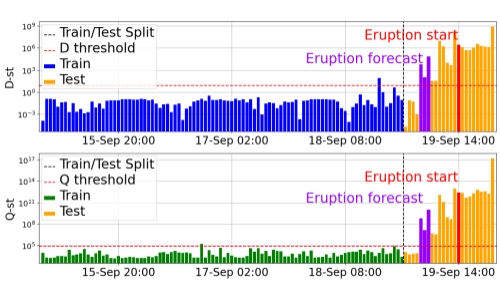
This archipelago also bears a submarine DAS fibre infrastructure deployed between the islands of La Palma and Tenerife (see Fig. 2). In this contribution, we expand the MS framework developed for seismic station data to a DAS data framework.
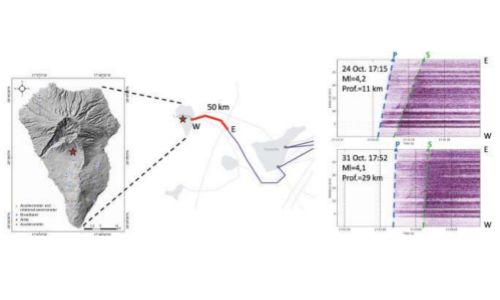
The development of this framework has the potential to significantly increase the risk monitoring capabilities of DAS infrastructures in areas with high seismic and volcanic activity, which can be instrumental for public safety during times of crisis. Thanks to the interpretability provided by MS methods, specialists would be able to assess the anomalies detected by a monitoring system, distinguishing real threats from false alarms. This approach leaves the agency and decision making to the specialists, who don’t need to trust a warning system blindly.
As a result of this work, we will generate an expertise in understanding DAS data structures for seismic data, its particular challenges, related to data size, spatial correlation and computational challenges in real time applications. Results are compared to those of conventional seismometers analyzed in previous works.
[1] García Sánchez, J., García, L., D'Auria, L., Fernández-Carabantes, J., Benítez Ortúzar, C., Camacho, J. Volcanic eruption forecast using PCA. IEEE International Geoscience and Remote Sensing Symposium 2025, Brisbane (Australia), 2025.
[2] Camacho, J. Observation-based missing data methods for exploratory data analysis to unveil the connection between observations and variables in latent subspace models. Journal of Chemometrics, 2011, 25 (11) : 592 - 600.
[3] Fuentes-García, N.M., Maciá-Fernández, G., Camacho, J. Evaluation of diagnosis methods in PCA-based Multivariate Statistical Process Control. Chemometrics and Intelligent Laboratory Systems, 2018, 172 : 194 - 210.
This work is part of project Multi-scale Spatio-Temporal Analysis of Research Data (MuSTARD,https://codas.ugr.es/mustard/en/), supported by grant no. PID2023-1523010B-IOO funded by the Agencia Estatal de Investigación in Spain, call no. MICIU/AEI/10.13039/501100011033, and by the European Regional Development Fund.
How to cite: García Sánchez, J., Benítez, C., D'Auria, L., García, L., and Camacho, J.: Multivariate Statistical analysis of DAS seismic data, Galileo conference: Fibre Optic Sensing in Geosciences, Aussois, France, 31 Aug–4 Sep 2026, GC14-FibreOptic-12, 2026.
Distributed Acoustic Sensing (DAS) provides several benefits over conventional seismic station sensing. DAS offers long spatial coverage at high resolution: approximately every 10 meters of a kilometric optical fiber can act as a seismic sensor. Furthermore, the elements necessary for DAS sensing require very little maintenance. This sort of sensing generates large volumes of data with high spatial correlation, bringing opportunities for more precise exploratory analysis, monitoring and knowledge generation; as well as new data analysis challenges.
In previous works [1], we have studied the data collected by conventional seismic stations in the Canary Islands, Spain; including data from the volcanic eruption of La Palma of 2021 (see Fig. 1). These studies employed data fusion techniques as well as Multivariate Statistic (MS) methods like oMEDA [2] and PCA-MSPC [3] to understand the combined data of several spatially distributed stations. This approach let us develop an interpretable real time monitoring system able to not only detect anomalies, but also trace them to their source in the original data, locating them in time and space
This archipelago also bears a submarine DAS fibre infrastructure deployed between the islands of La Palma and Tenerife (see Fig. 2). In this contribution, we expand the MS framework developed for seismic station data to a DAS data framework.
The development of this framework has the potential to significantly increase the risk monitoring capabilities of DAS infrastructures in areas with high seismic and volcanic activity, which can be instrumental for public safety during times of crisis. Thanks to the interpretability provided by MS methods, specialists would be able to assess the anomalies detected by a monitoring system, distinguishing real threats from false alarms. This approach leaves the agency and decision making to the specialists, who don’t need to trust a warning system blindly.
As a result of this work, we will generate an expertise in understanding DAS data structures for seismic data, its particular challenges, related to data size, spatial correlation and computational challenges in real time applications. Results are compared to those of conventional seismometers analyzed in previous works.
[1] García Sánchez, J., García, L., D'Auria, L., Fernández-Carabantes, J., Benítez Ortúzar, C., Camacho, J. Volcanic eruption forecast using PCA. IEEE International Geoscience and Remote Sensing Symposium 2025, Brisbane (Australia), 2025.
[2] Camacho, J. Observation-based missing data methods for exploratory data analysis to unveil the connection between observations and variables in latent subspace models. Journal of Chemometrics, 2011, 25 (11) : 592 - 600.
[3] Fuentes-García, N.M., Maciá-Fernández, G., Camacho, J. Evaluation of diagnosis methods in PCA-based Multivariate Statistical Process Control. Chemometrics and Intelligent Laboratory Systems, 2018, 172 : 194 - 210.
This work is part of project Multi-scale Spatio-Temporal Analysis of Research Data (MuSTARD,https://codas.ugr.es/mustard/en/), supported by grant no. PID2023-1523010B-IOO funded by the Agencia Estatal de Investigación in Spain, call no. MICIU/AEI/10.13039/501100011033, and by the European Regional Development Fund.
How to cite: García Sánchez, J., Benítez, C., D'Auria, L., García, L., and Camacho, J.: Multivariate Statistical analysis of DAS seismic data, Galileo conference: Fibre Optic Sensing in Geosciences, Aussois, France, 31 Aug–4 Sep 2026, GC14-FibreOptic-12, 2026.
GC14-FibreOptic-28 | Orals | Session 2
Continuous DAS Acquisition for Seismic Event Detection in an Underground EnvironmentVincent Brémaud, Olivier Sèbe, Charly Lallemand, Roxane Chauvet, Stoyan Nikolov, Jean-Baptiste Decitre, Guillaume Rouillé, and François Goyer
Distributed Acoustic Sensing (DAS) has recently emerged in seismological monitoring, converting standard telecommunication fiber optic cables into dense linear arrays of virtual seismic sensors. This capability is particularly relevant in underground environments, where existing infrastructure can be reused.
This study presents results from a continuous experiment, conducted at the Low-Noise Underground Laboratory (LSBB, Laboratoire Souterrain à Bas Bruit, https://www.lsbb.eu/ located in Rustrel, southern France). Multiple fiber optic cables with varying characteristics and installation configurations were deployed throughout the gallery network, including cables laid directly on the ground, weighted with sandbags, sealed in concrete trenches, or structurally attached to gallery walls. These fibers were interrogated by a Febus Optics DAS A1 interrogator. A dense array of seismometers is already in place at the LSBB site, inside the galleries and also at the surface. The geometry of the seismic and the DAS networks is detailed in the Figure 1.
Figure 1 : Map of the LSBB galleries with seismic stations (red stations inside the galleries, green stations at the surface). On the right, map of the fiber optic cable deployment. We deployed two different cable types Telecom and MultiSens.
A key objective of the study is to develop and evaluate automated workflows for the detection and characterization of teleseismic and regional events recorded on DAS arrays. For development we used the Xdas[i] python library. Two complementary detection strategies were applied. The first relies on the classical STA/LTA algorithm. The detection is based on statistics of STA/LTA among all channels (see Figure 2).
The second detection strategy leverages deep-learning phase pickers. The standard PhaseNet[ii] model, applied channel by channel, and the PhaseNet-DAS[iii] model, designed to exploit the multi-channels geometry, were evaluated. The Figure 2, shows a representative regional event, a magnitude 2.6 earthquake at an epicentral distance of 147 km. PhaseNet-DAS, exploiting the spatial continuity of the array, found coherent picks collocated with the predicted P and S arrival times. Both approaches confirmed the capability of the DAS system to detect regional events at the LSBB, even at moderate magnitudes. The goal is to create a catalog detection and to develop an automatic detection workflow.
Figure 2 : Strain-rate data with PhaseNet-DAS picks (top). PhaseNet-DAS detection (middle). Seismic detection using STA/LTA (bottom). The PhaseNet-DAS detection enlightening the better detection of P waves for AI algorithms.
The results demonstrate that DAS fiber networks deployed in underground galleries can reliably detect regional seismic events. Machine-learning phase pickers improve the detection of P waves and offer a better phase discrimination compared to energy-based STA/LTA detectors.
[i] Trabattoni, A., Baillet, M., Ende, M. van den, Rivet, D., Stutzman, E., Strumia, C., & Biagioli, F. (2025). Xdas: A Python Framework for Distributed Acoustic Sensing. Seismological Research Letters. https://doi.org/10.1785/0220240366
[ii] Weiqiang Zhu, Gregory C Beroza, PhaseNet: a deep-neural-network-based seismic arrival-time picking method, Geophysical Journal International, Volume 216, Issue 1, January 2019, Pages 261–273, https://doi.org/10.1093/gji/ggy423
[iii] Zhu, W., Biondi, E., Li, J. et al. Seismic arrival-time picking on distributed acoustic sensing data using semi-supervised learning. Nat Commun 14, 8192 (2023). https://doi.org/10.1038/s41467-023-43355-3
How to cite: Brémaud, V., Sèbe, O., Lallemand, C., Chauvet, R., Nikolov, S., Decitre, J.-B., Rouillé, G., and Goyer, F.: Continuous DAS Acquisition for Seismic Event Detection in an Underground Environment, Galileo conference: Fibre Optic Sensing in Geosciences, Aussois, France, 31 Aug–4 Sep 2026, GC14-FibreOptic-28, 2026.
Distributed Acoustic Sensing (DAS) has recently emerged in seismological monitoring, converting standard telecommunication fiber optic cables into dense linear arrays of virtual seismic sensors. This capability is particularly relevant in underground environments, where existing infrastructure can be reused.
This study presents results from a continuous experiment, conducted at the Low-Noise Underground Laboratory (LSBB, Laboratoire Souterrain à Bas Bruit, https://www.lsbb.eu/ located in Rustrel, southern France). Multiple fiber optic cables with varying characteristics and installation configurations were deployed throughout the gallery network, including cables laid directly on the ground, weighted with sandbags, sealed in concrete trenches, or structurally attached to gallery walls. These fibers were interrogated by a Febus Optics DAS A1 interrogator. A dense array of seismometers is already in place at the LSBB site, inside the galleries and also at the surface. The geometry of the seismic and the DAS networks is detailed in the Figure 1.
Figure 1 : Map of the LSBB galleries with seismic stations (red stations inside the galleries, green stations at the surface). On the right, map of the fiber optic cable deployment. We deployed two different cable types Telecom and MultiSens.
A key objective of the study is to develop and evaluate automated workflows for the detection and characterization of teleseismic and regional events recorded on DAS arrays. For development we used the Xdas[i] python library. Two complementary detection strategies were applied. The first relies on the classical STA/LTA algorithm. The detection is based on statistics of STA/LTA among all channels (see Figure 2).
The second detection strategy leverages deep-learning phase pickers. The standard PhaseNet[ii] model, applied channel by channel, and the PhaseNet-DAS[iii] model, designed to exploit the multi-channels geometry, were evaluated. The Figure 2, shows a representative regional event, a magnitude 2.6 earthquake at an epicentral distance of 147 km. PhaseNet-DAS, exploiting the spatial continuity of the array, found coherent picks collocated with the predicted P and S arrival times. Both approaches confirmed the capability of the DAS system to detect regional events at the LSBB, even at moderate magnitudes. The goal is to create a catalog detection and to develop an automatic detection workflow.
Figure 2 : Strain-rate data with PhaseNet-DAS picks (top). PhaseNet-DAS detection (middle). Seismic detection using STA/LTA (bottom). The PhaseNet-DAS detection enlightening the better detection of P waves for AI algorithms.
The results demonstrate that DAS fiber networks deployed in underground galleries can reliably detect regional seismic events. Machine-learning phase pickers improve the detection of P waves and offer a better phase discrimination compared to energy-based STA/LTA detectors.
[i] Trabattoni, A., Baillet, M., Ende, M. van den, Rivet, D., Stutzman, E., Strumia, C., & Biagioli, F. (2025). Xdas: A Python Framework for Distributed Acoustic Sensing. Seismological Research Letters. https://doi.org/10.1785/0220240366
[ii] Weiqiang Zhu, Gregory C Beroza, PhaseNet: a deep-neural-network-based seismic arrival-time picking method, Geophysical Journal International, Volume 216, Issue 1, January 2019, Pages 261–273, https://doi.org/10.1093/gji/ggy423
[iii] Zhu, W., Biondi, E., Li, J. et al. Seismic arrival-time picking on distributed acoustic sensing data using semi-supervised learning. Nat Commun 14, 8192 (2023). https://doi.org/10.1038/s41467-023-43355-3
How to cite: Brémaud, V., Sèbe, O., Lallemand, C., Chauvet, R., Nikolov, S., Decitre, J.-B., Rouillé, G., and Goyer, F.: Continuous DAS Acquisition for Seismic Event Detection in an Underground Environment, Galileo conference: Fibre Optic Sensing in Geosciences, Aussois, France, 31 Aug–4 Sep 2026, GC14-FibreOptic-28, 2026.
GC14-FibreOptic-93 | ECS | Orals | Session 2
Real-Time Seismic Monitoring Using DAS and AIMiriana Corsaro, Gilda Currenti, Flavio Cannavò, Martina Allegra, Michele Prestifilippo, Philippe Jousset, Concetto Spampinato, and Simone Palazzo
Seismic monitoring in active volcanic areas requires systems capable of providing high spatial and temporal resolution, in order to capture the complex and rapidly evolving dynamics of such environments. In this context, the reuse of existing telecommunications infrastructure through distributed acoustic sensing (DAS) technology represents a promising solution, as it transforms standard optical fibres into dense arrays of virtual sensors distributed over large distances. This approach enables continuous, high-sensitivity monitoring and significantly improves the detection capability of local seismic activity, even for low-magnitude events.
In this study, we present an integrated seismic monitoring system for the Campi Flegrei area based on the combined use of artificial intelligence (AI) and DAS technology. The system has been implemented along the 22 km Bagnoli–Bacoli route by leveraging an existing optical fibre link. The continuous data stream acquired by the DAS system is processed in real-time by a cascade of AI models, specifically designed for the automatic detection of seismic phases (P and S waves), event association and localization, as well as magnitude estimation. This multi-stage architecture allows robust and efficient analysis of large volumes of data, enabling near real-time detection and characterization of local seismicity.
The processing results are stored in a structured database and made accessible through web services, including real-time visualization interfaces for monitoring and analysis. This architecture demonstrates how the integration of existing telecommunications infrastructure, distributed sensing technologies, and advanced AI methods can provide an effective, scalable, and low-cost solution for continuous seismic monitoring in complex volcanic areas. Such systems have the potential to enhance early warning capabilities and support risk mitigation strategies in densely populated regions exposed to volcanic hazards.
How to cite: Corsaro, M., Currenti, G., Cannavò, F., Allegra, M., Prestifilippo, M., Jousset, P., Spampinato, C., and Palazzo, S.: Real-Time Seismic Monitoring Using DAS and AI, Galileo conference: Fibre Optic Sensing in Geosciences, Aussois, France, 31 Aug–4 Sep 2026, GC14-FibreOptic-93, 2026.
Seismic monitoring in active volcanic areas requires systems capable of providing high spatial and temporal resolution, in order to capture the complex and rapidly evolving dynamics of such environments. In this context, the reuse of existing telecommunications infrastructure through distributed acoustic sensing (DAS) technology represents a promising solution, as it transforms standard optical fibres into dense arrays of virtual sensors distributed over large distances. This approach enables continuous, high-sensitivity monitoring and significantly improves the detection capability of local seismic activity, even for low-magnitude events.
In this study, we present an integrated seismic monitoring system for the Campi Flegrei area based on the combined use of artificial intelligence (AI) and DAS technology. The system has been implemented along the 22 km Bagnoli–Bacoli route by leveraging an existing optical fibre link. The continuous data stream acquired by the DAS system is processed in real-time by a cascade of AI models, specifically designed for the automatic detection of seismic phases (P and S waves), event association and localization, as well as magnitude estimation. This multi-stage architecture allows robust and efficient analysis of large volumes of data, enabling near real-time detection and characterization of local seismicity.
The processing results are stored in a structured database and made accessible through web services, including real-time visualization interfaces for monitoring and analysis. This architecture demonstrates how the integration of existing telecommunications infrastructure, distributed sensing technologies, and advanced AI methods can provide an effective, scalable, and low-cost solution for continuous seismic monitoring in complex volcanic areas. Such systems have the potential to enhance early warning capabilities and support risk mitigation strategies in densely populated regions exposed to volcanic hazards.
How to cite: Corsaro, M., Currenti, G., Cannavò, F., Allegra, M., Prestifilippo, M., Jousset, P., Spampinato, C., and Palazzo, S.: Real-Time Seismic Monitoring Using DAS and AI, Galileo conference: Fibre Optic Sensing in Geosciences, Aussois, France, 31 Aug–4 Sep 2026, GC14-FibreOptic-93, 2026.
GC14-FibreOptic-54 | ECS | Orals | Session 2
Modular real-time streaming architecture for high-throughput DAS monitoringHristo V. Valev, Wilfred F.J. Visser, Hamed Ali Diab‑Montero, Wen Zhou, Boris Boullenger, and Loes Buijze
Distributed Acoustic Sensing (DAS) converts fiber-optic cables into continuous seismic sensors, producing measurements at rates exceeding hundreds of megabytes per second. Conventional workflows designed for periodic analysis introduce a latency incompatible with real-time monitoring: events remain invisible until the next scheduled processing window completes, often hours or days after occurrence. Furthermore, this process is brittle for monitoring contexts as data is processed with predefined parameters, and changing those requires manual effort. Additionally, reprocessing historic data of those volumes requires a lot of time and compute, either of which may not be readily available when the need occurs. To address those challenges, we present a modular, real-time system architecture consisting of interconnected services designed for high throughput data ingestion and processing. The system will be deployed within the POSEIMON‑I project, which focuses on extending induced seismicity monitoring in the vicinity of the Porthos CO₂ storage site. It is built around two core components - Apache Kafka for data streaming and Apache Flink for stateful, real-time processing of live data from multiple sources. Additionally, further services allow for the storage, querying and visualization of operational, processed or derived event data. Additionally, algorithms can be deployed or removed from a running system through task-based orchestration enabling the continuous development, refinement and evaluation of algorithms that can adapt to a changing environment. This system design bridges the gap between research and industry by enabling the use of industry-grade systems in scientific contexts and bringing experimentation closer to real-world deployments. Finally, the system is fully built on open-source components ensuring data and system sovereignty and albeit designed to deal with high-throughput data, characteristic for DAS, is agnostic to the domain and can be applied in any context with live data-streams.
How to cite: Valev, H. V., Visser, W. F. J., Diab‑Montero, H. A., Zhou, W., Boullenger, B., and Buijze, L.: Modular real-time streaming architecture for high-throughput DAS monitoring, Galileo conference: Fibre Optic Sensing in Geosciences, Aussois, France, 31 Aug–4 Sep 2026, GC14-FibreOptic-54, 2026.
Distributed Acoustic Sensing (DAS) converts fiber-optic cables into continuous seismic sensors, producing measurements at rates exceeding hundreds of megabytes per second. Conventional workflows designed for periodic analysis introduce a latency incompatible with real-time monitoring: events remain invisible until the next scheduled processing window completes, often hours or days after occurrence. Furthermore, this process is brittle for monitoring contexts as data is processed with predefined parameters, and changing those requires manual effort. Additionally, reprocessing historic data of those volumes requires a lot of time and compute, either of which may not be readily available when the need occurs. To address those challenges, we present a modular, real-time system architecture consisting of interconnected services designed for high throughput data ingestion and processing. The system will be deployed within the POSEIMON‑I project, which focuses on extending induced seismicity monitoring in the vicinity of the Porthos CO₂ storage site. It is built around two core components - Apache Kafka for data streaming and Apache Flink for stateful, real-time processing of live data from multiple sources. Additionally, further services allow for the storage, querying and visualization of operational, processed or derived event data. Additionally, algorithms can be deployed or removed from a running system through task-based orchestration enabling the continuous development, refinement and evaluation of algorithms that can adapt to a changing environment. This system design bridges the gap between research and industry by enabling the use of industry-grade systems in scientific contexts and bringing experimentation closer to real-world deployments. Finally, the system is fully built on open-source components ensuring data and system sovereignty and albeit designed to deal with high-throughput data, characteristic for DAS, is agnostic to the domain and can be applied in any context with live data-streams.
How to cite: Valev, H. V., Visser, W. F. J., Diab‑Montero, H. A., Zhou, W., Boullenger, B., and Buijze, L.: Modular real-time streaming architecture for high-throughput DAS monitoring, Galileo conference: Fibre Optic Sensing in Geosciences, Aussois, France, 31 Aug–4 Sep 2026, GC14-FibreOptic-54, 2026.
GC14-FibreOptic-66 | ECS | Orals | Session 2
A workflow for building an automatic earthquake catalog from DAS data recorded on offshore telecommunications cable in central ChileMarie Baillet, Alister Trabattoni, David Ambrois, Jérôme Chèze, Fabrice Peix, Martijn van den Ende, Clara Vernet, and Diane Rivet
Distributed Acoustic Sensing (DAS) is of critical value for the offshore expansion of seismological networks. The work presented here is part of the 5-years ERC ABYSS project, which aims at building a permanent seafloor seismic observatory leveraging offshore telecommunication cables along the central coast of Chile.
The ABYSS project near-real time data collection started the 30th of September 2023 using three ASN (Alcatel Submarine Networks) OptoDAS units to sense three segments over two offshore telecommunications cables connecting the cities of Concón to La Serena and La Serena to Caldera. The DAS data covers over 500 km of cable, comprising 26,664 virtual sensors sampled at 62.5 Hz and 100 Hz. These data are synchronized once a day with a storage server located in France, the volume of which is anticipated to reach an estimated 608 TB by the end of the project. We developed an automatic workflow to detect an average of 100 daily local, regional and teleseismic events with magnitudes down to ML = 0.5, over 59 GB of data per day after compression.
As a first step, we perform automatic seismic phase arrival picking using PhaseNet pretrained on conventional seismological stations, followed by phase association with GaMMA. We then apply a correction of the phase picks to account for shallow sedimentary layers and invert for the event hypocenters with NonLinLoc software. Finally, we estimate the Richter local magnitude based on peak ground displacements. The results show that DAS data combined with data from the national onland seismic network greatly increases the accuracy of the earthquake hypocenters. Once the earthquake catalogs are built, we can perform a relative relocation of the earthquakes with HypoDD software using cross-correlation and/or the catalog results. With this workflow we show that conventional tools used in seismology can be used on DAS data with few adjustments. Furthermore, the size of our catalog, enriched with numerous undetected offshore events is a significant improvement over the existing regional catalogs, which may aid future studies of the Chilean margin subduction zone seismicity.
How to cite: Baillet, M., Trabattoni, A., Ambrois, D., Chèze, J., Peix, F., van den Ende, M., Vernet, C., and Rivet, D.: A workflow for building an automatic earthquake catalog from DAS data recorded on offshore telecommunications cable in central Chile, Galileo conference: Fibre Optic Sensing in Geosciences, Aussois, France, 31 Aug–4 Sep 2026, GC14-FibreOptic-66, 2026.
Distributed Acoustic Sensing (DAS) is of critical value for the offshore expansion of seismological networks. The work presented here is part of the 5-years ERC ABYSS project, which aims at building a permanent seafloor seismic observatory leveraging offshore telecommunication cables along the central coast of Chile.
The ABYSS project near-real time data collection started the 30th of September 2023 using three ASN (Alcatel Submarine Networks) OptoDAS units to sense three segments over two offshore telecommunications cables connecting the cities of Concón to La Serena and La Serena to Caldera. The DAS data covers over 500 km of cable, comprising 26,664 virtual sensors sampled at 62.5 Hz and 100 Hz. These data are synchronized once a day with a storage server located in France, the volume of which is anticipated to reach an estimated 608 TB by the end of the project. We developed an automatic workflow to detect an average of 100 daily local, regional and teleseismic events with magnitudes down to ML = 0.5, over 59 GB of data per day after compression.
As a first step, we perform automatic seismic phase arrival picking using PhaseNet pretrained on conventional seismological stations, followed by phase association with GaMMA. We then apply a correction of the phase picks to account for shallow sedimentary layers and invert for the event hypocenters with NonLinLoc software. Finally, we estimate the Richter local magnitude based on peak ground displacements. The results show that DAS data combined with data from the national onland seismic network greatly increases the accuracy of the earthquake hypocenters. Once the earthquake catalogs are built, we can perform a relative relocation of the earthquakes with HypoDD software using cross-correlation and/or the catalog results. With this workflow we show that conventional tools used in seismology can be used on DAS data with few adjustments. Furthermore, the size of our catalog, enriched with numerous undetected offshore events is a significant improvement over the existing regional catalogs, which may aid future studies of the Chilean margin subduction zone seismicity.
How to cite: Baillet, M., Trabattoni, A., Ambrois, D., Chèze, J., Peix, F., van den Ende, M., Vernet, C., and Rivet, D.: A workflow for building an automatic earthquake catalog from DAS data recorded on offshore telecommunications cable in central Chile, Galileo conference: Fibre Optic Sensing in Geosciences, Aussois, France, 31 Aug–4 Sep 2026, GC14-FibreOptic-66, 2026.
GC14-FibreOptic-29 | Orals | Session 2
A Prototypal DAS-Based Earthquake Early Warning System Offshore ChileClaudio Strumia, Diane Rivet, Marie Baillet, Alister Trabattoni, Simona Colombelli, Luca Elia, and Gaetano Festa
Distributed Acoustic Sensing (DAS) transforms fibre-optic cables into densely spaced arrays of strain sensors, providing metre-scale resolution over distances of up to hundreds of kilometres. By analysing interferometric backscatter from laser pulses, DAS measures deformation rate along the fibre, yielding single-component recordings of longitudinal strain.
In seismology, DAS supports both high-resolution imaging and seismic monitoring. Its dense sampling enables regional tomography and detailed characterization of shallow structures, while coherent travel-time data can be integrated into standard processing workflows. Phase picking can be performed using adapted artificial intelligence methods for continuous data, although earthquake location remains challenging due to cable geometry. Nevertheless, DAS observations allow for source characterization, including magnitude and source parameter estimation, and in some cases focal mechanism determination.
Beyond offline applications, DAS shows strong potential for real-time monitoring, particularly for Earthquake Early Warning (EEW). Its integration into operational systems requires tailored strategies to exploit dense spatial sampling and to address system-specific features such as directional sensitivity and strain-rate saturation.
Here, we evaluate the applicability of EEW methodologies to DAS data using three interrogators from the ABYSS network in central Chile that sense 450km of offshore cables running parallel to the subduction trench. The region, characterized by frequent moderate-to-large earthquakes, provides an ideal testbed for assessing EEW performance and the potential for rapid alerting.
We develop a real-time magnitude estimation approach suited to offshore DAS conditions, where direct P-wave signals are often weak and followed in the first seconds by stronger arrivals of secondary phases, and integrate it into the QuakeUp algorithm. Performance is assessed using M≥4 events and 60 days of continuous data to evaluate both source characterization capability and robustness to false alerts and missed detections. Our results demonstrate the feasibility of a prototype DAS-based EEW system and highlight its potential to improve response times in high-seismicity regions.
Part of this work has been performed by the Transnational Access to the GeoAzur laboratory MAREA (Magnitude estimAtion in Real TimE using DAS) supported by the EU project Geo-INQUIRE. Geo-INQUIRE is funded by the European Commission under project number 101058518 within the HORIZON-INFRA-2021-SERV-01 call.
How to cite: Strumia, C., Rivet, D., Baillet, M., Trabattoni, A., Colombelli, S., Elia, L., and Festa, G.: A Prototypal DAS-Based Earthquake Early Warning System Offshore Chile, Galileo conference: Fibre Optic Sensing in Geosciences, Aussois, France, 31 Aug–4 Sep 2026, GC14-FibreOptic-29, 2026.
Distributed Acoustic Sensing (DAS) transforms fibre-optic cables into densely spaced arrays of strain sensors, providing metre-scale resolution over distances of up to hundreds of kilometres. By analysing interferometric backscatter from laser pulses, DAS measures deformation rate along the fibre, yielding single-component recordings of longitudinal strain.
In seismology, DAS supports both high-resolution imaging and seismic monitoring. Its dense sampling enables regional tomography and detailed characterization of shallow structures, while coherent travel-time data can be integrated into standard processing workflows. Phase picking can be performed using adapted artificial intelligence methods for continuous data, although earthquake location remains challenging due to cable geometry. Nevertheless, DAS observations allow for source characterization, including magnitude and source parameter estimation, and in some cases focal mechanism determination.
Beyond offline applications, DAS shows strong potential for real-time monitoring, particularly for Earthquake Early Warning (EEW). Its integration into operational systems requires tailored strategies to exploit dense spatial sampling and to address system-specific features such as directional sensitivity and strain-rate saturation.
Here, we evaluate the applicability of EEW methodologies to DAS data using three interrogators from the ABYSS network in central Chile that sense 450km of offshore cables running parallel to the subduction trench. The region, characterized by frequent moderate-to-large earthquakes, provides an ideal testbed for assessing EEW performance and the potential for rapid alerting.
We develop a real-time magnitude estimation approach suited to offshore DAS conditions, where direct P-wave signals are often weak and followed in the first seconds by stronger arrivals of secondary phases, and integrate it into the QuakeUp algorithm. Performance is assessed using M≥4 events and 60 days of continuous data to evaluate both source characterization capability and robustness to false alerts and missed detections. Our results demonstrate the feasibility of a prototype DAS-based EEW system and highlight its potential to improve response times in high-seismicity regions.
Part of this work has been performed by the Transnational Access to the GeoAzur laboratory MAREA (Magnitude estimAtion in Real TimE using DAS) supported by the EU project Geo-INQUIRE. Geo-INQUIRE is funded by the European Commission under project number 101058518 within the HORIZON-INFRA-2021-SERV-01 call.
How to cite: Strumia, C., Rivet, D., Baillet, M., Trabattoni, A., Colombelli, S., Elia, L., and Festa, G.: A Prototypal DAS-Based Earthquake Early Warning System Offshore Chile, Galileo conference: Fibre Optic Sensing in Geosciences, Aussois, France, 31 Aug–4 Sep 2026, GC14-FibreOptic-29, 2026.
Session 3 – New frontiers using fibre sensing: from laboratories to space
GC14-FibreOptic-52 | ECS | Posters | Session 3
Probing subsurface heterogeneity through the spatial variability of spectral peaks in DAS data at Mount EtnaAlexander Yates, Philippe Jousset, Gilda Currenti, Christoph Sens-Schönfelder, and Corentin Caudron
Distributed Acoustic Sensing (DAS) offers unprecedented spatial resolution relative to conventional seismic networks. This provides new opportunities to investigate the composition of the recorded seismic wavefield in volcanic environments, which are often highly heterogeneous. At Mt Etna, recent work (Yates et al. 2026) has highlighted the presence of stable spectral peaks that emerge during broadband volcanic tremor. Using seismic stations from the permanent monitoring network, these were found to vary significantly between stations and to respond to seismic velocity changes through proportional frequency shifts. Combined, these observations support the interpretation that they originate from persistent scattering structures that cause resonance-like effects in heterogeneous environments.
In this study, we present a preliminary analysis of DAS data acquired between Zafferana and Linera on the eastern flank of Mt Etna in 2019 (~15 km length). Anthropogenic noise is found to dominate the recorded wavefield during a significant proportion of the day. However, stable spectral peaks are clearly visible during periods of reduced activity (late evening / early morning). We quantify the spatial variability of these peaks, taking advantage of the high spatial resolution offered by DAS. Our work provides the opportunity to (1) better constrain the relative roles of source, path, and site effects in generating stable spectral peaks, and (2) assess subsurface heterogeneity through quantification of the characteristic length scales over which spectral peaks vary. Together, this approach demonstrates the potential of DAS to provide insights into the subsurface at spatial scales not resolvable with conventional seismic networks.
This work has been performed in the frame of USCV-DAS, a Transnational Access to the Eastern Sicily testbed supported by the EU project Geo-INQUIRE. Geo-INQUIRE is funded by the European Commission under project number 101058518 within the HORIZON-INFRA-2021-SERV-01 call.
References
Yates, A. S., Heuninck, S., Barajas, A., Bektas, H., Caudron, C., De Angelis, S., & Zuccarello, L. (2026). Tracking subsurface changes via frequency shifts in volcanic tremor spectral lines: observations from Mt Etna. Geophysical Research Letters, 53(2), e2025GL117819.
How to cite: Yates, A., Jousset, P., Currenti, G., Sens-Schönfelder, C., and Caudron, C.: Probing subsurface heterogeneity through the spatial variability of spectral peaks in DAS data at Mount Etna, Galileo conference: Fibre Optic Sensing in Geosciences, Aussois, France, 31 Aug–4 Sep 2026, GC14-FibreOptic-52, 2026.
Distributed Acoustic Sensing (DAS) offers unprecedented spatial resolution relative to conventional seismic networks. This provides new opportunities to investigate the composition of the recorded seismic wavefield in volcanic environments, which are often highly heterogeneous. At Mt Etna, recent work (Yates et al. 2026) has highlighted the presence of stable spectral peaks that emerge during broadband volcanic tremor. Using seismic stations from the permanent monitoring network, these were found to vary significantly between stations and to respond to seismic velocity changes through proportional frequency shifts. Combined, these observations support the interpretation that they originate from persistent scattering structures that cause resonance-like effects in heterogeneous environments.
In this study, we present a preliminary analysis of DAS data acquired between Zafferana and Linera on the eastern flank of Mt Etna in 2019 (~15 km length). Anthropogenic noise is found to dominate the recorded wavefield during a significant proportion of the day. However, stable spectral peaks are clearly visible during periods of reduced activity (late evening / early morning). We quantify the spatial variability of these peaks, taking advantage of the high spatial resolution offered by DAS. Our work provides the opportunity to (1) better constrain the relative roles of source, path, and site effects in generating stable spectral peaks, and (2) assess subsurface heterogeneity through quantification of the characteristic length scales over which spectral peaks vary. Together, this approach demonstrates the potential of DAS to provide insights into the subsurface at spatial scales not resolvable with conventional seismic networks.
This work has been performed in the frame of USCV-DAS, a Transnational Access to the Eastern Sicily testbed supported by the EU project Geo-INQUIRE. Geo-INQUIRE is funded by the European Commission under project number 101058518 within the HORIZON-INFRA-2021-SERV-01 call.
References
Yates, A. S., Heuninck, S., Barajas, A., Bektas, H., Caudron, C., De Angelis, S., & Zuccarello, L. (2026). Tracking subsurface changes via frequency shifts in volcanic tremor spectral lines: observations from Mt Etna. Geophysical Research Letters, 53(2), e2025GL117819.
How to cite: Yates, A., Jousset, P., Currenti, G., Sens-Schönfelder, C., and Caudron, C.: Probing subsurface heterogeneity through the spatial variability of spectral peaks in DAS data at Mount Etna, Galileo conference: Fibre Optic Sensing in Geosciences, Aussois, France, 31 Aug–4 Sep 2026, GC14-FibreOptic-52, 2026.
GC14-FibreOptic-86 | ECS | Posters | Session 3
Observations of P-wave phase arrivals from major earthquakes with the IRIS fiber-opticsubsea cable connecting Iceland and IrelandAude Lepère, Vala Hjörleifsdóttir, Arnar Ingi Gunnarsson, Mikael Mazur, Valey Kamalov, Martin Karrenbach, Ethan F. Williams, Örn Jónsson, Nicolas K. Fontaine, Roland Ryf, Lauren Dallachiesa, and David T. Neilson
Approximately 70% of the Earth's surface is covered by the oceans. Installing permanent seismic sensors on the seafloor is both difficult and costly, resulting in a gap in the the global seismic monitoring. Recently, the potential of using the existing network of submarine fiber-optic cables for the observation of seismic waves has been investigated, several works demonstrating the feasibility of using trans-oceanic subsea cables as seismic sensors (f.ex. Marra 2018,2022; Zhan, 2021; Mazur 2024). In this work, we use a distributed fiber optic sensing (DFOS) prototype capable of measuring the integrated strain between each repeater along the entire length of a fiber optic cable (the repeaters are typically placed 100 km from each other). This instrument is used on the IRIS telecommunication cable, an operational subsea cable connecting Iceland to Ireland, transforming 17 spans of the cable into an array of 17 individual seismic sensors. Signals from several large earthquakes can be observed on the recorded data from the cable and surface waves as well as multiple seismic body wave phases can be tracked across the spans.
To assess the capability of the monitoring system to detect the P-wave phase, we use an STA-LTA algorithm to automatically detect the arrival of P-waves in the data and we compare the phase detections to those predicted by travel-time curves from a catalogue of major earthquakes from the USGS database (with a magnitude above 6 and a distance of 30 to 100° from the fiber-optic subsea cable). We manage to retrieve 40% of our earthquake catalogue with our detection algorithm. However, a large part of our detections are not pickings of the P-wave phase.
How to cite: Lepère, A., Hjörleifsdóttir, V., Gunnarsson, A. I., Mazur, M., Kamalov, V., Karrenbach, M., Williams, E. F., Jónsson, Ö., Fontaine, N. K., Ryf, R., Dallachiesa, L., and Neilson, D. T.: Observations of P-wave phase arrivals from major earthquakes with the IRIS fiber-opticsubsea cable connecting Iceland and Ireland, Galileo conference: Fibre Optic Sensing in Geosciences, Aussois, France, 31 Aug–4 Sep 2026, GC14-FibreOptic-86, 2026.
Approximately 70% of the Earth's surface is covered by the oceans. Installing permanent seismic sensors on the seafloor is both difficult and costly, resulting in a gap in the the global seismic monitoring. Recently, the potential of using the existing network of submarine fiber-optic cables for the observation of seismic waves has been investigated, several works demonstrating the feasibility of using trans-oceanic subsea cables as seismic sensors (f.ex. Marra 2018,2022; Zhan, 2021; Mazur 2024). In this work, we use a distributed fiber optic sensing (DFOS) prototype capable of measuring the integrated strain between each repeater along the entire length of a fiber optic cable (the repeaters are typically placed 100 km from each other). This instrument is used on the IRIS telecommunication cable, an operational subsea cable connecting Iceland to Ireland, transforming 17 spans of the cable into an array of 17 individual seismic sensors. Signals from several large earthquakes can be observed on the recorded data from the cable and surface waves as well as multiple seismic body wave phases can be tracked across the spans.
To assess the capability of the monitoring system to detect the P-wave phase, we use an STA-LTA algorithm to automatically detect the arrival of P-waves in the data and we compare the phase detections to those predicted by travel-time curves from a catalogue of major earthquakes from the USGS database (with a magnitude above 6 and a distance of 30 to 100° from the fiber-optic subsea cable). We manage to retrieve 40% of our earthquake catalogue with our detection algorithm. However, a large part of our detections are not pickings of the P-wave phase.
How to cite: Lepère, A., Hjörleifsdóttir, V., Gunnarsson, A. I., Mazur, M., Kamalov, V., Karrenbach, M., Williams, E. F., Jónsson, Ö., Fontaine, N. K., Ryf, R., Dallachiesa, L., and Neilson, D. T.: Observations of P-wave phase arrivals from major earthquakes with the IRIS fiber-opticsubsea cable connecting Iceland and Ireland, Galileo conference: Fibre Optic Sensing in Geosciences, Aussois, France, 31 Aug–4 Sep 2026, GC14-FibreOptic-86, 2026.
GC14-FibreOptic-124 | Orals | Session 3
Onshore and offshore fibre optic sensing – examples and lessons learnedMartin Landrø and Robin Rørstadbotnen
Distributed acoustic sensing (DAS) has been a research topic for several decades, and in conjunction with the steadily increasing number of various practical applications the interest for this relatively new technology has increased significantly in the past years. There has been a number of significant developments on the hardware side making it possible to interrogate large distance using a fibre cable. Today it is feasible to interrogate between 100 to 200 km, and recent experiments indicate that this can be extended to several thousands km.
During the past decade, we have tested various geophysical applications of fibre optic sensing. In this paper we will show offshore examples including whale tracking, detection of ships and distant storms and other oceanographic examples such as ocean gravity waves, as well as earthquakes. Onshore examples include road traffic, eigenfrequencies of bridges and development of warning systems for rockfall and avalanches. In Norway most railways are equipped with fibre optic cables close to the railway and often deployed in specific pipes 1-2 m away from the line. This causes variation in coupling along the line and we will discuss how these variations can be determined and accounted for in processing. The major challenge for warning systems is to reduce the number of false positive events, and this will be addressed in the talk.
Recently we have demonstrated that it is possible to use fibre optic cables trenched at the seabed to detect silent whales. Using DAS-data containing ultra-low frequencies we show that it is possible to detect the water movements of a whale if it swims closer than approximately 40 m from the fibre. For ships the corresponding distances are typically 400-500 m. Since a fibre optic cable has a long antenna, the fibre can detect low frequency signals that are very hard to measure by a single hydrophone. The huge advantage of the seabed fibre cable is of course the capacity of monitoring large distances (100 km or more), which makes the DAS-technology very attractive for a multifold of applications.
In the future we expect that both the range and signal to noise ratio of DAS-data will increase significantly. In parallel with these huge technical achievements the need for secure handling of data will increase, leaving challenges to the research community that it is important to address and handle.
How to cite: Landrø, M. and Rørstadbotnen, R.: Onshore and offshore fibre optic sensing – examples and lessons learned , Galileo conference: Fibre Optic Sensing in Geosciences, Aussois, France, 31 Aug–4 Sep 2026, GC14-FibreOptic-124, 2026.
Distributed acoustic sensing (DAS) has been a research topic for several decades, and in conjunction with the steadily increasing number of various practical applications the interest for this relatively new technology has increased significantly in the past years. There has been a number of significant developments on the hardware side making it possible to interrogate large distance using a fibre cable. Today it is feasible to interrogate between 100 to 200 km, and recent experiments indicate that this can be extended to several thousands km.
During the past decade, we have tested various geophysical applications of fibre optic sensing. In this paper we will show offshore examples including whale tracking, detection of ships and distant storms and other oceanographic examples such as ocean gravity waves, as well as earthquakes. Onshore examples include road traffic, eigenfrequencies of bridges and development of warning systems for rockfall and avalanches. In Norway most railways are equipped with fibre optic cables close to the railway and often deployed in specific pipes 1-2 m away from the line. This causes variation in coupling along the line and we will discuss how these variations can be determined and accounted for in processing. The major challenge for warning systems is to reduce the number of false positive events, and this will be addressed in the talk.
Recently we have demonstrated that it is possible to use fibre optic cables trenched at the seabed to detect silent whales. Using DAS-data containing ultra-low frequencies we show that it is possible to detect the water movements of a whale if it swims closer than approximately 40 m from the fibre. For ships the corresponding distances are typically 400-500 m. Since a fibre optic cable has a long antenna, the fibre can detect low frequency signals that are very hard to measure by a single hydrophone. The huge advantage of the seabed fibre cable is of course the capacity of monitoring large distances (100 km or more), which makes the DAS-technology very attractive for a multifold of applications.
In the future we expect that both the range and signal to noise ratio of DAS-data will increase significantly. In parallel with these huge technical achievements the need for secure handling of data will increase, leaving challenges to the research community that it is important to address and handle.
How to cite: Landrø, M. and Rørstadbotnen, R.: Onshore and offshore fibre optic sensing – examples and lessons learned , Galileo conference: Fibre Optic Sensing in Geosciences, Aussois, France, 31 Aug–4 Sep 2026, GC14-FibreOptic-124, 2026.
GC14-FibreOptic-100 | ECS | Posters | Session 3
Beyond Conventional Monitoring: Permanent Fibre Optic Sensing in a Geothermal Reservoir During Production and InjectionAurelio Andy, Johannes Hart, Felix Schölderle, Charlotte M. Krawczyk, and Kai Zosseder
In deep geothermal wells, conventional downhole data is commonly very limited, especially during long-term plant operation. Since 2021, permanently installed fibre optic cables in one production and one injection well at a hydrogeothermal site in Munich have enabled continuous DTS (Distributed Temperature Sensing) measurements along the entire borehole length (~4 km) as well as pressure monitoring at reservoir depth at 3000 m MD (measured depth) using Fabry–Pérot gauges. In addition, several DDSS (Distributed Dynamic Strain Sensing) campaigns were conducted during different operational stages of the geothermal plant. In this contribution, we present borehole and reservoir processes derived from this unique long-term fibre optic dataset and discuss their implications for reservoir characterization and geothermal field development.
Different approaches were applied to resolve production and injection zones within the reservoir at high spatial resolution. These include energy and mass balance modelling of temperature profiles during production, thermal slug tracking to derive fluid velocities and flow contributions, and analysis of borehole warmback during shut-in periods. DTS-derived results provide rapid and robust characterization of flow zones and extend beyond the spatial and temporal limitations of conventional flowmeter logging. In addition, low-frequency DDSS (LF-DDSS) measurements reveal highly detailed flow dynamics and previously unresolved flow processes within the wells and reservoir. In the injection well, 78 % of the injection happens in the upper 120 m MD of the 1000 m long reservoir section. In the lower half, free convection cells dominate in the wellbore during steady injection and a 40 m thick localized hydraulic anomaly even shows 1 l/s of inflow into the wellbore from the formation.
Furthermore, the temporal evolution of the production/injection temperature and flow zones indicates dynamic changes in reservoir properties during plant operation. Pressure data from fibre optic gauges enables repeated pressure transient analysis (PTA) of shut-in phases. These show that long-term operation has significantly increased the transmissivity of one of the wells and suggest an altered flow regime. The measurements further provide an important basis for calibration and validation of 3D thermo-hydraulic numerical models of the entire six-well system at the Munich plant.
Overall, the presented results show how the applied methodical approaches can improve the geological and reservoir understanding of deep geothermal systems in the Bavarian Molasse Basin and will support future reservoir engineering, field development, and forecasting of long-term well performance.
How to cite: Andy, A., Hart, J., Schölderle, F., Krawczyk, C. M., and Zosseder, K.: Beyond Conventional Monitoring: Permanent Fibre Optic Sensing in a Geothermal Reservoir During Production and Injection, Galileo conference: Fibre Optic Sensing in Geosciences, Aussois, France, 31 Aug–4 Sep 2026, GC14-FibreOptic-100, 2026.
In deep geothermal wells, conventional downhole data is commonly very limited, especially during long-term plant operation. Since 2021, permanently installed fibre optic cables in one production and one injection well at a hydrogeothermal site in Munich have enabled continuous DTS (Distributed Temperature Sensing) measurements along the entire borehole length (~4 km) as well as pressure monitoring at reservoir depth at 3000 m MD (measured depth) using Fabry–Pérot gauges. In addition, several DDSS (Distributed Dynamic Strain Sensing) campaigns were conducted during different operational stages of the geothermal plant. In this contribution, we present borehole and reservoir processes derived from this unique long-term fibre optic dataset and discuss their implications for reservoir characterization and geothermal field development.
Different approaches were applied to resolve production and injection zones within the reservoir at high spatial resolution. These include energy and mass balance modelling of temperature profiles during production, thermal slug tracking to derive fluid velocities and flow contributions, and analysis of borehole warmback during shut-in periods. DTS-derived results provide rapid and robust characterization of flow zones and extend beyond the spatial and temporal limitations of conventional flowmeter logging. In addition, low-frequency DDSS (LF-DDSS) measurements reveal highly detailed flow dynamics and previously unresolved flow processes within the wells and reservoir. In the injection well, 78 % of the injection happens in the upper 120 m MD of the 1000 m long reservoir section. In the lower half, free convection cells dominate in the wellbore during steady injection and a 40 m thick localized hydraulic anomaly even shows 1 l/s of inflow into the wellbore from the formation.
Furthermore, the temporal evolution of the production/injection temperature and flow zones indicates dynamic changes in reservoir properties during plant operation. Pressure data from fibre optic gauges enables repeated pressure transient analysis (PTA) of shut-in phases. These show that long-term operation has significantly increased the transmissivity of one of the wells and suggest an altered flow regime. The measurements further provide an important basis for calibration and validation of 3D thermo-hydraulic numerical models of the entire six-well system at the Munich plant.
Overall, the presented results show how the applied methodical approaches can improve the geological and reservoir understanding of deep geothermal systems in the Bavarian Molasse Basin and will support future reservoir engineering, field development, and forecasting of long-term well performance.
How to cite: Andy, A., Hart, J., Schölderle, F., Krawczyk, C. M., and Zosseder, K.: Beyond Conventional Monitoring: Permanent Fibre Optic Sensing in a Geothermal Reservoir During Production and Injection, Galileo conference: Fibre Optic Sensing in Geosciences, Aussois, France, 31 Aug–4 Sep 2026, GC14-FibreOptic-100, 2026.
GC14-FibreOptic-3 | Orals | Session 3
The MOST project: Monitoring Ocean Seafloor Temperature and currents using fiber optic sensing in shallow shelf seasMarc-Andre Gutscher, Lionel Quetel, Emanuelle Autret, Jean-Frederic Lebrun, Melody Philippon, Christophe Nativelle, Sarah Vitalis-Simon, Florian Le Pape, Martin Träsch, Michel Repecaud, and Vincent Lanticq
Shallow shelf seas (<200 m depth) cover 7% of the ocean’s surface, yet generate 15-20% of global primary productivity and are vital for fisheries, tourism, and coastal economies. However, the sparsity of sub-surface and seafloor observations makes them under monitored, leaving key circulation processes (e.g.- marine heatwaves) poorly constrained. The MOST project aims to bridge this data gap using distributed fiber optic sensing on submarine cables to perform real-time monitoring of water temperature changes, currents and pressure at the seafloor. The first pilot study area is a commercial network of telecom cables in Guadeloupe where an intermittent three-year time series using BOTDR (Brillouin Optical Time Domain Reflectometry) correlates with the Sea Surface Temperature to within 0.1°C and continuous BOTDR monitoring has begun. Building upon this we will perform continuous DAS (Distributed Acoustic Sensing) and deploy in-situ seafloor instruments. The second study area is the macrotidal Bay of Brest, where a prototype hybrid telecom cable (featuring loose and tight sensor fibers) has been deployed enabling a novel method for separating temperature and mechanical strain signals, with potential application to future telecom cables. In both study areas, fiber sensing observations will be cross-validated by oceanographic and seismological instruments deployed next to the cable to calibrate the signals and upscale our technique to other cables worldwide. Starting with commercial cables on the Brittany shelf, we plan to perform L-band DAS interrogation to avoid disrupting internet data transmission. Leveraging the world’s 1.5 million km of submarine cables, MOST can transform the coastal portions into dense arrays of environmental sensors at unprecedented spatial (<10 m) and temporal (<1 hr) scales to better evaluate and anticipate the impact of climate change on the oceans and the seafloor.
How to cite: Gutscher, M.-A., Quetel, L., Autret, E., Lebrun, J.-F., Philippon, M., Nativelle, C., Vitalis-Simon, S., Le Pape, F., Träsch, M., Repecaud, M., and Lanticq, V.: The MOST project: Monitoring Ocean Seafloor Temperature and currents using fiber optic sensing in shallow shelf seas, Galileo conference: Fibre Optic Sensing in Geosciences, Aussois, France, 31 Aug–4 Sep 2026, GC14-FibreOptic-3, 2026.
Shallow shelf seas (<200 m depth) cover 7% of the ocean’s surface, yet generate 15-20% of global primary productivity and are vital for fisheries, tourism, and coastal economies. However, the sparsity of sub-surface and seafloor observations makes them under monitored, leaving key circulation processes (e.g.- marine heatwaves) poorly constrained. The MOST project aims to bridge this data gap using distributed fiber optic sensing on submarine cables to perform real-time monitoring of water temperature changes, currents and pressure at the seafloor. The first pilot study area is a commercial network of telecom cables in Guadeloupe where an intermittent three-year time series using BOTDR (Brillouin Optical Time Domain Reflectometry) correlates with the Sea Surface Temperature to within 0.1°C and continuous BOTDR monitoring has begun. Building upon this we will perform continuous DAS (Distributed Acoustic Sensing) and deploy in-situ seafloor instruments. The second study area is the macrotidal Bay of Brest, where a prototype hybrid telecom cable (featuring loose and tight sensor fibers) has been deployed enabling a novel method for separating temperature and mechanical strain signals, with potential application to future telecom cables. In both study areas, fiber sensing observations will be cross-validated by oceanographic and seismological instruments deployed next to the cable to calibrate the signals and upscale our technique to other cables worldwide. Starting with commercial cables on the Brittany shelf, we plan to perform L-band DAS interrogation to avoid disrupting internet data transmission. Leveraging the world’s 1.5 million km of submarine cables, MOST can transform the coastal portions into dense arrays of environmental sensors at unprecedented spatial (<10 m) and temporal (<1 hr) scales to better evaluate and anticipate the impact of climate change on the oceans and the seafloor.
How to cite: Gutscher, M.-A., Quetel, L., Autret, E., Lebrun, J.-F., Philippon, M., Nativelle, C., Vitalis-Simon, S., Le Pape, F., Träsch, M., Repecaud, M., and Lanticq, V.: The MOST project: Monitoring Ocean Seafloor Temperature and currents using fiber optic sensing in shallow shelf seas, Galileo conference: Fibre Optic Sensing in Geosciences, Aussois, France, 31 Aug–4 Sep 2026, GC14-FibreOptic-3, 2026.
GC14-FibreOptic-39 | ECS | Posters | Session 3
Fibre optic sensing of fracture processes: from small-scale laboratory experiments to multi-scale applicationsEvgeniia Martuganova and André Niemeijer
Distributed fibre optic sensing (DFOS) is increasingly used for subsurface monitoring due to its ability to provide dense spatial coverage and a broad range of strain measurements, from slow quasi-static deformation to rapid dynamic signals. Distributed strain sensing (DSS) provides detailed measurements of strain evolution along the fibre, enabling identification of strain localisation. However, linking these measurements to underlying fracturing and failure processes remains challenging, as it is unclear how strain localisation, acoustic emission (AE) activity, and observed fracture development relate to the same underlying fracture process. These signals are often analysed separately, limiting the ability to consistently relate DFOS observations to fracture processes and to understand how these relationships evolve across spatial scales.
In this study we present results from the first stage of a multi-scale experimental campaign designed to investigate how fracture processes are expressed in DSS, AE, and high-speed imaging within a single controlled experiment. The focus is on controlled laboratory experiments on cylindrical sandstone samples of approximately 6 cm in diameter and 12 cm in height. Cyclic loading is used as a controlled probe of damage evolution, allowing progressive activation and reactivation of deformation and fracturing processes over repeated loading cycles. The loading protocol is based on monotonic failure tests and consists of stepwise increases in displacement amplitude with repeated loading–unloading cycles at each level.
High-resolution DSS measurements are conducted on the sample surface to capture the development of strain localisation. In addition, experiments include configurations with fibres deployed both on the sample surface and within a borehole drilled through the sample, enabling direct comparison between externally observed deformation and internal strain response. These measurements are complemented by AE monitoring using sensors located on the sample surface to track microcracking activity and by high-speed camera imaging to observe fracture initiation and propagation. The cyclic protocol enables identification of the onset and evolution of localised deformation, as well as changes in signal response between successive loading cycles. The experiments focus on how the different measurement techniques respond to the same evolving damage state and how signals recorded at the surface relate to those observed within the sample.
Preliminary results show how DSS and AE signals evolve in time and space during fracture nucleation and propagation, and how these relate to directly observed fracture development. The comparison between surface and borehole measurements provides insight into how internal deformation processes are expressed in fibre optic signals, with implications for interpreting borehole-based monitoring data. These observations provide a basis for identifying robust indicators of fracture evolution and assessing their sensitivity to loading history.
This centimetre-scale study forms the foundation for subsequent experiments at larger scales, where similar protocols will be applied to investigate the consistency of observed relationships under more complex conditions. With our multi-scale approach, we aim to improve the interpretation of distributed fibre optic measurements and support the development of more reliable, physics-based monitoring strategies for subsurface systems.
How to cite: Martuganova, E. and Niemeijer, A.: Fibre optic sensing of fracture processes: from small-scale laboratory experiments to multi-scale applications, Galileo conference: Fibre Optic Sensing in Geosciences, Aussois, France, 31 Aug–4 Sep 2026, GC14-FibreOptic-39, 2026.
Distributed fibre optic sensing (DFOS) is increasingly used for subsurface monitoring due to its ability to provide dense spatial coverage and a broad range of strain measurements, from slow quasi-static deformation to rapid dynamic signals. Distributed strain sensing (DSS) provides detailed measurements of strain evolution along the fibre, enabling identification of strain localisation. However, linking these measurements to underlying fracturing and failure processes remains challenging, as it is unclear how strain localisation, acoustic emission (AE) activity, and observed fracture development relate to the same underlying fracture process. These signals are often analysed separately, limiting the ability to consistently relate DFOS observations to fracture processes and to understand how these relationships evolve across spatial scales.
In this study we present results from the first stage of a multi-scale experimental campaign designed to investigate how fracture processes are expressed in DSS, AE, and high-speed imaging within a single controlled experiment. The focus is on controlled laboratory experiments on cylindrical sandstone samples of approximately 6 cm in diameter and 12 cm in height. Cyclic loading is used as a controlled probe of damage evolution, allowing progressive activation and reactivation of deformation and fracturing processes over repeated loading cycles. The loading protocol is based on monotonic failure tests and consists of stepwise increases in displacement amplitude with repeated loading–unloading cycles at each level.
High-resolution DSS measurements are conducted on the sample surface to capture the development of strain localisation. In addition, experiments include configurations with fibres deployed both on the sample surface and within a borehole drilled through the sample, enabling direct comparison between externally observed deformation and internal strain response. These measurements are complemented by AE monitoring using sensors located on the sample surface to track microcracking activity and by high-speed camera imaging to observe fracture initiation and propagation. The cyclic protocol enables identification of the onset and evolution of localised deformation, as well as changes in signal response between successive loading cycles. The experiments focus on how the different measurement techniques respond to the same evolving damage state and how signals recorded at the surface relate to those observed within the sample.
Preliminary results show how DSS and AE signals evolve in time and space during fracture nucleation and propagation, and how these relate to directly observed fracture development. The comparison between surface and borehole measurements provides insight into how internal deformation processes are expressed in fibre optic signals, with implications for interpreting borehole-based monitoring data. These observations provide a basis for identifying robust indicators of fracture evolution and assessing their sensitivity to loading history.
This centimetre-scale study forms the foundation for subsequent experiments at larger scales, where similar protocols will be applied to investigate the consistency of observed relationships under more complex conditions. With our multi-scale approach, we aim to improve the interpretation of distributed fibre optic measurements and support the development of more reliable, physics-based monitoring strategies for subsurface systems.
How to cite: Martuganova, E. and Niemeijer, A.: Fibre optic sensing of fracture processes: from small-scale laboratory experiments to multi-scale applications, Galileo conference: Fibre Optic Sensing in Geosciences, Aussois, France, 31 Aug–4 Sep 2026, GC14-FibreOptic-39, 2026.
GC14-FibreOptic-56 | Posters | Session 3
Stress-transfer characterization in a concrete-rock system using DSS measurementsMarco Dominguez-Bureos, Zbigniew Wilczynski, and Auke Barnhoorn
Well-based Fiber Optic Cable (FOC) constitutes a novel technology for sensing and monitoring, with high spatial resolution, strain resulting from changes in reservoir pressure due to thermal, mechanical, and hydraulic stresses triggered by critical activities which endanger wellbore stability.
As wellbore integrity assessments depend on reliable, calibrated strain measurements, the strain recorded in such configurations needs to be corrected for coupled stresses across multiple media, such as cement-formation systems.
In this research, we aim to enhance the understanding of mechanical stress transfer in cement-rock formation systems through laboratory experiments by recording and comparing FOC strain measurements with 2-D strain-gage measurements.
We crafted two cylindrical sandstone samples of 50 mm diameter and 100 mm height with a concentric hole where concrete of standard mix was poured; one of the samples is equipped with a segment of fiber-optic cable coiled at the concrete-rock interface, and a second segment coiled around the external surface of the rock sample. The second sample is equipped with a set of 2D strain gauges: three are placed at the concrete-rock interface, and three more on the external surface of the sandstone.
Both samples are subjected to the same stress protocol: cyclic uniaxial compression with increments at the end of each cycle over the entire elastic regime until yielding.
The end goal is to provide FOC data calibration for formation-cement interface under uniaxial mechanical stress, as well as providing insights into the micromechanical behavior of the formation-cement interaction.
This work was supported by CETP Q-Fibre (proposal code Cetp-FP-2023-00079). CETP Q-Fibre is co-funded by the European Commission (GA no. 101069750), the Netherlands Enterprise Agency (RVO), the Research Council of Norway (RCN), and the U.S. Department of Energy (DOE).
How to cite: Dominguez-Bureos, M., Wilczynski, Z., and Barnhoorn, A.: Stress-transfer characterization in a concrete-rock system using DSS measurements, Galileo conference: Fibre Optic Sensing in Geosciences, Aussois, France, 31 Aug–4 Sep 2026, GC14-FibreOptic-56, 2026.
Well-based Fiber Optic Cable (FOC) constitutes a novel technology for sensing and monitoring, with high spatial resolution, strain resulting from changes in reservoir pressure due to thermal, mechanical, and hydraulic stresses triggered by critical activities which endanger wellbore stability.
As wellbore integrity assessments depend on reliable, calibrated strain measurements, the strain recorded in such configurations needs to be corrected for coupled stresses across multiple media, such as cement-formation systems.
In this research, we aim to enhance the understanding of mechanical stress transfer in cement-rock formation systems through laboratory experiments by recording and comparing FOC strain measurements with 2-D strain-gage measurements.
We crafted two cylindrical sandstone samples of 50 mm diameter and 100 mm height with a concentric hole where concrete of standard mix was poured; one of the samples is equipped with a segment of fiber-optic cable coiled at the concrete-rock interface, and a second segment coiled around the external surface of the rock sample. The second sample is equipped with a set of 2D strain gauges: three are placed at the concrete-rock interface, and three more on the external surface of the sandstone.
Both samples are subjected to the same stress protocol: cyclic uniaxial compression with increments at the end of each cycle over the entire elastic regime until yielding.
The end goal is to provide FOC data calibration for formation-cement interface under uniaxial mechanical stress, as well as providing insights into the micromechanical behavior of the formation-cement interaction.
This work was supported by CETP Q-Fibre (proposal code Cetp-FP-2023-00079). CETP Q-Fibre is co-funded by the European Commission (GA no. 101069750), the Netherlands Enterprise Agency (RVO), the Research Council of Norway (RCN), and the U.S. Department of Energy (DOE).
How to cite: Dominguez-Bureos, M., Wilczynski, Z., and Barnhoorn, A.: Stress-transfer characterization in a concrete-rock system using DSS measurements, Galileo conference: Fibre Optic Sensing in Geosciences, Aussois, France, 31 Aug–4 Sep 2026, GC14-FibreOptic-56, 2026.
GC14-FibreOptic-101 | Orals | Session 3
Near-coast fibre-optic sensing within project SAFAtorCharLotte Krawczyk, Verónica Rodríguez Tribaldos, Philippe Jousset, and Patricia Martínez-Garzón and the SAFAtor Team
The SAFAtor project (SMART cables And Fibre-optic sensing Amphibious demonstrator) was kicked-off in March 2025, as a €30 million infrastructure initiative by the German Helmholtz Association. We investigate critical observational gaps from the continental landmass to the shelf and slope (coordinated by GFZ, and focus of this presentation) and in the deep ocean using novel cable technologies (coordinated by GEOMAR). This infrastructure project further includes the establishment of data services.
Our testbeds comprise sites at onshore and offshore Mount Etna/Italy, from Istanbul into the Marmara Sea/Turkey, and at the Northern Chilean coast. Here, we have started integrating surveying with Distributed Dynamic Strain Sensing (DDSS) into existing Plate Boundary Observatories to address key questions on volcanic processes, fault dynamics, and preparatory phases of earthquakes. Thereby, we want to significantly enhance monitoring capabilities observing tectonic, volcanic, and fluid-driven activities. Further, we tackle technical challenges like amphibious monitoring and recording of strong-motion events for seismic hazard assessment. Using both well proven and also new DAS devices, we will complement this rapidly evolving field also in urban areas. This will allow us to explore near-surface structures and material properties, as well as hydrological processes in connection with hazardous events.
In our presentation we will provide an overview of the overall project concept and address the specific targets of the different tectonic regimes investigated near-coast. We will discuss the experimental setups that we have started implementing in the light of first data gained, helping to optimize hazard research using distributed dynamic strain sensing techniques. Hence, we will contribute ultimately to better prepare areas exposed to hazard at active plate boundaries and volcanic systems in coastal zones.
How to cite: Krawczyk, C., Rodríguez Tribaldos, V., Jousset, P., and Martínez-Garzón, P. and the SAFAtor Team: Near-coast fibre-optic sensing within project SAFAtor, Galileo conference: Fibre Optic Sensing in Geosciences, Aussois, France, 31 Aug–4 Sep 2026, GC14-FibreOptic-101, 2026.
The SAFAtor project (SMART cables And Fibre-optic sensing Amphibious demonstrator) was kicked-off in March 2025, as a €30 million infrastructure initiative by the German Helmholtz Association. We investigate critical observational gaps from the continental landmass to the shelf and slope (coordinated by GFZ, and focus of this presentation) and in the deep ocean using novel cable technologies (coordinated by GEOMAR). This infrastructure project further includes the establishment of data services.
Our testbeds comprise sites at onshore and offshore Mount Etna/Italy, from Istanbul into the Marmara Sea/Turkey, and at the Northern Chilean coast. Here, we have started integrating surveying with Distributed Dynamic Strain Sensing (DDSS) into existing Plate Boundary Observatories to address key questions on volcanic processes, fault dynamics, and preparatory phases of earthquakes. Thereby, we want to significantly enhance monitoring capabilities observing tectonic, volcanic, and fluid-driven activities. Further, we tackle technical challenges like amphibious monitoring and recording of strong-motion events for seismic hazard assessment. Using both well proven and also new DAS devices, we will complement this rapidly evolving field also in urban areas. This will allow us to explore near-surface structures and material properties, as well as hydrological processes in connection with hazardous events.
In our presentation we will provide an overview of the overall project concept and address the specific targets of the different tectonic regimes investigated near-coast. We will discuss the experimental setups that we have started implementing in the light of first data gained, helping to optimize hazard research using distributed dynamic strain sensing techniques. Hence, we will contribute ultimately to better prepare areas exposed to hazard at active plate boundaries and volcanic systems in coastal zones.
How to cite: Krawczyk, C., Rodríguez Tribaldos, V., Jousset, P., and Martínez-Garzón, P. and the SAFAtor Team: Near-coast fibre-optic sensing within project SAFAtor, Galileo conference: Fibre Optic Sensing in Geosciences, Aussois, France, 31 Aug–4 Sep 2026, GC14-FibreOptic-101, 2026.
GC14-FibreOptic-10 | ECS | Posters | Session 3
Distributed Acoustic Sensing for Subsurface Characterization in a LUNA Moon analog test facilityNora Schoeder, Martin Zeckra, and Brigitte Knapmeyer-Endrun
Distributed Acoustic Sensing (DAS) has emerged as a powerful fibre-optic technology for high-resolution seismic monitoring, particularly in environments where conventional sensor deployment is limited or impractical. Its ability to transform standard fibre-optic cables into dense arrays of virtual sensors offers significant advantages for applications in extreme and remote settings, including planetary exploration. In this study, we investigate the feasibility and performance of DAS for subsurface characterization under controlled lunar-analogue conditions.
The experiment was conducted in the LUNA Moon analog test facility at the German Aerospace Center (DLR), which provides a controlled environment designed to simulate key aspects of extraterrestrial surfaces. The primary objective was to evaluate the applicability of refraction seismics for detecting subsurface structures analogous to water ice deposits, which is one of the most critical resources for future lunar and planetary missions.
A DAS system was deployed along a fibre-optic cable to record seismic wavefields with high spatial resolution. To generate seismic energy, we employed a combination of active source types with complementary characteristics. Impulsive sources, such as sledgehammer impacts, were used to produce high-amplitude, broadband signals suitable for shallow subsurface imaging. In addition, a PASS (Portable Active Seismic Source) system was utilized to provide a controlled source sweep with distinct frequency features, enabling a systematic coverage of the frequency spectrum and the corresponding penetration depths.
The integration of these source types allows for enhanced flexibility in seismic data acquisition and facilitates a more comprehensive analysis of subsurface properties. The recorded DAS data were processed using refraction seismic techniques to identify velocity contrasts associated with potential ice-equivalent layers. The controlled test environment enables direct assessment of signal quality, repeatability, and resolution, offering valuable insights into the strengths and limitations of DAS under conditions relevant to planetary exploration.
Our results demonstrate that DAS is capable of capturing seismic signals in a lunar-analogue setting and shows high sensitivity to heterogenities in the shallow subsurface. The combination of different seismic sources proves particularly effective in optimizing data quality across varying depths and frequency ranges. These findings highlight the potential of fibre-optic sensing technologies as a robust and scalable solution for future geophysical investigations beyond Earth. This work contributes to the advancement of seismic exploration methodologies for extreme environments and supports the development of innovative sensing strategies for upcoming missions targeting the Moon and other planetary bodies.
How to cite: Schoeder, N., Zeckra, M., and Knapmeyer-Endrun, B.: Distributed Acoustic Sensing for Subsurface Characterization in a LUNA Moon analog test facility, Galileo conference: Fibre Optic Sensing in Geosciences, Aussois, France, 31 Aug–4 Sep 2026, GC14-FibreOptic-10, 2026.
Distributed Acoustic Sensing (DAS) has emerged as a powerful fibre-optic technology for high-resolution seismic monitoring, particularly in environments where conventional sensor deployment is limited or impractical. Its ability to transform standard fibre-optic cables into dense arrays of virtual sensors offers significant advantages for applications in extreme and remote settings, including planetary exploration. In this study, we investigate the feasibility and performance of DAS for subsurface characterization under controlled lunar-analogue conditions.
The experiment was conducted in the LUNA Moon analog test facility at the German Aerospace Center (DLR), which provides a controlled environment designed to simulate key aspects of extraterrestrial surfaces. The primary objective was to evaluate the applicability of refraction seismics for detecting subsurface structures analogous to water ice deposits, which is one of the most critical resources for future lunar and planetary missions.
A DAS system was deployed along a fibre-optic cable to record seismic wavefields with high spatial resolution. To generate seismic energy, we employed a combination of active source types with complementary characteristics. Impulsive sources, such as sledgehammer impacts, were used to produce high-amplitude, broadband signals suitable for shallow subsurface imaging. In addition, a PASS (Portable Active Seismic Source) system was utilized to provide a controlled source sweep with distinct frequency features, enabling a systematic coverage of the frequency spectrum and the corresponding penetration depths.
The integration of these source types allows for enhanced flexibility in seismic data acquisition and facilitates a more comprehensive analysis of subsurface properties. The recorded DAS data were processed using refraction seismic techniques to identify velocity contrasts associated with potential ice-equivalent layers. The controlled test environment enables direct assessment of signal quality, repeatability, and resolution, offering valuable insights into the strengths and limitations of DAS under conditions relevant to planetary exploration.
Our results demonstrate that DAS is capable of capturing seismic signals in a lunar-analogue setting and shows high sensitivity to heterogenities in the shallow subsurface. The combination of different seismic sources proves particularly effective in optimizing data quality across varying depths and frequency ranges. These findings highlight the potential of fibre-optic sensing technologies as a robust and scalable solution for future geophysical investigations beyond Earth. This work contributes to the advancement of seismic exploration methodologies for extreme environments and supports the development of innovative sensing strategies for upcoming missions targeting the Moon and other planetary bodies.
How to cite: Schoeder, N., Zeckra, M., and Knapmeyer-Endrun, B.: Distributed Acoustic Sensing for Subsurface Characterization in a LUNA Moon analog test facility, Galileo conference: Fibre Optic Sensing in Geosciences, Aussois, France, 31 Aug–4 Sep 2026, GC14-FibreOptic-10, 2026.
GC14-FibreOptic-89 | Orals | Session 3
Tectonic Evolution and Magmatism of the South Atlantic Ocean and Margin - PROASA project.George Sand Franca and Carlos Alberto M. Chaves and the PROASA project
The South Atlantic Ocean and Margin (SAOM) serves as a crucial natural laboratory for studying passive continental margin formation, continental breakup, and the interactions between tectonic, magmatic, and sedimentary processes. This project investigates with DAS and short perido seimographs stations the tectonic evolution and magmatism of SAOM, with particular focus on seaward-dipping reflectors (SDRs), volcanic formations, and the continent-ocean transition zones. The primary objective is to generate high-resolution structural models of SAOM through an integrated approach combining advanced techniques including surface wave tomography, anisotropic analysis, receiver functions, reflected phase analysis, and joint inversion. This innovative methodology will enable precise mapping of subsurface architecture, particularly the crucial crustal transition zone. SDRs, which record volcano-magmatic processes during rifting, will be investigated as key markers to reconstruct the region's magmatic history, including its relationship to crustal thinning, oceanic crust formation, and tectonic activity. This project will examine the role of magmatism in SAOM evolution, analyzing its influence on fault development, fluid migration, and resource accumulation. Spatio-temporal analysis of these processes, from initial rifting through oceanic spreading, will provide new insights into passive margin dynamics. We will present how the project will be carried out and the first steps to be implemented.
How to cite: Franca, G. S. and Chaves, C. A. M. and the PROASA project: Tectonic Evolution and Magmatism of the South Atlantic Ocean and Margin - PROASA project. , Galileo conference: Fibre Optic Sensing in Geosciences, Aussois, France, 31 Aug–4 Sep 2026, GC14-FibreOptic-89, 2026.
The South Atlantic Ocean and Margin (SAOM) serves as a crucial natural laboratory for studying passive continental margin formation, continental breakup, and the interactions between tectonic, magmatic, and sedimentary processes. This project investigates with DAS and short perido seimographs stations the tectonic evolution and magmatism of SAOM, with particular focus on seaward-dipping reflectors (SDRs), volcanic formations, and the continent-ocean transition zones. The primary objective is to generate high-resolution structural models of SAOM through an integrated approach combining advanced techniques including surface wave tomography, anisotropic analysis, receiver functions, reflected phase analysis, and joint inversion. This innovative methodology will enable precise mapping of subsurface architecture, particularly the crucial crustal transition zone. SDRs, which record volcano-magmatic processes during rifting, will be investigated as key markers to reconstruct the region's magmatic history, including its relationship to crustal thinning, oceanic crust formation, and tectonic activity. This project will examine the role of magmatism in SAOM evolution, analyzing its influence on fault development, fluid migration, and resource accumulation. Spatio-temporal analysis of these processes, from initial rifting through oceanic spreading, will provide new insights into passive margin dynamics. We will present how the project will be carried out and the first steps to be implemented.
How to cite: Franca, G. S. and Chaves, C. A. M. and the PROASA project: Tectonic Evolution and Magmatism of the South Atlantic Ocean and Margin - PROASA project. , Galileo conference: Fibre Optic Sensing in Geosciences, Aussois, France, 31 Aug–4 Sep 2026, GC14-FibreOptic-89, 2026.
GC14-FibreOptic-91 | Orals | Session 3
T-waves, explosions, and submarine: an overview of the Danish kingdom's seas soundscapeAurélien Mordret, Robin Andre Rørstadbotnen, Vala Hjörleifsdóttir, Andreas Wuestefeld, Emil Fønss Jensen, Tine Larsen, Peter Voss, and Trine Dahl-Jensen
Fiber Optic Sensing and Distributed Acoustic Sensing (DAS) are emerging technologies that are revolutionizing the way we monitor the acoustic and seismic wavefield in the oceans. By turning tens of kilometers of fiber-optic cables into seismo-acoustic sensors with meter-scale spacing, DAS enables unprecedented spatiotemporal monitoring of submarine soundscapes.
GEUS was granted access to four major submarine telecommunication cables with available dark fibers: AURORA between the island of Bornholm and Germany; two segments of Cantat-3, one north of the Faroe Islands and another in the North Sea; and the SHEFA-2 cable between the Faroe Islands and Shetland.
In this presentation, we review various seismo-acoustic signals detected on the four cables, spanning natural and anthropogenic sources. We will dive deeper into the analysis of a submarine explosion in the Baltic Sea to see how a hybrid seismic network comprising DAS and standard seismometer measurements helped characterize the source. We will also present the results of our investigations into the March 10, 2025, M6.5 Jan Mayen earthquake, focusing on its strong T-wave recorded throughout the Greenland and the Norwegian Seas basins.
How to cite: Mordret, A., Rørstadbotnen, R. A., Hjörleifsdóttir, V., Wuestefeld, A., Fønss Jensen, E., Larsen, T., Voss, P., and Dahl-Jensen, T.: T-waves, explosions, and submarine: an overview of the Danish kingdom's seas soundscape, Galileo conference: Fibre Optic Sensing in Geosciences, Aussois, France, 31 Aug–4 Sep 2026, GC14-FibreOptic-91, 2026.
Fiber Optic Sensing and Distributed Acoustic Sensing (DAS) are emerging technologies that are revolutionizing the way we monitor the acoustic and seismic wavefield in the oceans. By turning tens of kilometers of fiber-optic cables into seismo-acoustic sensors with meter-scale spacing, DAS enables unprecedented spatiotemporal monitoring of submarine soundscapes.
GEUS was granted access to four major submarine telecommunication cables with available dark fibers: AURORA between the island of Bornholm and Germany; two segments of Cantat-3, one north of the Faroe Islands and another in the North Sea; and the SHEFA-2 cable between the Faroe Islands and Shetland.
In this presentation, we review various seismo-acoustic signals detected on the four cables, spanning natural and anthropogenic sources. We will dive deeper into the analysis of a submarine explosion in the Baltic Sea to see how a hybrid seismic network comprising DAS and standard seismometer measurements helped characterize the source. We will also present the results of our investigations into the March 10, 2025, M6.5 Jan Mayen earthquake, focusing on its strong T-wave recorded throughout the Greenland and the Norwegian Seas basins.
How to cite: Mordret, A., Rørstadbotnen, R. A., Hjörleifsdóttir, V., Wuestefeld, A., Fønss Jensen, E., Larsen, T., Voss, P., and Dahl-Jensen, T.: T-waves, explosions, and submarine: an overview of the Danish kingdom's seas soundscape, Galileo conference: Fibre Optic Sensing in Geosciences, Aussois, France, 31 Aug–4 Sep 2026, GC14-FibreOptic-91, 2026.
GC14-FibreOptic-26 | Orals | Session 3
Mediterranean Casablanca-DAS seafloor fibre optics: from geoscience to real time offshore monitoringJosé-María Gonzalez-Muñoz, Guillermo Marro, German Ocampo, Marin Toljanic, Arantza Ugalde, Francisco Lopez, and Cesar Ranero
Offshore decommissioning of oil and gas platforms, once fields have completed their productive life, presents several impacts—primarily economic and environmental. However, these impacts can be mitigated, offering both challenges and opportunities (win-win). It is worth noting that offshore platforms, close to the coast, concentrate dense maritime traffic, are prone to environmental, geohazards & subsurface monitoring; not forgetting that they are usually located in strategic areas.
Casablanca platform (offshore Mediterranean, REPSOL operator & CLMV-MOEVE-NATURGY partners) has been operated for more than 40 years until 2021. Located in the continent shelf off Tarragona (Spain), its area is nearby a major Mediterranean port, active fishing grounds, intense surface-wave & storms and presence of a known migration corridor for marine mammals. This infrastructure represents a real opportunity for long-term observations, specifically in an offshore region (> 160 meters water-depth) were natural, anthropogenic, geophysical and biological processes converge periodically.
Last year a submarine fiber-optics cable (Distributed Acoustic Sensing DAS) was deployed in Casablanca platform; with real time data since Q4-2025. This project was carried out under the European Union Next Generation EU in a public-private collaboration between ICM-CSIC, REPSOL, Alcalá University and Aragon Photonics. By transforming submarine optical fiber cable into dense arrays of virtual sensors, this pilot project enables continuous monitoring of physical processes across solid earth, water column not forgetting atmosphere -ocean interface over displayed cable length of seafloor. But this is not just data acquisition, there is a further paramount computing potential ahead. Artificial Intelligence (AI) has been implemented to tailor DAS data to detect and also classify, almost automatically existing signals from several physical domains. In this case after conditioning & denoising it is possible to differentiate seismic events, vessel activity, marine mammals, ocean-wave and infrastructure related noise; among others. Data Analysis supported by artificial intelligence has proved quite useful, at first sight, for continuous offshore monitoring, detection of low magnitude seismic events.
First results, even still provisional, are quite promising and reveal further potential of fiber-optics sensing based on additional cable deployment and focused seafloor design. These real capabilities, not just hypothetical studies, would visualize Casablanca platform as a host scientific observatory for offshore seismicity, ocean noise maritime traffic and possible geohazards, among others. This is a potential step (with real insights) to visualize sustainable & useful future for a legacy asset. A second phase study is already in motion, through a scalable pathway; so, this project just moved from geoscience to real time offshore monitoring. More results to come, stay tuned.
How to cite: Gonzalez-Muñoz, J.-M., Marro, G., Ocampo, G., Toljanic, M., Ugalde, A., Lopez, F., and Ranero, C.: Mediterranean Casablanca-DAS seafloor fibre optics: from geoscience to real time offshore monitoring , Galileo conference: Fibre Optic Sensing in Geosciences, Aussois, France, 31 Aug–4 Sep 2026, GC14-FibreOptic-26, 2026.
Offshore decommissioning of oil and gas platforms, once fields have completed their productive life, presents several impacts—primarily economic and environmental. However, these impacts can be mitigated, offering both challenges and opportunities (win-win). It is worth noting that offshore platforms, close to the coast, concentrate dense maritime traffic, are prone to environmental, geohazards & subsurface monitoring; not forgetting that they are usually located in strategic areas.
Casablanca platform (offshore Mediterranean, REPSOL operator & CLMV-MOEVE-NATURGY partners) has been operated for more than 40 years until 2021. Located in the continent shelf off Tarragona (Spain), its area is nearby a major Mediterranean port, active fishing grounds, intense surface-wave & storms and presence of a known migration corridor for marine mammals. This infrastructure represents a real opportunity for long-term observations, specifically in an offshore region (> 160 meters water-depth) were natural, anthropogenic, geophysical and biological processes converge periodically.
Last year a submarine fiber-optics cable (Distributed Acoustic Sensing DAS) was deployed in Casablanca platform; with real time data since Q4-2025. This project was carried out under the European Union Next Generation EU in a public-private collaboration between ICM-CSIC, REPSOL, Alcalá University and Aragon Photonics. By transforming submarine optical fiber cable into dense arrays of virtual sensors, this pilot project enables continuous monitoring of physical processes across solid earth, water column not forgetting atmosphere -ocean interface over displayed cable length of seafloor. But this is not just data acquisition, there is a further paramount computing potential ahead. Artificial Intelligence (AI) has been implemented to tailor DAS data to detect and also classify, almost automatically existing signals from several physical domains. In this case after conditioning & denoising it is possible to differentiate seismic events, vessel activity, marine mammals, ocean-wave and infrastructure related noise; among others. Data Analysis supported by artificial intelligence has proved quite useful, at first sight, for continuous offshore monitoring, detection of low magnitude seismic events.
First results, even still provisional, are quite promising and reveal further potential of fiber-optics sensing based on additional cable deployment and focused seafloor design. These real capabilities, not just hypothetical studies, would visualize Casablanca platform as a host scientific observatory for offshore seismicity, ocean noise maritime traffic and possible geohazards, among others. This is a potential step (with real insights) to visualize sustainable & useful future for a legacy asset. A second phase study is already in motion, through a scalable pathway; so, this project just moved from geoscience to real time offshore monitoring. More results to come, stay tuned.
How to cite: Gonzalez-Muñoz, J.-M., Marro, G., Ocampo, G., Toljanic, M., Ugalde, A., Lopez, F., and Ranero, C.: Mediterranean Casablanca-DAS seafloor fibre optics: from geoscience to real time offshore monitoring , Galileo conference: Fibre Optic Sensing in Geosciences, Aussois, France, 31 Aug–4 Sep 2026, GC14-FibreOptic-26, 2026.
GC14-FibreOptic-31 | ECS | Orals | Session 3
Fibre sensing at regional scales on onshore-offshore telecom cablesNicolas Luca Celli, Chris Bean, Adonis Bogris, Georgios Aias-Karydis, Eoin Kenny, Rosa Vergara, Örn Jonsson, and Marco Ruffini
Fibre sensing technology can provide seismic data at a variety of scales, but most studies sensing telecom infrastructure however focus on short (<50 km) cables, due to instrumentation range limitations, presence of line amplifiers and, importantly, difficulty in accessing commercially valuable fibres. This has so far hampered the use of fibre sensing to study low frequency signals—key for global seismic monitoring and deep Earth imaging—for which large inter-channel distances and spatial stacking are required.
In this study, we showcase results from a new project acquiring on- and offshore fibre sensing data on commercial telecom fibres in the North Atlantic Ocean, Irish Sea and across Ireland, using a combination of Distributed Strain Sensing (DSS, also known as DAS) across >400 km on land and near-shore, and new distributed Microwave Frequency Fiber Interferometer (MFFI) technology to sense the 1700 km on the IRIS submarine cable connecting Ireland to Iceland. All data were recorded using technology capable of sensing live, traffic-carrying fibres, and the onshore DSS data were recorded on fibres actively carrying the Irish National Research and Education Network traffic.
Our DSS results show that while having lower signal to noise ratios compared to nearby seismic stations, DSS on noisy telecom fibres can successfully record most Mw>6 teleseismic events worldwide, microseisms originating in the North Atlantic and Irish Sea as well as broadband seismic signal caused by localised rainfall on the cable. In order to sense the North Atlantic Ocean, we present the newly developed MFFI sensor, which uses fibre interferometry in conjunction with high-loss loop backs at line amplifiers, turning each section between amplifiers (50-100 km) of the cable into independent strain sensors. Since its installation in November 2025, we have sensed major teleseismic earthquakes (Mw 7.6 Hokkaido-Japan and Mw 7.4 Molucca Sea-Indonesia), secondary microseisms generated by Atlantic storms and local, ocean-bottom variations in ocean tides.
Our results show that we can leverage the existing telecom infrastructure to perform seismic and environmental sensing over large distances, filling the seismic instrumental gap in the oceans and provide key data for seismic and ocean monitoring and deep Earth imaging.
How to cite: Celli, N. L., Bean, C., Bogris, A., Aias-Karydis, G., Kenny, E., Vergara, R., Jonsson, Ö., and Ruffini, M.: Fibre sensing at regional scales on onshore-offshore telecom cables , Galileo conference: Fibre Optic Sensing in Geosciences, Aussois, France, 31 Aug–4 Sep 2026, GC14-FibreOptic-31, 2026.
Fibre sensing technology can provide seismic data at a variety of scales, but most studies sensing telecom infrastructure however focus on short (<50 km) cables, due to instrumentation range limitations, presence of line amplifiers and, importantly, difficulty in accessing commercially valuable fibres. This has so far hampered the use of fibre sensing to study low frequency signals—key for global seismic monitoring and deep Earth imaging—for which large inter-channel distances and spatial stacking are required.
In this study, we showcase results from a new project acquiring on- and offshore fibre sensing data on commercial telecom fibres in the North Atlantic Ocean, Irish Sea and across Ireland, using a combination of Distributed Strain Sensing (DSS, also known as DAS) across >400 km on land and near-shore, and new distributed Microwave Frequency Fiber Interferometer (MFFI) technology to sense the 1700 km on the IRIS submarine cable connecting Ireland to Iceland. All data were recorded using technology capable of sensing live, traffic-carrying fibres, and the onshore DSS data were recorded on fibres actively carrying the Irish National Research and Education Network traffic.
Our DSS results show that while having lower signal to noise ratios compared to nearby seismic stations, DSS on noisy telecom fibres can successfully record most Mw>6 teleseismic events worldwide, microseisms originating in the North Atlantic and Irish Sea as well as broadband seismic signal caused by localised rainfall on the cable. In order to sense the North Atlantic Ocean, we present the newly developed MFFI sensor, which uses fibre interferometry in conjunction with high-loss loop backs at line amplifiers, turning each section between amplifiers (50-100 km) of the cable into independent strain sensors. Since its installation in November 2025, we have sensed major teleseismic earthquakes (Mw 7.6 Hokkaido-Japan and Mw 7.4 Molucca Sea-Indonesia), secondary microseisms generated by Atlantic storms and local, ocean-bottom variations in ocean tides.
Our results show that we can leverage the existing telecom infrastructure to perform seismic and environmental sensing over large distances, filling the seismic instrumental gap in the oceans and provide key data for seismic and ocean monitoring and deep Earth imaging.
How to cite: Celli, N. L., Bean, C., Bogris, A., Aias-Karydis, G., Kenny, E., Vergara, R., Jonsson, Ö., and Ruffini, M.: Fibre sensing at regional scales on onshore-offshore telecom cables , Galileo conference: Fibre Optic Sensing in Geosciences, Aussois, France, 31 Aug–4 Sep 2026, GC14-FibreOptic-31, 2026.
GC14-FibreOptic-8 | Orals | Session 3
A diagnostic framework for tidal signal recovery under diurnal environmental aliasing: application to a fiber-optic and seismic deployment on Astrolabe Glacier, East AntarcticaAlessia Maggi, Cassandra Batista, Dimitri Zigone, Tifenn Le Bris, and Guilhem Barruol
How to cite: Maggi, A., Batista, C., Zigone, D., Le Bris, T., and Barruol, G.: A diagnostic framework for tidal signal recovery under diurnal environmental aliasing: application to a fiber-optic and seismic deployment on Astrolabe Glacier, East Antarctica, Galileo conference: Fibre Optic Sensing in Geosciences, Aussois, France, 31 Aug–4 Sep 2026, GC14-FibreOptic-8, 2026.
How to cite: Maggi, A., Batista, C., Zigone, D., Le Bris, T., and Barruol, G.: A diagnostic framework for tidal signal recovery under diurnal environmental aliasing: application to a fiber-optic and seismic deployment on Astrolabe Glacier, East Antarctica, Galileo conference: Fibre Optic Sensing in Geosciences, Aussois, France, 31 Aug–4 Sep 2026, GC14-FibreOptic-8, 2026.
GC14-FibreOptic-25 | ECS | Orals | Session 3
When River Ice Breaks Faster Than Expected: One Week of Distributed Acoustic Sensing on the Sävar River in SwedenJiahui Kang, Fabian Walter, Sophia Laporte, Lina Polvi, Felix Blumenschein, Richard Mason, and Jens Turowski
In cold climates, rivers are affected by ice cover for several months a year, seasonally transforming hydraulic and hydrological conditions. This, in turn, impacts channel morphology and ecology. During ongoing climate warming, river-ice extent is declining and freeze-up and break-up patterns are changing. River ice break-up in the spring is considered the most dynamic period of the year. It is driven by thermal processes like surface melting in response to rising air temperatures and/or mechanical forces like increased discharge and flow-induced fracturing. However, these processes remain difficult to constrain with observations as field sites are difficult to access and instrument at a sufficient spatial coverage. Here, we present a comprehensive observational dataset combining seismic, Distributed Acoustic Sensing (DAS), and auxiliary measurements that captures the complete river-ice breakup process in a northern river.
We deployed a DAS system along a 400-meter, regulated reach of the Sävar River located at around 64 No latitude in northern Sweden. The fiber-optic cable configuration included a longitudinal section mid-channel on the river ice and a sawtooth pattern across the channel. Additionally, we installed eleven three-component geophones at key cable crossing points to collect benchmark seismograms. During our field campaign between 26 March and 3 April 2025, we captured the complete breakup of the ice cover. Ice failure began on 30 March, and the channel was ice-free on 3 April.
Detections with short-term over long-term averages (STA/LTA) and visual inspection revealed over 2000 ice cracking events. Frequency-wavenumber analysis of the DAS data along the longitudinal cable indicates the presence of the fundamental quasi-symmetric mode (QS0) and the quasi-Scholte (QS) mode. We further discuss event location and waveform modelling to advance the characterization of crack event frequency and orientation (longitudinal vs. cross-channel). Our measurements allow us to asses the roles of environmental factors, particularly river discharge and temperature, in the breakup process. By resolving fine-scale ice fracturing processes, our results provide new constraints on the timing of river-ice breakup and the corresponding ice thickness evolution, with implications for flood hazard assessment, sediment transport, and river management in cold regions under a warming climate.
How to cite: Kang, J., Walter, F., Laporte, S., Polvi, L., Blumenschein, F., Mason, R., and Turowski, J.: When River Ice Breaks Faster Than Expected: One Week of Distributed Acoustic Sensing on the Sävar River in Sweden, Galileo conference: Fibre Optic Sensing in Geosciences, Aussois, France, 31 Aug–4 Sep 2026, GC14-FibreOptic-25, 2026.
In cold climates, rivers are affected by ice cover for several months a year, seasonally transforming hydraulic and hydrological conditions. This, in turn, impacts channel morphology and ecology. During ongoing climate warming, river-ice extent is declining and freeze-up and break-up patterns are changing. River ice break-up in the spring is considered the most dynamic period of the year. It is driven by thermal processes like surface melting in response to rising air temperatures and/or mechanical forces like increased discharge and flow-induced fracturing. However, these processes remain difficult to constrain with observations as field sites are difficult to access and instrument at a sufficient spatial coverage. Here, we present a comprehensive observational dataset combining seismic, Distributed Acoustic Sensing (DAS), and auxiliary measurements that captures the complete river-ice breakup process in a northern river.
We deployed a DAS system along a 400-meter, regulated reach of the Sävar River located at around 64 No latitude in northern Sweden. The fiber-optic cable configuration included a longitudinal section mid-channel on the river ice and a sawtooth pattern across the channel. Additionally, we installed eleven three-component geophones at key cable crossing points to collect benchmark seismograms. During our field campaign between 26 March and 3 April 2025, we captured the complete breakup of the ice cover. Ice failure began on 30 March, and the channel was ice-free on 3 April.
Detections with short-term over long-term averages (STA/LTA) and visual inspection revealed over 2000 ice cracking events. Frequency-wavenumber analysis of the DAS data along the longitudinal cable indicates the presence of the fundamental quasi-symmetric mode (QS0) and the quasi-Scholte (QS) mode. We further discuss event location and waveform modelling to advance the characterization of crack event frequency and orientation (longitudinal vs. cross-channel). Our measurements allow us to asses the roles of environmental factors, particularly river discharge and temperature, in the breakup process. By resolving fine-scale ice fracturing processes, our results provide new constraints on the timing of river-ice breakup and the corresponding ice thickness evolution, with implications for flood hazard assessment, sediment transport, and river management in cold regions under a warming climate.
How to cite: Kang, J., Walter, F., Laporte, S., Polvi, L., Blumenschein, F., Mason, R., and Turowski, J.: When River Ice Breaks Faster Than Expected: One Week of Distributed Acoustic Sensing on the Sävar River in Sweden, Galileo conference: Fibre Optic Sensing in Geosciences, Aussois, France, 31 Aug–4 Sep 2026, GC14-FibreOptic-25, 2026.
GC14-FibreOptic-97 | Orals | Session 3
Sources of dynamic and static deformation associated with eruptive and intrusive events on Reykjanes Peninsula, SW Iceland (2023-2026).Philippe Jousset, Egill Gudnason, Gilda Currenti, Christopher Wollin, Lise Holstein, Regina Maass, Sergio Diaz-Meza, Maria Hurley, Michele Prestifilippo, Ella Jacobs, Thomas Walter, Gylfi Páll Hersir, Dadi Sigurdarson, and Charlotte M. Krawczyk
Deformation and seismicity often precede and accompany volcanic eruptions. Models of magma emplacement and ground deformation associated with eruptions are obtained from GNSS and InSAR observations and associated seismic source mechanisms from seismometer observations. While satellite sensing techniques benefit from large spatial coverage with coarse temporal resolution and accuracy (mm range), seismometer networks acquire dense temporal data but are sparsely distributed and suffer from spatial aliasing. However, dynamic models of sources prior to the eruptive event are challenging to obtain, because they are in most cases too small or too slow to be observed accurately with conventional instrumentation. Here, we demonstrate that distributed fibre optic sensing with phase optical time domain reflectometry (Φ-OTDR) allows us to retrieve dynamic and static deformation processes associated to magma transfer from the reservoir below Svartsengi in SW Iceland, at depth and through diking events, prior to volcanic eruptions. Since November 2023, we are continuously monitoring an existing telecom fibre optic cable with a commercial iDAS interrogator, set-up on the western Reykjanes Peninsula. Reykjanes Peninsula is the onshore expression of the Mid-Atlantic oceanic ridge, where a series of magmatic intrusions and eruptions have occurred since 2020. Unlike previous studies, the used cable spans across locations from a large inflation/deflation area near dyke outbreaks at its eastern end, to a remote area where little signatures from eruptions are observed at its western end. In-situ down-sampled strain-rate data (1000 Hz to 200 Hz) are transferred continuously via internet to our computing centre at the GFZ in Germany. We further down-sample data to 2 minutes and perform time integration in order to analyse long period strain signals both spatially and temporally. We present resulting distributed dynamic strain (i.e., strain rate) observations and their source inversions associated with a series of eruptions and intrusions. Our inversions comprise a Mogi source and an Okada model, and we test several inversion methods. For each recorded eruption, we invert the distributed spatial strain taken every 2 minutes, allowing us to follow magma progression prior to each eruption with time. We investigate sizes and locations of the deflating reservoir and dykes with observed eruption locations. We also compare faults reactivated during the successive eruptions with the fibre optic cable records. These results show that distributed fibre optic sensing is capable of simultaneous seismological and geodetic observations in a volcanic context, opening the path for a better understanding and potentially improved real-time monitoring of volcanic processes.
How to cite: Jousset, P., Gudnason, E., Currenti, G., Wollin, C., Holstein, L., Maass, R., Diaz-Meza, S., Hurley, M., Prestifilippo, M., Jacobs, E., Walter, T., Hersir, G. P., Sigurdarson, D., and Krawczyk, C. M.: Sources of dynamic and static deformation associated with eruptive and intrusive events on Reykjanes Peninsula, SW Iceland (2023-2026)., Galileo conference: Fibre Optic Sensing in Geosciences, Aussois, France, 31 Aug–4 Sep 2026, GC14-FibreOptic-97, 2026.
Deformation and seismicity often precede and accompany volcanic eruptions. Models of magma emplacement and ground deformation associated with eruptions are obtained from GNSS and InSAR observations and associated seismic source mechanisms from seismometer observations. While satellite sensing techniques benefit from large spatial coverage with coarse temporal resolution and accuracy (mm range), seismometer networks acquire dense temporal data but are sparsely distributed and suffer from spatial aliasing. However, dynamic models of sources prior to the eruptive event are challenging to obtain, because they are in most cases too small or too slow to be observed accurately with conventional instrumentation. Here, we demonstrate that distributed fibre optic sensing with phase optical time domain reflectometry (Φ-OTDR) allows us to retrieve dynamic and static deformation processes associated to magma transfer from the reservoir below Svartsengi in SW Iceland, at depth and through diking events, prior to volcanic eruptions. Since November 2023, we are continuously monitoring an existing telecom fibre optic cable with a commercial iDAS interrogator, set-up on the western Reykjanes Peninsula. Reykjanes Peninsula is the onshore expression of the Mid-Atlantic oceanic ridge, where a series of magmatic intrusions and eruptions have occurred since 2020. Unlike previous studies, the used cable spans across locations from a large inflation/deflation area near dyke outbreaks at its eastern end, to a remote area where little signatures from eruptions are observed at its western end. In-situ down-sampled strain-rate data (1000 Hz to 200 Hz) are transferred continuously via internet to our computing centre at the GFZ in Germany. We further down-sample data to 2 minutes and perform time integration in order to analyse long period strain signals both spatially and temporally. We present resulting distributed dynamic strain (i.e., strain rate) observations and their source inversions associated with a series of eruptions and intrusions. Our inversions comprise a Mogi source and an Okada model, and we test several inversion methods. For each recorded eruption, we invert the distributed spatial strain taken every 2 minutes, allowing us to follow magma progression prior to each eruption with time. We investigate sizes and locations of the deflating reservoir and dykes with observed eruption locations. We also compare faults reactivated during the successive eruptions with the fibre optic cable records. These results show that distributed fibre optic sensing is capable of simultaneous seismological and geodetic observations in a volcanic context, opening the path for a better understanding and potentially improved real-time monitoring of volcanic processes.
How to cite: Jousset, P., Gudnason, E., Currenti, G., Wollin, C., Holstein, L., Maass, R., Diaz-Meza, S., Hurley, M., Prestifilippo, M., Jacobs, E., Walter, T., Hersir, G. P., Sigurdarson, D., and Krawczyk, C. M.: Sources of dynamic and static deformation associated with eruptive and intrusive events on Reykjanes Peninsula, SW Iceland (2023-2026)., Galileo conference: Fibre Optic Sensing in Geosciences, Aussois, France, 31 Aug–4 Sep 2026, GC14-FibreOptic-97, 2026.
GC14-FibreOptic-34 | Orals | Session 3
Detecting volcano unrest at Etna using borehole distributed fibre optic sensingGilda Currenti, Philippe Jousset, Sascha Liehr, Luigi Carleo, Daniele Pellegrino, Mario Pulvirenti, Charlotte Krawczyk, and Alessandro Bonaccorso
In 2024 an innovative Distributed Fiber Optic Sensing prototype has been set up to interrogate a fiber optic cable installed in a 190-m deep borehole on the southern Etna flank about 5 km away from the summit crater. We use a full-band distributed strain sensing (FB-DSS) fibre optic method, implemented using a reference-based Rayleigh backscatter correlation approach, in which each acquisition is compared with previously recorded reference data to retrieve distributed strain changes with long-term stability at nanostrain-level.
The local strain response is assessed by comparing the distributed signals against natural and controlled deformation sources. Thanks to the nanostrain level sensitivity, variations induced by Earth tide and environmental parameters, including temperature, precipitation and atmospheric pressure, are clearly visible and in agreement with theoretical expectations.
The strain residuals, achieved after the removal of the Earth tide components, show up deformation related to Etna volcano activity. On the morning of 10th November 2024 Etna experienced a weak lava fountain preceded by a short and small seismic swarm. Despite the tiny deformation induced by the volcano unrest, the FB-DSS prototype was able to discern strain variations on the order of 125 nanostrain over 2 h (0.02 nanostrain/s). The strain variations are in agreement with dilatometer and tilt signals recorded by the permanent high-precision deformation network of Etna. No displacements above the background noise level are observed in the GPS data. The joint analysis and modeling of the deformation dataset from the FB-DSS and permanent network allows to track the eruptive activity, constraints the magmatic processes and estimate source parameters. Our findings demonstrate that the FB-DSS approach concurs in bridging the seismo-geodetic bandgap, while offering important advantages over conventional borehole point sensors.
How to cite: Currenti, G., Jousset, P., Liehr, S., Carleo, L., Pellegrino, D., Pulvirenti, M., Krawczyk, C., and Bonaccorso, A.: Detecting volcano unrest at Etna using borehole distributed fibre optic sensing, Galileo conference: Fibre Optic Sensing in Geosciences, Aussois, France, 31 Aug–4 Sep 2026, GC14-FibreOptic-34, 2026.
In 2024 an innovative Distributed Fiber Optic Sensing prototype has been set up to interrogate a fiber optic cable installed in a 190-m deep borehole on the southern Etna flank about 5 km away from the summit crater. We use a full-band distributed strain sensing (FB-DSS) fibre optic method, implemented using a reference-based Rayleigh backscatter correlation approach, in which each acquisition is compared with previously recorded reference data to retrieve distributed strain changes with long-term stability at nanostrain-level.
The local strain response is assessed by comparing the distributed signals against natural and controlled deformation sources. Thanks to the nanostrain level sensitivity, variations induced by Earth tide and environmental parameters, including temperature, precipitation and atmospheric pressure, are clearly visible and in agreement with theoretical expectations.
The strain residuals, achieved after the removal of the Earth tide components, show up deformation related to Etna volcano activity. On the morning of 10th November 2024 Etna experienced a weak lava fountain preceded by a short and small seismic swarm. Despite the tiny deformation induced by the volcano unrest, the FB-DSS prototype was able to discern strain variations on the order of 125 nanostrain over 2 h (0.02 nanostrain/s). The strain variations are in agreement with dilatometer and tilt signals recorded by the permanent high-precision deformation network of Etna. No displacements above the background noise level are observed in the GPS data. The joint analysis and modeling of the deformation dataset from the FB-DSS and permanent network allows to track the eruptive activity, constraints the magmatic processes and estimate source parameters. Our findings demonstrate that the FB-DSS approach concurs in bridging the seismo-geodetic bandgap, while offering important advantages over conventional borehole point sensors.
How to cite: Currenti, G., Jousset, P., Liehr, S., Carleo, L., Pellegrino, D., Pulvirenti, M., Krawczyk, C., and Bonaccorso, A.: Detecting volcano unrest at Etna using borehole distributed fibre optic sensing, Galileo conference: Fibre Optic Sensing in Geosciences, Aussois, France, 31 Aug–4 Sep 2026, GC14-FibreOptic-34, 2026.
GC14-FibreOptic-57 | ECS | Orals | Session 3
Baseline DAS observations for active-source time-lapse monitoring at the TU Delft geothermal siteZbigniew Wilczynski, Guy Drijkoningen, Marco Dominguez Bureos, and Auke Barnhoorn
At TU Delft, a combined geothermal and high-temperature aquifer thermal energy storage (HT-ATES) infrastructure is being developed, linking a deep geothermal doublet to a shallow storage system that buffers the seasonal mismatch between heat supply and demand. Geothermal heat production and seasonal thermal energy storage both require reliable subsurface monitoring to assess reservoir behaviour, system efficiency, and the evolution of injected heat in both space and time.
The site includes injector-producer wells, deep and shallow monitoring boreholes, and a planned set of five storage wells arranged in hot and warm groups for direct use and reheating, respectively. These boreholes are instrumented with fibre-optic systems for distributed strain, temperature, and acoustic sensing, providing an experimental setup for evaluating the role of distributed acoustic sensing (DAS) in geothermal monitoring.
In this study, we present an overview of baseline DAS measurements acquired to support future monitoring of the geothermal site operation. The dataset includes observations from fibre installations deployed inside and outside the casing and enables an initial comparison of acquisition parameters, including pulse width, gauge length, and fibre type. Baseline active-source measurements were acquired using an electric vibrator operating over a 2–180 Hz sweep band, with repeated sweeps to improve signal-to-noise ratio through stacking.
The analysis aims to identify acquisition configurations that provide robust repeatability and sufficient sensitivity for active-source time-lapse monitoring. The work forms the foundation for repeated seismic surveys to target thermal-plume evolution and reservoir response during future operation of the TU Delft system. In the long term, these baseline observations will support the development of 4D full-waveform inversion to track changes in elastic properties resulting from temperature and fluid injection, with the broader goal of improving monitoring and maintenance of geothermal energy systems.
Acknowledgements: This work was supported by the European Union under the Horizon Europe PUSH-IT project (grant no. 1011096566) and by CETP Q-Fibre (proposal code Cetp-FP-2023-00079). CETP Q-Fibre is co-funded by the European Commission (GA no. 101069750), the Netherlands Enterprise Agency (RVO), the Research Council of Norway (RCN), and the U.S. Department of Energy (DOE).
How to cite: Wilczynski, Z., Drijkoningen, G., Dominguez Bureos, M., and Barnhoorn, A.: Baseline DAS observations for active-source time-lapse monitoring at the TU Delft geothermal site, Galileo conference: Fibre Optic Sensing in Geosciences, Aussois, France, 31 Aug–4 Sep 2026, GC14-FibreOptic-57, 2026.
At TU Delft, a combined geothermal and high-temperature aquifer thermal energy storage (HT-ATES) infrastructure is being developed, linking a deep geothermal doublet to a shallow storage system that buffers the seasonal mismatch between heat supply and demand. Geothermal heat production and seasonal thermal energy storage both require reliable subsurface monitoring to assess reservoir behaviour, system efficiency, and the evolution of injected heat in both space and time.
The site includes injector-producer wells, deep and shallow monitoring boreholes, and a planned set of five storage wells arranged in hot and warm groups for direct use and reheating, respectively. These boreholes are instrumented with fibre-optic systems for distributed strain, temperature, and acoustic sensing, providing an experimental setup for evaluating the role of distributed acoustic sensing (DAS) in geothermal monitoring.
In this study, we present an overview of baseline DAS measurements acquired to support future monitoring of the geothermal site operation. The dataset includes observations from fibre installations deployed inside and outside the casing and enables an initial comparison of acquisition parameters, including pulse width, gauge length, and fibre type. Baseline active-source measurements were acquired using an electric vibrator operating over a 2–180 Hz sweep band, with repeated sweeps to improve signal-to-noise ratio through stacking.
The analysis aims to identify acquisition configurations that provide robust repeatability and sufficient sensitivity for active-source time-lapse monitoring. The work forms the foundation for repeated seismic surveys to target thermal-plume evolution and reservoir response during future operation of the TU Delft system. In the long term, these baseline observations will support the development of 4D full-waveform inversion to track changes in elastic properties resulting from temperature and fluid injection, with the broader goal of improving monitoring and maintenance of geothermal energy systems.
Acknowledgements: This work was supported by the European Union under the Horizon Europe PUSH-IT project (grant no. 1011096566) and by CETP Q-Fibre (proposal code Cetp-FP-2023-00079). CETP Q-Fibre is co-funded by the European Commission (GA no. 101069750), the Netherlands Enterprise Agency (RVO), the Research Council of Norway (RCN), and the U.S. Department of Energy (DOE).
How to cite: Wilczynski, Z., Drijkoningen, G., Dominguez Bureos, M., and Barnhoorn, A.: Baseline DAS observations for active-source time-lapse monitoring at the TU Delft geothermal site, Galileo conference: Fibre Optic Sensing in Geosciences, Aussois, France, 31 Aug–4 Sep 2026, GC14-FibreOptic-57, 2026.
GC14-FibreOptic-74 | ECS | Orals | Session 3
Seven Years of Fiber Optic Monitoring in Highly Deviated Deep Geothermal Wells: Hard-Won Lessons from Deployment to Long-Term Data IntegrityFelix Schölderle, Aurelio Andy, Johannes Hart, Daniela Pfrang, Sven Haberer, and Kai Zosseder
In autumn 2019, fiber-optic cables with both single-mode and multi-mode fibers were permanently installed in an urban multi-well project in Munich, southern Germany, which was under construction at the time. One cable was cemented in place behind the casing to a depth of 700 meters, a practice commonly seen in the oil and gas industry but rare in geothermal energy. Meanwhile, a second cable was permanently suspended in a deviated, 3.7 km long (measured depth) and 2.9 km deep (true vertical depth) production well within the thermal water stream to bottom end. The newly installation was specifically designed and optimized for this purpose. Since then, DTS data, as well as pressure/temperature data from a Fabry-Pérot PT gauge spliced into the cable, have been continuously measured during shut-in, testing, and production phases of the well. DDSS/DAS data were also collected as part of various campaigns, including water injection tests and vertical seismic profiling. In 2023, a third well at the site, an injection well with up to 69° deviation with a more challenging geometry (no production casing in the reservoir “open hole” and large outbreaks), was reequipped with an additional cable including two Fabry-Pérot gauges and integrated into the underground monitoring infrastructure.
This contribution presents key learnings from seven years of continuous fiber-optic monitoring across all operational phases of a geothermal site. We discuss installation concepts and their practical trade-offs, including the challenges of data acquisition and interpretation in a complex urban geothermal setting: distinguishing dynamic strain from thermally induced signals, pump and flow signatures, and other operational states remains a central analytical challenge. The long-term performance of the permanently installed cables is evaluated with respect to fiber integrity, signal degradation, and the risks associated with well interventions as pump changes over a seven-year period. We further assess the potential and current limitations of single-mode DTS in our setting. On the application side, we examine which conventional downhole logging operations can be replaced or validated by the permanent monitoring system, and what benefit continuous monitoring provides for reservoir management and operational decision-making. Finally, we provide an outlook on the planned completion of the site's monitoring infrastructure and the scientific and operational objectives we aim to address with the expanded multi-well fiber-optic network.
How to cite: Schölderle, F., Andy, A., Hart, J., Pfrang, D., Haberer, S., and Zosseder, K.: Seven Years of Fiber Optic Monitoring in Highly Deviated Deep Geothermal Wells: Hard-Won Lessons from Deployment to Long-Term Data Integrity, Galileo conference: Fibre Optic Sensing in Geosciences, Aussois, France, 31 Aug–4 Sep 2026, GC14-FibreOptic-74, 2026.
In autumn 2019, fiber-optic cables with both single-mode and multi-mode fibers were permanently installed in an urban multi-well project in Munich, southern Germany, which was under construction at the time. One cable was cemented in place behind the casing to a depth of 700 meters, a practice commonly seen in the oil and gas industry but rare in geothermal energy. Meanwhile, a second cable was permanently suspended in a deviated, 3.7 km long (measured depth) and 2.9 km deep (true vertical depth) production well within the thermal water stream to bottom end. The newly installation was specifically designed and optimized for this purpose. Since then, DTS data, as well as pressure/temperature data from a Fabry-Pérot PT gauge spliced into the cable, have been continuously measured during shut-in, testing, and production phases of the well. DDSS/DAS data were also collected as part of various campaigns, including water injection tests and vertical seismic profiling. In 2023, a third well at the site, an injection well with up to 69° deviation with a more challenging geometry (no production casing in the reservoir “open hole” and large outbreaks), was reequipped with an additional cable including two Fabry-Pérot gauges and integrated into the underground monitoring infrastructure.
This contribution presents key learnings from seven years of continuous fiber-optic monitoring across all operational phases of a geothermal site. We discuss installation concepts and their practical trade-offs, including the challenges of data acquisition and interpretation in a complex urban geothermal setting: distinguishing dynamic strain from thermally induced signals, pump and flow signatures, and other operational states remains a central analytical challenge. The long-term performance of the permanently installed cables is evaluated with respect to fiber integrity, signal degradation, and the risks associated with well interventions as pump changes over a seven-year period. We further assess the potential and current limitations of single-mode DTS in our setting. On the application side, we examine which conventional downhole logging operations can be replaced or validated by the permanent monitoring system, and what benefit continuous monitoring provides for reservoir management and operational decision-making. Finally, we provide an outlook on the planned completion of the site's monitoring infrastructure and the scientific and operational objectives we aim to address with the expanded multi-well fiber-optic network.
How to cite: Schölderle, F., Andy, A., Hart, J., Pfrang, D., Haberer, S., and Zosseder, K.: Seven Years of Fiber Optic Monitoring in Highly Deviated Deep Geothermal Wells: Hard-Won Lessons from Deployment to Long-Term Data Integrity, Galileo conference: Fibre Optic Sensing in Geosciences, Aussois, France, 31 Aug–4 Sep 2026, GC14-FibreOptic-74, 2026.
GC14-FibreOptic-46 | Orals | Session 3
DFOS based fault creep monitoring - insights from an underground mine experimentJannes-Lennart Kinscher, Derrick Chambers, Pascal Bernard, Mariano Arnaiz Rodriguez, and Claudio Satriano
In tectonic active regions, fault creep induced ground motions represent a hazard that may put at risk infrastructures (railroad, highway, bridges etc.), buildings and industrial constructions. Proper monitoring in this context is not only a prerequisite for risk assessment but is also of value to provide insights into the understanding of fault loading process which helps to constrain seismic hazard. Today, monitoring of fault creep is widely done by means of local in-situ (GPS, extensometers) or broad scale remote sensing (INSAR ect.) measurement techniques which lack either in spatial continuity and range or temporal resolution. Given its quasi-continuity at kilometer scale in space and time, Distributed Fiber Optic Sensing (DFOS) monitoring techniques may represent a promising complementary tool in this respect. Here we provide insights on the monitoring potential using Distributed Strain Sensing (DSS) from an in-situ fault monitoring experiment in a deep underground mine in Sweden. At the so-called Garpenberg mine, seismicity is associated with long-term occurrences (several months to years) of seismic repeaters and multiplets documenting repetitive fault failure in specific zones. Comparison to in-situ strain measurement shows that this repetitive seismic signature is widely driven by aseismic creep of the rockmass following the excavation of stopes (volumes of ~ 27000 m3). Further investigations confirmed that rockmass readjustment and stress redistribution following excavation is dominated by aseismic creep which itself may (but not always) trigger seismicity. DSS monitoring has been applied together with Distributed Acoustic Sensing (DAS) and other fiber optic technologies in order to monitor the full seismic cycle of certain repeater/multiplet targets. DSS allowed detecting multiple active fault structures and associated creeping sequences either triggered from excavation progress and/or self-triggered from interactive loading processes. In addition, reliable first order approximation of fault slip (displacement) could be derived from the recorded strain using a simplified shear zone geometry model. Next to these promising results, currently, the potential of DSS is further explored in a real fault creep monitoring scenario at an outcropping actively creeping fault structure.
How to cite: Kinscher, J.-L., Chambers, D., Bernard, P., Arnaiz Rodriguez, M., and Satriano, C.: DFOS based fault creep monitoring - insights from an underground mine experiment , Galileo conference: Fibre Optic Sensing in Geosciences, Aussois, France, 31 Aug–4 Sep 2026, GC14-FibreOptic-46, 2026.
In tectonic active regions, fault creep induced ground motions represent a hazard that may put at risk infrastructures (railroad, highway, bridges etc.), buildings and industrial constructions. Proper monitoring in this context is not only a prerequisite for risk assessment but is also of value to provide insights into the understanding of fault loading process which helps to constrain seismic hazard. Today, monitoring of fault creep is widely done by means of local in-situ (GPS, extensometers) or broad scale remote sensing (INSAR ect.) measurement techniques which lack either in spatial continuity and range or temporal resolution. Given its quasi-continuity at kilometer scale in space and time, Distributed Fiber Optic Sensing (DFOS) monitoring techniques may represent a promising complementary tool in this respect. Here we provide insights on the monitoring potential using Distributed Strain Sensing (DSS) from an in-situ fault monitoring experiment in a deep underground mine in Sweden. At the so-called Garpenberg mine, seismicity is associated with long-term occurrences (several months to years) of seismic repeaters and multiplets documenting repetitive fault failure in specific zones. Comparison to in-situ strain measurement shows that this repetitive seismic signature is widely driven by aseismic creep of the rockmass following the excavation of stopes (volumes of ~ 27000 m3). Further investigations confirmed that rockmass readjustment and stress redistribution following excavation is dominated by aseismic creep which itself may (but not always) trigger seismicity. DSS monitoring has been applied together with Distributed Acoustic Sensing (DAS) and other fiber optic technologies in order to monitor the full seismic cycle of certain repeater/multiplet targets. DSS allowed detecting multiple active fault structures and associated creeping sequences either triggered from excavation progress and/or self-triggered from interactive loading processes. In addition, reliable first order approximation of fault slip (displacement) could be derived from the recorded strain using a simplified shear zone geometry model. Next to these promising results, currently, the potential of DSS is further explored in a real fault creep monitoring scenario at an outcropping actively creeping fault structure.
How to cite: Kinscher, J.-L., Chambers, D., Bernard, P., Arnaiz Rodriguez, M., and Satriano, C.: DFOS based fault creep monitoring - insights from an underground mine experiment , Galileo conference: Fibre Optic Sensing in Geosciences, Aussois, France, 31 Aug–4 Sep 2026, GC14-FibreOptic-46, 2026.
GC14-FibreOptic-11 | ECS | Orals | Session 3
A 13-km subsea fiber deployment in the Sea of Galilee for earthquake monitoring and subsurface imagingAriel Lellouch and Shaked Stein
We report a new deployment of a purpose-designed, 13-km long optical fiber in the Sea of Galilee, a freshwater lake within a tectonically active basin along the Dead Sea Fault. The fiber trajectory was designed to cross mapped faults, maximize earthquake detection, location, and focal-mechanism estimation capabilities, and intersect existing monitoring stations. The maximum deployment depth is about 35 m. The ~170 km2 lake is covered by 12 strong-motion monitoring stations, which we use to independently validate our seismological analysis. We will present initial results from earthquake monitoring and ambient noise analysis, as well as lessons learned from an academic fiber deployment operation. We suggest that, given adequate planning, such deployments are feasible for many academic groups and can significantly improve observational capabilities in traditionally unmonitored areas.
How to cite: Lellouch, A. and Stein, S.: A 13-km subsea fiber deployment in the Sea of Galilee for earthquake monitoring and subsurface imaging, Galileo conference: Fibre Optic Sensing in Geosciences, Aussois, France, 31 Aug–4 Sep 2026, GC14-FibreOptic-11, 2026.
We report a new deployment of a purpose-designed, 13-km long optical fiber in the Sea of Galilee, a freshwater lake within a tectonically active basin along the Dead Sea Fault. The fiber trajectory was designed to cross mapped faults, maximize earthquake detection, location, and focal-mechanism estimation capabilities, and intersect existing monitoring stations. The maximum deployment depth is about 35 m. The ~170 km2 lake is covered by 12 strong-motion monitoring stations, which we use to independently validate our seismological analysis. We will present initial results from earthquake monitoring and ambient noise analysis, as well as lessons learned from an academic fiber deployment operation. We suggest that, given adequate planning, such deployments are feasible for many academic groups and can significantly improve observational capabilities in traditionally unmonitored areas.
How to cite: Lellouch, A. and Stein, S.: A 13-km subsea fiber deployment in the Sea of Galilee for earthquake monitoring and subsurface imaging, Galileo conference: Fibre Optic Sensing in Geosciences, Aussois, France, 31 Aug–4 Sep 2026, GC14-FibreOptic-11, 2026.
GC14-FibreOptic-82 | Orals | Session 3
Distributed fibre-optic strain sensing on cylindrical geomaterial specimens under triaxial stress, pore pressure, and temperature conditionsSerhii Lozovyi
How to cite: Lozovyi, S.: Distributed fibre-optic strain sensing on cylindrical geomaterial specimens under triaxial stress, pore pressure, and temperature conditions, Galileo conference: Fibre Optic Sensing in Geosciences, Aussois, France, 31 Aug–4 Sep 2026, GC14-FibreOptic-82, 2026.
How to cite: Lozovyi, S.: Distributed fibre-optic strain sensing on cylindrical geomaterial specimens under triaxial stress, pore pressure, and temperature conditions, Galileo conference: Fibre Optic Sensing in Geosciences, Aussois, France, 31 Aug–4 Sep 2026, GC14-FibreOptic-82, 2026.
GC14-FibreOptic-32 | Orals | Session 3
Distributed Fibre Optic Sensing for Tree DendrometryCedric Schmelzbach, Lorna Macrae, Claudio Madonna, Katrin Di Bella Meusburger, and Roman Zweifel
Trees play a key role in climate-change mitigation and biodiversity conservation, but increasing drought and heat stress threaten their vitality. Monitoring tree water status and stem dynamics is therefore essential, particularly for early stress detection. However, conventional dendrometric approaches are often invasive or lack the spatial and temporal resolution required to resolve fine-scale structural and hydraulic dynamics along stems and branches.
Here, we evaluate Distributed Fibre Optic Sensing (DFOS) as a non-invasive method for continuous, high-resolution dendrometry and strain monitoring in trees. Using a LUNA ODiSI 7100 interrogator based on Rayleigh backscattering, we measure relative microstrain at a gage pitch (spacing of
adjacent gage centre points) of 0.65 mm under laboratory conditions. We test the hypothesis that water transport induces small but measurable changes in stem and branch geometry, producing strain signals that can be used to infer hydraulic and mechanical responses.
Initial experiments were conducted on hazel branch cuttings submerged in water and on a small beech tree under controlled conditions representative of active water transport. These tests provide a proof of concept for assessing signal sensitivity, stability, and the effective spatial resolution achievable in practice. The results are used to identify which strain patterns can be robustly recovered and to evaluate the suitability of DFOS for monitoring dynamic stem responses at scales not accessible with conventional point-based techniques.
We aim to establish the methodological basis for a field-deployable DFOS framework for tree monitoring. Beyond demonstrating feasibility, the approach offers potential for linking fine-scale stem mechanics with tree water transport and stress responses. In the longer term, DFOS could contribute to improved monitoring of tree functioning and resilience under increasingly frequent climate extremes.
How to cite: Schmelzbach, C., Macrae, L., Madonna, C., Di Bella Meusburger, K., and Zweifel, R.: Distributed Fibre Optic Sensing for Tree Dendrometry, Galileo conference: Fibre Optic Sensing in Geosciences, Aussois, France, 31 Aug–4 Sep 2026, GC14-FibreOptic-32, 2026.
Trees play a key role in climate-change mitigation and biodiversity conservation, but increasing drought and heat stress threaten their vitality. Monitoring tree water status and stem dynamics is therefore essential, particularly for early stress detection. However, conventional dendrometric approaches are often invasive or lack the spatial and temporal resolution required to resolve fine-scale structural and hydraulic dynamics along stems and branches.
Here, we evaluate Distributed Fibre Optic Sensing (DFOS) as a non-invasive method for continuous, high-resolution dendrometry and strain monitoring in trees. Using a LUNA ODiSI 7100 interrogator based on Rayleigh backscattering, we measure relative microstrain at a gage pitch (spacing of
adjacent gage centre points) of 0.65 mm under laboratory conditions. We test the hypothesis that water transport induces small but measurable changes in stem and branch geometry, producing strain signals that can be used to infer hydraulic and mechanical responses.
Initial experiments were conducted on hazel branch cuttings submerged in water and on a small beech tree under controlled conditions representative of active water transport. These tests provide a proof of concept for assessing signal sensitivity, stability, and the effective spatial resolution achievable in practice. The results are used to identify which strain patterns can be robustly recovered and to evaluate the suitability of DFOS for monitoring dynamic stem responses at scales not accessible with conventional point-based techniques.
We aim to establish the methodological basis for a field-deployable DFOS framework for tree monitoring. Beyond demonstrating feasibility, the approach offers potential for linking fine-scale stem mechanics with tree water transport and stress responses. In the longer term, DFOS could contribute to improved monitoring of tree functioning and resilience under increasingly frequent climate extremes.
How to cite: Schmelzbach, C., Macrae, L., Madonna, C., Di Bella Meusburger, K., and Zweifel, R.: Distributed Fibre Optic Sensing for Tree Dendrometry, Galileo conference: Fibre Optic Sensing in Geosciences, Aussois, France, 31 Aug–4 Sep 2026, GC14-FibreOptic-32, 2026.
Session 4 – Sensing natural environments
GC14-FibreOptic-16 | Posters | Session 4
Characterizing ocean-bottom DAS data for Ambient Noise Interferometry offshore Catania, SicilyNitarani Bishoyi, Stephan Ker, Shane Murphy, Florian Le Pape, and Marc-Andre Gutscher
The North Alfeo Fault System is a major strike-slip structure in the Ionian Sea offshore Catania, Sicily. An important element of earthquake rupture generated on such faults is understanding the role of damage zones. To achieve this, accurate high resolution subsurface imaging of such structures is essential. Ambient noise interferometry has become well established for land-based seismic arrays and more recently showing potential in reaching higher resolutions using distributed acoustic sensing (DAS) data. DAS applied on submarine infrastructures such as existing telecommunication cables appears promising for using such techniques, as it is highly sensitive to Scholte waves that propagate along the seafloor interface.
Offshore Catania, the North Alfeo fault is crossed five times by fibre optic cables, once by the 29km INFN-LNS MEOC cable and four times by the 6km FOCUS cable, a branch extension of the former. We investigated DAS strain-rate data recorded at metric channel spacing, analyzing both cable segments. In this setting, the ultimate goal is a surface wave tomography of the fault zone to constrain shear-wave velocity structure and damage zone geometry. We therefore aim to address several open methodological challenges using ocean-bottom DAS data for the reliable retrieval of Green’s functions from ambient seismic noise cross-correlations.
First, spectral and statistical characterization are conducted to identify dominant signal types including sea gravity waves, Scholte waves, earthquake signals, volcanic tremor, and boat signals, along with their frequency content. Although signal quality variations along the cable may arise from several factors, we focus on suspended cable sections, which exhibit high spatial signal similarity due to coherent ringing effects. Accordingly, a Pearson correlation matrix computed over short time windows (e.g., 1hr and 15mins) reveals that 11.8% and 4.6% of the FOCUS and MEOC cables respectively, are suspended based on ambient noise signals, with slightly higher but spatially consistent estimates from earthquake signals. These suspended sections are primarily located on the continental slope and fault crossings in case of the FOCUS cable. A standard short-term average/long-term average (STA/LTA) method is then applied to detect all non-stationary events, such as earthquakes, whose frequency band overlaps with that of ambient seismic noise. As an initial step, the analysis is conducted for a single day (15 November, 2023) where up to 13 more events are identified that are not reported in terrestrial catalogues. These time windows are subsequently removed to retain only stationary ambient noise for cross-correlation analysis. Finally, cross-correlation using a reference channel is performed to obtain a baseline understanding of the wavefield structure. The resulting cross-correlation functions are analyzed to assess signal quality and their temporal evolution.
How to cite: Bishoyi, N., Ker, S., Murphy, S., Le Pape, F., and Gutscher, M.-A.: Characterizing ocean-bottom DAS data for Ambient Noise Interferometry offshore Catania, Sicily, Galileo conference: Fibre Optic Sensing in Geosciences, Aussois, France, 31 Aug–4 Sep 2026, GC14-FibreOptic-16, 2026.
The North Alfeo Fault System is a major strike-slip structure in the Ionian Sea offshore Catania, Sicily. An important element of earthquake rupture generated on such faults is understanding the role of damage zones. To achieve this, accurate high resolution subsurface imaging of such structures is essential. Ambient noise interferometry has become well established for land-based seismic arrays and more recently showing potential in reaching higher resolutions using distributed acoustic sensing (DAS) data. DAS applied on submarine infrastructures such as existing telecommunication cables appears promising for using such techniques, as it is highly sensitive to Scholte waves that propagate along the seafloor interface.
Offshore Catania, the North Alfeo fault is crossed five times by fibre optic cables, once by the 29km INFN-LNS MEOC cable and four times by the 6km FOCUS cable, a branch extension of the former. We investigated DAS strain-rate data recorded at metric channel spacing, analyzing both cable segments. In this setting, the ultimate goal is a surface wave tomography of the fault zone to constrain shear-wave velocity structure and damage zone geometry. We therefore aim to address several open methodological challenges using ocean-bottom DAS data for the reliable retrieval of Green’s functions from ambient seismic noise cross-correlations.
First, spectral and statistical characterization are conducted to identify dominant signal types including sea gravity waves, Scholte waves, earthquake signals, volcanic tremor, and boat signals, along with their frequency content. Although signal quality variations along the cable may arise from several factors, we focus on suspended cable sections, which exhibit high spatial signal similarity due to coherent ringing effects. Accordingly, a Pearson correlation matrix computed over short time windows (e.g., 1hr and 15mins) reveals that 11.8% and 4.6% of the FOCUS and MEOC cables respectively, are suspended based on ambient noise signals, with slightly higher but spatially consistent estimates from earthquake signals. These suspended sections are primarily located on the continental slope and fault crossings in case of the FOCUS cable. A standard short-term average/long-term average (STA/LTA) method is then applied to detect all non-stationary events, such as earthquakes, whose frequency band overlaps with that of ambient seismic noise. As an initial step, the analysis is conducted for a single day (15 November, 2023) where up to 13 more events are identified that are not reported in terrestrial catalogues. These time windows are subsequently removed to retain only stationary ambient noise for cross-correlation analysis. Finally, cross-correlation using a reference channel is performed to obtain a baseline understanding of the wavefield structure. The resulting cross-correlation functions are analyzed to assess signal quality and their temporal evolution.
How to cite: Bishoyi, N., Ker, S., Murphy, S., Le Pape, F., and Gutscher, M.-A.: Characterizing ocean-bottom DAS data for Ambient Noise Interferometry offshore Catania, Sicily, Galileo conference: Fibre Optic Sensing in Geosciences, Aussois, France, 31 Aug–4 Sep 2026, GC14-FibreOptic-16, 2026.
GC14-FibreOptic-106 | Orals | Session 4
DAS observations of oceanic volcanism with a Tonga seafloor cable: challenges and future perspectivesMie Ichihara, Shunsuke Nakao, Masaru Nakano, Rennie Vaiomounga, Taaniela Kula, Takao Ohminato, and Masanao Shinohara
Eruptions may occur at poorly instrumented volcanoes. In the case of submarine volcanoes, the rapid installation of monitoring systems is almost impossible, even though both scientific and societal demands are very high. When the Hunga volcano, a submarine volcano in Tonga, produced a massive eruption on January 15, 2022, no seismic stations were operating in Tonga, and no tide data were available between the volcano and the inhabited islands. After the event, the Tongan government and international collaborators discussed improvements and planned the installation of permanent seismic stations across the islands of Tonga. Although this effort is progressing, the remoteness of the islands still prevents rapid deployment. In addition, spatial coverage remains poor due to the limited accessible land areas. The domestic submarine telecommunication cable in Tonga, which runs along the volcanic arc, appeared to be an ideal solution to this problem.
Although we initiated this plan shortly after the eruption, we conducted the first DAS observation for one week in February 2023, one year after the eruption. This was possible because the cable had not yet been repaired following damage caused by the eruption. Only a ~30 km section from the land station in Tongatapu was available, with its offshore end located about 40 km from the Hunga volcano. The first challenge was to extract useful information under these limitations. We successfully located 17 local earthquakes, one of which occurred directly beneath the Hunga volcano (Nakano et al., 2024). In addition, we developed a novel method to extract unclear low-frequency events, detected approximately 700 such events, and estimated their apparent propagation speeds (Nakao et al., 2026).
Subsequently, we planned a second DAS observation using the fully restored domestic cable, which passes near the Hunga volcano. The main challenge was to conduct observations without disrupting telecommunications, as the Tonga cable system does not include dark fiber. A new technology, wavelength division multiplexing (WDM), provided a solution. We carried out observations from August to December 2025. Although only limited raw data were available, the results provided a new perspective on the oscillatory environment of the seafloor along the active volcanic arc of Tonga (Nakao et al., this meeting). The next challenge is how to extract useful information from these data and share it with stakeholders in a timely manner. If such a framework can be established, it would enable the rapid deployment of monitoring systems on the seafloor, significantly enhancing disaster mitigation and advancing volcanological research.
Volcanic seismic observations have both similarities to and differences from tectonic earthquake observations. Based on our previous studies of active volcanoes on land and beneath the ocean in Japan, we propose the use of DAS observations for monitoring oceanic volcanism and welcome further input from the DAS research community.
This study used the data obtained by the collaboration with FiberSense Ltd., Tonga Cable Ltd., Tasmania University team led by Prof. Rebecca Carey, JICA, and Tonga Geological Services. This research was supported by JST and JICA (SATREPS: No. JPMJSA2309).
How to cite: Ichihara, M., Nakao, S., Nakano, M., Vaiomounga, R., Kula, T., Ohminato, T., and Shinohara, M.: DAS observations of oceanic volcanism with a Tonga seafloor cable: challenges and future perspectives, Galileo conference: Fibre Optic Sensing in Geosciences, Aussois, France, 31 Aug–4 Sep 2026, GC14-FibreOptic-106, 2026.
Eruptions may occur at poorly instrumented volcanoes. In the case of submarine volcanoes, the rapid installation of monitoring systems is almost impossible, even though both scientific and societal demands are very high. When the Hunga volcano, a submarine volcano in Tonga, produced a massive eruption on January 15, 2022, no seismic stations were operating in Tonga, and no tide data were available between the volcano and the inhabited islands. After the event, the Tongan government and international collaborators discussed improvements and planned the installation of permanent seismic stations across the islands of Tonga. Although this effort is progressing, the remoteness of the islands still prevents rapid deployment. In addition, spatial coverage remains poor due to the limited accessible land areas. The domestic submarine telecommunication cable in Tonga, which runs along the volcanic arc, appeared to be an ideal solution to this problem.
Although we initiated this plan shortly after the eruption, we conducted the first DAS observation for one week in February 2023, one year after the eruption. This was possible because the cable had not yet been repaired following damage caused by the eruption. Only a ~30 km section from the land station in Tongatapu was available, with its offshore end located about 40 km from the Hunga volcano. The first challenge was to extract useful information under these limitations. We successfully located 17 local earthquakes, one of which occurred directly beneath the Hunga volcano (Nakano et al., 2024). In addition, we developed a novel method to extract unclear low-frequency events, detected approximately 700 such events, and estimated their apparent propagation speeds (Nakao et al., 2026).
Subsequently, we planned a second DAS observation using the fully restored domestic cable, which passes near the Hunga volcano. The main challenge was to conduct observations without disrupting telecommunications, as the Tonga cable system does not include dark fiber. A new technology, wavelength division multiplexing (WDM), provided a solution. We carried out observations from August to December 2025. Although only limited raw data were available, the results provided a new perspective on the oscillatory environment of the seafloor along the active volcanic arc of Tonga (Nakao et al., this meeting). The next challenge is how to extract useful information from these data and share it with stakeholders in a timely manner. If such a framework can be established, it would enable the rapid deployment of monitoring systems on the seafloor, significantly enhancing disaster mitigation and advancing volcanological research.
Volcanic seismic observations have both similarities to and differences from tectonic earthquake observations. Based on our previous studies of active volcanoes on land and beneath the ocean in Japan, we propose the use of DAS observations for monitoring oceanic volcanism and welcome further input from the DAS research community.
This study used the data obtained by the collaboration with FiberSense Ltd., Tonga Cable Ltd., Tasmania University team led by Prof. Rebecca Carey, JICA, and Tonga Geological Services. This research was supported by JST and JICA (SATREPS: No. JPMJSA2309).
How to cite: Ichihara, M., Nakao, S., Nakano, M., Vaiomounga, R., Kula, T., Ohminato, T., and Shinohara, M.: DAS observations of oceanic volcanism with a Tonga seafloor cable: challenges and future perspectives, Galileo conference: Fibre Optic Sensing in Geosciences, Aussois, France, 31 Aug–4 Sep 2026, GC14-FibreOptic-106, 2026.
GC14-FibreOptic-41 | ECS | Posters | Session 4
Imaging the North Ligurian Fault System (NLFS) with a submarine DAS cableBalthazar Dubois-Dognon, Laurine Andres, and Anthony Sladen
The NLFS extends along the French–Italian Riviera, offshore one of Europe's most densely populated coastlines. Originally formed as a normal-fault system during back-arc opening of the Ligurian basin, it is now being reactivated in reverse motion under regional compression driven by Africa–Eurasia convergence. Its most recent large rupture, the 1887 Mw ~6.8 Imperia earthquake, triggered a damaging tsunami along the Riviera - mostly on the Italian side. Yet the geometry of the fault system at seismogenic depth remains essentially unresolved. Dedicated marine surveys have imaged the fault traces at the seafloor and characterised the shallow structure through multibeam bathymetry and seismic reflection, but the thick Messinian salt layer prevents the imaging of deeper structures. Offshore earthquakes are located by land networks with kilometer-scale depth uncertainty, and small-magnitude seismicity (Mw < 2) around the fault is neither reliably detected nor accurately located.
We use the Lido submarine dark-fibre cable (ANR MARMOR), which runs from Monaco to Savona directly over the eastern part of the fault system, as a dense seismic array. Distributed acoustic sensing turns this 160-km cable into tens of thousands of channels, filling the offshore coverage gap directly above the active structures.
We present results from continuous DAS recordings acquired over the fault system: a two-year catalogue of submarine events including a wealth of previously undetected signals. The detection of very small earthquakes allows us to place new constraints on the fault geometry at depth. These new submarine observations extend the community's decade-long effort to image the Ligurian margin and assess its seismic risk.
How to cite: Dubois-Dognon, B., Andres, L., and Sladen, A.: Imaging the North Ligurian Fault System (NLFS) with a submarine DAS cable, Galileo conference: Fibre Optic Sensing in Geosciences, Aussois, France, 31 Aug–4 Sep 2026, GC14-FibreOptic-41, 2026.
The NLFS extends along the French–Italian Riviera, offshore one of Europe's most densely populated coastlines. Originally formed as a normal-fault system during back-arc opening of the Ligurian basin, it is now being reactivated in reverse motion under regional compression driven by Africa–Eurasia convergence. Its most recent large rupture, the 1887 Mw ~6.8 Imperia earthquake, triggered a damaging tsunami along the Riviera - mostly on the Italian side. Yet the geometry of the fault system at seismogenic depth remains essentially unresolved. Dedicated marine surveys have imaged the fault traces at the seafloor and characterised the shallow structure through multibeam bathymetry and seismic reflection, but the thick Messinian salt layer prevents the imaging of deeper structures. Offshore earthquakes are located by land networks with kilometer-scale depth uncertainty, and small-magnitude seismicity (Mw < 2) around the fault is neither reliably detected nor accurately located.
We use the Lido submarine dark-fibre cable (ANR MARMOR), which runs from Monaco to Savona directly over the eastern part of the fault system, as a dense seismic array. Distributed acoustic sensing turns this 160-km cable into tens of thousands of channels, filling the offshore coverage gap directly above the active structures.
We present results from continuous DAS recordings acquired over the fault system: a two-year catalogue of submarine events including a wealth of previously undetected signals. The detection of very small earthquakes allows us to place new constraints on the fault geometry at depth. These new submarine observations extend the community's decade-long effort to image the Ligurian margin and assess its seismic risk.
How to cite: Dubois-Dognon, B., Andres, L., and Sladen, A.: Imaging the North Ligurian Fault System (NLFS) with a submarine DAS cable, Galileo conference: Fibre Optic Sensing in Geosciences, Aussois, France, 31 Aug–4 Sep 2026, GC14-FibreOptic-41, 2026.
GC14-FibreOptic-5 | ECS | Orals | Session 4
Coseismic velocity decreases and logarithmic recovery at Sakurajima volcano imaged by DAS-based seismic interferometryTakashi Hirose, Takeshi Nishimura, Hisashi Nakahara, Yoichi Shimomura, Hiroyuki Takizawa, Kimiko Taguchi, Haruhisa Nakamichi, Kentaro Emoto, Kohei Yonemori, and Syed Idros Abdul Rahman
Seismic shaking introduces dynamic strain/stress changes to volcanic edifices and could activate volcanic systems. Continuous monitoring of crustal seismic velocity using seismic interferometry is a powerful approach to detect stress changes and dynamic magmatic processes that are otherwise difficult to observe. Applying this technique to DAS data with thousands of channels enables unprecedented spatial resolution for subsurface structure monitoring.
We analyzed continuous DAS data between September 2024 and October 2025 at Sakurajima volcano, Japan, using the optical fiber cable installed along a loop road around the volcano. Seismic ambient noise cross-correlation functions (CCFs) were computed for approximately 1.22 million channel pairs. The AOBA-S high-performance computing system at Tohoku University Cyberscience Center allowed us to drastically reduce the estimated computation time from 46 years to 26 days. Relative velocity changes were measured by applying the doublet method to 20-day stacked CCFs in the 0.25–0.5 Hz band.
Significant coseismic velocity decreases and velocity recovery were detected. After the Mw 6.8 Hyuganada earthquake in January 2025, we observed a velocity decrease of 0.09%. Tomographic analysis revealed a pronounced velocity decrease (0.12%) around the crater. Smaller changes (0.01%) occurred during the Mw 6.0 Osumi earthquake in April 2025, and recovery after the Mw 7.0 Hyuganada earthquake in August 2024 was also identified. Velocity recovery followed a logarithmic trend (dv/v = m log₁₀t + A), with the recovery rate m decreasing from 0.173 after the Mw 7.0 event to 0.055 and 0.030 after the subsequent Mw 6.8 and Mw 6.0 events, respectively. The logarithmic recovery is consistent with relaxation of cracks with different aspect ratios, and the decreasing m values suggest progressive exhaustion of easily healed cracks through successive events [Illien et al., 2025]. Moreover, paths crossing the crater area showed faster recovery than peripheral paths, possibly reflecting elevated temperatures and/or the presence of fluids near the crater [Brantut, 2015; Snieder et al., 2017].
These results demonstrate that DAS-based seismic interferometry can resolve spatiotemporal velocity changes with exceptional detail, offering new insights into the response of volcanic systems to seismic shaking.
Acknowledgments: We used fiber optic cables of the Ministry of Land, Infrastructure, Transport and Tourism. We would like to thank the Osumi River National Highway Office for helping us with the DAS observation. We also thank the Tohoku University Cyberscience Center for providing access to the AOBA-S high-performance computing system for CCF calculations.
How to cite: Hirose, T., Nishimura, T., Nakahara, H., Shimomura, Y., Takizawa, H., Taguchi, K., Nakamichi, H., Emoto, K., Yonemori, K., and Abdul Rahman, S. I.: Coseismic velocity decreases and logarithmic recovery at Sakurajima volcano imaged by DAS-based seismic interferometry, Galileo conference: Fibre Optic Sensing in Geosciences, Aussois, France, 31 Aug–4 Sep 2026, GC14-FibreOptic-5, 2026.
Seismic shaking introduces dynamic strain/stress changes to volcanic edifices and could activate volcanic systems. Continuous monitoring of crustal seismic velocity using seismic interferometry is a powerful approach to detect stress changes and dynamic magmatic processes that are otherwise difficult to observe. Applying this technique to DAS data with thousands of channels enables unprecedented spatial resolution for subsurface structure monitoring.
We analyzed continuous DAS data between September 2024 and October 2025 at Sakurajima volcano, Japan, using the optical fiber cable installed along a loop road around the volcano. Seismic ambient noise cross-correlation functions (CCFs) were computed for approximately 1.22 million channel pairs. The AOBA-S high-performance computing system at Tohoku University Cyberscience Center allowed us to drastically reduce the estimated computation time from 46 years to 26 days. Relative velocity changes were measured by applying the doublet method to 20-day stacked CCFs in the 0.25–0.5 Hz band.
Significant coseismic velocity decreases and velocity recovery were detected. After the Mw 6.8 Hyuganada earthquake in January 2025, we observed a velocity decrease of 0.09%. Tomographic analysis revealed a pronounced velocity decrease (0.12%) around the crater. Smaller changes (0.01%) occurred during the Mw 6.0 Osumi earthquake in April 2025, and recovery after the Mw 7.0 Hyuganada earthquake in August 2024 was also identified. Velocity recovery followed a logarithmic trend (dv/v = m log₁₀t + A), with the recovery rate m decreasing from 0.173 after the Mw 7.0 event to 0.055 and 0.030 after the subsequent Mw 6.8 and Mw 6.0 events, respectively. The logarithmic recovery is consistent with relaxation of cracks with different aspect ratios, and the decreasing m values suggest progressive exhaustion of easily healed cracks through successive events [Illien et al., 2025]. Moreover, paths crossing the crater area showed faster recovery than peripheral paths, possibly reflecting elevated temperatures and/or the presence of fluids near the crater [Brantut, 2015; Snieder et al., 2017].
These results demonstrate that DAS-based seismic interferometry can resolve spatiotemporal velocity changes with exceptional detail, offering new insights into the response of volcanic systems to seismic shaking.
Acknowledgments: We used fiber optic cables of the Ministry of Land, Infrastructure, Transport and Tourism. We would like to thank the Osumi River National Highway Office for helping us with the DAS observation. We also thank the Tohoku University Cyberscience Center for providing access to the AOBA-S high-performance computing system for CCF calculations.
How to cite: Hirose, T., Nishimura, T., Nakahara, H., Shimomura, Y., Takizawa, H., Taguchi, K., Nakamichi, H., Emoto, K., Yonemori, K., and Abdul Rahman, S. I.: Coseismic velocity decreases and logarithmic recovery at Sakurajima volcano imaged by DAS-based seismic interferometry, Galileo conference: Fibre Optic Sensing in Geosciences, Aussois, France, 31 Aug–4 Sep 2026, GC14-FibreOptic-5, 2026.
GC14-FibreOptic-33 | Posters | Session 4
Subsurface Imaging of Geothermal Systems: Insights from a Single Earthquake RecordJonas Pätzel, Vala Hjörleifsdóttir, and Corentin Caudron
Distributed Acoustic Sensing (DAS) applied to existing fibre-optic networks enables continuous, high-resolution strain measurements over tens of kilometres, making it possible to image hidden subsurface features. Here we present an initial analysis of passive seismic strain data acquired along a dark fibre in rural northern Iceland, where the cable crosses multiple geothermal systems. The setup allows us to illuminate the geometry of structures that otherwise show little to no surface expression and remain poorly constrained at depth.
Our study focuses on the strain response to a near-regional M5.0 earthquake, using the dense spatial sampling of DAS to extract structural information along the fibre. Localized strain amplification is observed above the geothermal areas, while autocorrelation analysis reveals reflected arrivals consistent with subsurface layering. Combined with distinct resonance frequencies along the same segments, these observations suggest sediment-filled basin geometries. Records of scattered surface waves and their migration reveal fault and strong scattering zones, indicating highly fractured regions that may provide permeable pathways for fluid flow within the geothermal systems.
These findings demonstrate that a single earthquake record can be sufficient to extract detailed structural information using DAS, complementing noise-based and other conventional geophysical imaging techniques. The approach builds on existing telecommunication infrastructure and is therefore cost- and labour-effective. Repeated analysis of future seismic events could enable temporal monitoring of reservoir evolution and fluid migration in geothermal and volcanic systems.
How to cite: Pätzel, J., Hjörleifsdóttir, V., and Caudron, C.: Subsurface Imaging of Geothermal Systems: Insights from a Single Earthquake Record, Galileo conference: Fibre Optic Sensing in Geosciences, Aussois, France, 31 Aug–4 Sep 2026, GC14-FibreOptic-33, 2026.
Distributed Acoustic Sensing (DAS) applied to existing fibre-optic networks enables continuous, high-resolution strain measurements over tens of kilometres, making it possible to image hidden subsurface features. Here we present an initial analysis of passive seismic strain data acquired along a dark fibre in rural northern Iceland, where the cable crosses multiple geothermal systems. The setup allows us to illuminate the geometry of structures that otherwise show little to no surface expression and remain poorly constrained at depth.
Our study focuses on the strain response to a near-regional M5.0 earthquake, using the dense spatial sampling of DAS to extract structural information along the fibre. Localized strain amplification is observed above the geothermal areas, while autocorrelation analysis reveals reflected arrivals consistent with subsurface layering. Combined with distinct resonance frequencies along the same segments, these observations suggest sediment-filled basin geometries. Records of scattered surface waves and their migration reveal fault and strong scattering zones, indicating highly fractured regions that may provide permeable pathways for fluid flow within the geothermal systems.
These findings demonstrate that a single earthquake record can be sufficient to extract detailed structural information using DAS, complementing noise-based and other conventional geophysical imaging techniques. The approach builds on existing telecommunication infrastructure and is therefore cost- and labour-effective. Repeated analysis of future seismic events could enable temporal monitoring of reservoir evolution and fluid migration in geothermal and volcanic systems.
How to cite: Pätzel, J., Hjörleifsdóttir, V., and Caudron, C.: Subsurface Imaging of Geothermal Systems: Insights from a Single Earthquake Record, Galileo conference: Fibre Optic Sensing in Geosciences, Aussois, France, 31 Aug–4 Sep 2026, GC14-FibreOptic-33, 2026.
GC14-FibreOptic-85 | Posters | Session 4
Evaluating dark-fiber DAS noise interferometry for geothermal site investigation: a comparative study with a co-located nodal arraysLeila Ehsaninezhad, Sven Schippkus, Jérôme Azzola, Céline Hadziioannou, and Emmanuel Gaucher
Distributed Acoustic Sensing (DAS) enables unused telecommunication fiber optic cables, commonly referred to as dark fibers, to operate as dense arrays of virtual seismic sensors. These systems are capable of recording both natural and anthropogenic seismic waves, providing opportunities for high-resolution, non-invasive subsurface investigations. This technology offers a cost-effective and scalable alternative to conventional seismic networks, particularly in areas where dense sensor deployment would otherwise be impractical. However, the use of existing telecommunication infrastructure for seismic experiments introduces several challenges, including heterogeneous cable installations, variable cable coupling conditions, and the directional sensitivity of DAS to the angle of incidence of seismic waves. As a result, DAS ambient-noise interferometry is strongly affected by these factors, which can influence the reliability of results.
Within the framework of the RUBADO project, we investigate the influence of cable geometries, noise-source distributions, source directions on DAS passive seismic interferometry by comparing DAS recordings with co-located conventional seismic sensors. The study aims to identify potential biases and improve the reliability of DAS-based monitoring and imaging of deep geothermal reservoirs. Experiments are being conducted at several spatial scales using the Karlsruhe Institute of Technology fiber infrastructure combined with nodal seismic measurements. By integrating dense DAS measurements with traditional seismic observations, we aim to better understand the recorded wavefield properties and improve the robustness of interferometric results. Preliminary results demonstrate the potential of DAS, using dark fiber, for large-scale geothermal monitoring and imaging across the wider Upper Rhine Graben region
How to cite: Ehsaninezhad, L., Schippkus, S., Azzola, J., Hadziioannou, C., and Gaucher, E.: Evaluating dark-fiber DAS noise interferometry for geothermal site investigation: a comparative study with a co-located nodal arrays, Galileo conference: Fibre Optic Sensing in Geosciences, Aussois, France, 31 Aug–4 Sep 2026, GC14-FibreOptic-85, 2026.
Distributed Acoustic Sensing (DAS) enables unused telecommunication fiber optic cables, commonly referred to as dark fibers, to operate as dense arrays of virtual seismic sensors. These systems are capable of recording both natural and anthropogenic seismic waves, providing opportunities for high-resolution, non-invasive subsurface investigations. This technology offers a cost-effective and scalable alternative to conventional seismic networks, particularly in areas where dense sensor deployment would otherwise be impractical. However, the use of existing telecommunication infrastructure for seismic experiments introduces several challenges, including heterogeneous cable installations, variable cable coupling conditions, and the directional sensitivity of DAS to the angle of incidence of seismic waves. As a result, DAS ambient-noise interferometry is strongly affected by these factors, which can influence the reliability of results.
Within the framework of the RUBADO project, we investigate the influence of cable geometries, noise-source distributions, source directions on DAS passive seismic interferometry by comparing DAS recordings with co-located conventional seismic sensors. The study aims to identify potential biases and improve the reliability of DAS-based monitoring and imaging of deep geothermal reservoirs. Experiments are being conducted at several spatial scales using the Karlsruhe Institute of Technology fiber infrastructure combined with nodal seismic measurements. By integrating dense DAS measurements with traditional seismic observations, we aim to better understand the recorded wavefield properties and improve the robustness of interferometric results. Preliminary results demonstrate the potential of DAS, using dark fiber, for large-scale geothermal monitoring and imaging across the wider Upper Rhine Graben region
How to cite: Ehsaninezhad, L., Schippkus, S., Azzola, J., Hadziioannou, C., and Gaucher, E.: Evaluating dark-fiber DAS noise interferometry for geothermal site investigation: a comparative study with a co-located nodal arrays, Galileo conference: Fibre Optic Sensing in Geosciences, Aussois, France, 31 Aug–4 Sep 2026, GC14-FibreOptic-85, 2026.
GC14-FibreOptic-1 | ECS | Orals | Session 4
Ambient Noise Cross-Correlations along Distributed Acoustic Sensing (DAS) for Imaging the Subsurface at Stromboli Volcano.Lilian Hébrard, Eléonore Stutzmann, Jean-Philippe Metaxian, Francesco Biagioli, Giorgio Lacanna, Fabian Bonilla, Martin Schimmel, Pascal Bernard, and Maurizio Ripepe
The deployment of dense seismic arrays on volcanoes has increased significantly over the past decades, enabling more precise monitoring of volcanic activity. While short-period sensors are commonly used, Distributed Acoustic Sensing (DAS) represents a promising complementary technology, providing high spatial resolution and remote location of the interrogator. Accurate monitoring requires a robust understanding of seismic wave propagation, particularly within the shallow subsurface beneath the sensors. On volcanic edifices, the distribution of eruptive deposits along the flanks can be highly heterogeneous, leading to strong lateral variations in physical properties that can significantly affect seismic records.
We use ambient noise cross-correlation to investigate the subsurface velocity structure beneath a 4 km-long DAS cable installed on Stromboli volcano, Italy. The analysis relies on two months of continuous strain-rate data recorded on this persistently active volcano, enabling a passive approach. Empirical Green’s Functions (EGFs) are retrieved using Phase Cross-Correlation and time-scale Phase-Weighted Stacking methods, and are validated through comparison with EGFs derived from collocated short-period seismic sensors. Local phase velocities are then estimated along the fiber and inverted to obtain a 2D S-wave velocity model. The results reveal two distinct regions along the profile, which correlate with variations in topography and volcanic deposits.
How to cite: Hébrard, L., Stutzmann, E., Metaxian, J.-P., Biagioli, F., Lacanna, G., Bonilla, F., Schimmel, M., Bernard, P., and Ripepe, M.: Ambient Noise Cross-Correlations along Distributed Acoustic Sensing (DAS) for Imaging the Subsurface at Stromboli Volcano., Galileo conference: Fibre Optic Sensing in Geosciences, Aussois, France, 31 Aug–4 Sep 2026, GC14-FibreOptic-1, 2026.
The deployment of dense seismic arrays on volcanoes has increased significantly over the past decades, enabling more precise monitoring of volcanic activity. While short-period sensors are commonly used, Distributed Acoustic Sensing (DAS) represents a promising complementary technology, providing high spatial resolution and remote location of the interrogator. Accurate monitoring requires a robust understanding of seismic wave propagation, particularly within the shallow subsurface beneath the sensors. On volcanic edifices, the distribution of eruptive deposits along the flanks can be highly heterogeneous, leading to strong lateral variations in physical properties that can significantly affect seismic records.
We use ambient noise cross-correlation to investigate the subsurface velocity structure beneath a 4 km-long DAS cable installed on Stromboli volcano, Italy. The analysis relies on two months of continuous strain-rate data recorded on this persistently active volcano, enabling a passive approach. Empirical Green’s Functions (EGFs) are retrieved using Phase Cross-Correlation and time-scale Phase-Weighted Stacking methods, and are validated through comparison with EGFs derived from collocated short-period seismic sensors. Local phase velocities are then estimated along the fiber and inverted to obtain a 2D S-wave velocity model. The results reveal two distinct regions along the profile, which correlate with variations in topography and volcanic deposits.
How to cite: Hébrard, L., Stutzmann, E., Metaxian, J.-P., Biagioli, F., Lacanna, G., Bonilla, F., Schimmel, M., Bernard, P., and Ripepe, M.: Ambient Noise Cross-Correlations along Distributed Acoustic Sensing (DAS) for Imaging the Subsurface at Stromboli Volcano., Galileo conference: Fibre Optic Sensing in Geosciences, Aussois, France, 31 Aug–4 Sep 2026, GC14-FibreOptic-1, 2026.
GC14-FibreOptic-90 | Orals | Session 4
Characterization of geothermal systems beneath the Hengill volcano in Iceland, using dense nodal networks together with distributed dynamic strain sensingVala Hjörleifsdóttir, Franck Latallerie, Marius Isken, Ettore Biondi, Anne Obermann, and Shi Peidong
How to cite: Hjörleifsdóttir, V., Latallerie, F., Isken, M., Biondi, E., Obermann, A., and Peidong, S.: Characterization of geothermal systems beneath the Hengill volcano in Iceland, using dense nodal networks together with distributed dynamic strain sensing, Galileo conference: Fibre Optic Sensing in Geosciences, Aussois, France, 31 Aug–4 Sep 2026, GC14-FibreOptic-90, 2026.
How to cite: Hjörleifsdóttir, V., Latallerie, F., Isken, M., Biondi, E., Obermann, A., and Peidong, S.: Characterization of geothermal systems beneath the Hengill volcano in Iceland, using dense nodal networks together with distributed dynamic strain sensing, Galileo conference: Fibre Optic Sensing in Geosciences, Aussois, France, 31 Aug–4 Sep 2026, GC14-FibreOptic-90, 2026.
GC14-FibreOptic-17 | ECS | Posters | Session 4
Utilizing train-induced prelude and coda wavefields from DAS for phase velocity dispersion imagingMaxellende Robin, Jose Grand, Eleonore Stutzmann, Luis Fabian Bonilla, Gabriel Papaiz, Tarik Hammi, and Baldrik Faure
The deployment of telecommunication fiber-optic cables along railway tracks facilitates the recording of strain-rate wavefields for subsurface characterization. However, the broadband seismic noise generated by the train itself often masks site-specific signals, complicating the extraction of local geological characteristics. To address this, recent research has utilized the ambient wavefield—recorded both immediately before (prelude) and after (coda) train passage—to compute cross-correlograms and derive phase velocity dispersion curves along the fiber.
In this study, we conduct a systematic comparative analysis of train-induced prelude and coda wavefields to assess the consistency of synthesized dispersion curves. The dataset consists of 24 h of DAS recordings acquired over a 1,250 m fiber, with a gauge length of 20 m, channel spacing of 5 m, and a sampling rate of 500 Hz. Homogeneous segments along the fiber are first identified by examining resonant site frequencies in the 1–20 Hz range using autocorrelation functions. Cross-correlograms are subsequently computed between a selected virtual source and neighboring channels within these homogeneous sections to reconstruct phase velocity dispersion curves.
Preliminary results indicate that comparing resonance frequency maps for the prelude and coda of the same train reveals channel-specific discrepancies of 2–3 Hz. Furthermore, the lateral stability of these resonance frequencies fluctuates depending on the wavefield phase analyzed. Even in segments identified as laterally homogeneous, the resulting correlograms vary significantly; wave propagation is generally clearer in the prelude, whereas the coda more frequently excites higher modes. Interestingly, the fundamental modes on the dispersion curves remain consistent across both phases, even when the underlying correlograms differ substantially. These variations are highly dependent on the train type. For instance, trains with higher RMS amplitude values produce more laterally stable resonance maps—particularly within the coda—though a discrepancy in absolute values between the prelude and coda persists. These trains also yield more consistent correlograms and dispersion curves along the fiber. These findings highlight the sensitivity of the results to the specific source signal and suggest that combining the prelude and coda data from multiple trains could significantly improve the stability and reliability of the seismic imaging of the sites along the fiber.
How to cite: Robin, M., Grand, J., Stutzmann, E., Bonilla, L. F., Papaiz, G., Hammi, T., and Faure, B.: Utilizing train-induced prelude and coda wavefields from DAS for phase velocity dispersion imaging, Galileo conference: Fibre Optic Sensing in Geosciences, Aussois, France, 31 Aug–4 Sep 2026, GC14-FibreOptic-17, 2026.
The deployment of telecommunication fiber-optic cables along railway tracks facilitates the recording of strain-rate wavefields for subsurface characterization. However, the broadband seismic noise generated by the train itself often masks site-specific signals, complicating the extraction of local geological characteristics. To address this, recent research has utilized the ambient wavefield—recorded both immediately before (prelude) and after (coda) train passage—to compute cross-correlograms and derive phase velocity dispersion curves along the fiber.
In this study, we conduct a systematic comparative analysis of train-induced prelude and coda wavefields to assess the consistency of synthesized dispersion curves. The dataset consists of 24 h of DAS recordings acquired over a 1,250 m fiber, with a gauge length of 20 m, channel spacing of 5 m, and a sampling rate of 500 Hz. Homogeneous segments along the fiber are first identified by examining resonant site frequencies in the 1–20 Hz range using autocorrelation functions. Cross-correlograms are subsequently computed between a selected virtual source and neighboring channels within these homogeneous sections to reconstruct phase velocity dispersion curves.
Preliminary results indicate that comparing resonance frequency maps for the prelude and coda of the same train reveals channel-specific discrepancies of 2–3 Hz. Furthermore, the lateral stability of these resonance frequencies fluctuates depending on the wavefield phase analyzed. Even in segments identified as laterally homogeneous, the resulting correlograms vary significantly; wave propagation is generally clearer in the prelude, whereas the coda more frequently excites higher modes. Interestingly, the fundamental modes on the dispersion curves remain consistent across both phases, even when the underlying correlograms differ substantially. These variations are highly dependent on the train type. For instance, trains with higher RMS amplitude values produce more laterally stable resonance maps—particularly within the coda—though a discrepancy in absolute values between the prelude and coda persists. These trains also yield more consistent correlograms and dispersion curves along the fiber. These findings highlight the sensitivity of the results to the specific source signal and suggest that combining the prelude and coda data from multiple trains could significantly improve the stability and reliability of the seismic imaging of the sites along the fiber.
How to cite: Robin, M., Grand, J., Stutzmann, E., Bonilla, L. F., Papaiz, G., Hammi, T., and Faure, B.: Utilizing train-induced prelude and coda wavefields from DAS for phase velocity dispersion imaging, Galileo conference: Fibre Optic Sensing in Geosciences, Aussois, France, 31 Aug–4 Sep 2026, GC14-FibreOptic-17, 2026.
GC14-FibreOptic-21 | Posters | Session 4
Submarine Distributed Acoustic Sensing: Covariance-Based Detection of Volcanic Tremor at La Palma Eruption, 2021 (Canary Island)Cinthia Carolina Guerrero Reinoso, Janire Prudencio, Corentin Caudron, Luca D'Auria, Carmen Benítez, Jesús Ibáñez, and Manuel Marcelino Titos Luzón
This study explores the use of Distributed Acoustic Sensing (DAS) data recorded along a submarine fiber-optic cable at La Palma (Canary Islands) during the 2021 Tajogaite eruption, with the aim of improving the detection of volcanic tremor sources. The cable, originally installed for telecommunications, was instrumented with a High-Fidelity DAS (HDAS) system by CanaLink on October 19, 2021. The array is located about 10 km from the Cumbre Vieja crater, providing continuous measurements with a spatial sampling of 10 m along 50 km. In this work, we focus on the first 30 km of the cable, corresponding to around 3,000 potential channels. From these, 12 representative channels were selected based on signal quality and spectral characteristics.The methodology follows the covariance-matrix analysis originally proposed by Seydoux (2016) and Soubestre (2018). This approach enables the detection and characterization of coherent seismic signals by analyzing the eigenstructure of frequency-dependent covariance matrices. In particular, the dominant eigenvalue is used as an indicator of coherent sources such as volcanic tremor, providing information about their presence and spectral characteristics. The analysis of three months of continuous data shows a persistent and coherent spectral band centered around 1 Hz, observed consistently in both DAS data and conventional seismic records. Compared to traditional seismic stations, the DAS measurements tend to exhibit a narrower and more stable spectral response, which helps to better constrain the dominant tremor frequency. Overall, these results suggest that submarine DAS systems may offer a useful complement in areas where conventional instrumentation is limited.
How to cite: Guerrero Reinoso, C. C., Prudencio, J., Caudron, C., D'Auria, L., Benítez, C., Ibáñez, J., and Titos Luzón, M. M.: Submarine Distributed Acoustic Sensing: Covariance-Based Detection of Volcanic Tremor at La Palma Eruption, 2021 (Canary Island), Galileo conference: Fibre Optic Sensing in Geosciences, Aussois, France, 31 Aug–4 Sep 2026, GC14-FibreOptic-21, 2026.
This study explores the use of Distributed Acoustic Sensing (DAS) data recorded along a submarine fiber-optic cable at La Palma (Canary Islands) during the 2021 Tajogaite eruption, with the aim of improving the detection of volcanic tremor sources. The cable, originally installed for telecommunications, was instrumented with a High-Fidelity DAS (HDAS) system by CanaLink on October 19, 2021. The array is located about 10 km from the Cumbre Vieja crater, providing continuous measurements with a spatial sampling of 10 m along 50 km. In this work, we focus on the first 30 km of the cable, corresponding to around 3,000 potential channels. From these, 12 representative channels were selected based on signal quality and spectral characteristics.The methodology follows the covariance-matrix analysis originally proposed by Seydoux (2016) and Soubestre (2018). This approach enables the detection and characterization of coherent seismic signals by analyzing the eigenstructure of frequency-dependent covariance matrices. In particular, the dominant eigenvalue is used as an indicator of coherent sources such as volcanic tremor, providing information about their presence and spectral characteristics. The analysis of three months of continuous data shows a persistent and coherent spectral band centered around 1 Hz, observed consistently in both DAS data and conventional seismic records. Compared to traditional seismic stations, the DAS measurements tend to exhibit a narrower and more stable spectral response, which helps to better constrain the dominant tremor frequency. Overall, these results suggest that submarine DAS systems may offer a useful complement in areas where conventional instrumentation is limited.
How to cite: Guerrero Reinoso, C. C., Prudencio, J., Caudron, C., D'Auria, L., Benítez, C., Ibáñez, J., and Titos Luzón, M. M.: Submarine Distributed Acoustic Sensing: Covariance-Based Detection of Volcanic Tremor at La Palma Eruption, 2021 (Canary Island), Galileo conference: Fibre Optic Sensing in Geosciences, Aussois, France, 31 Aug–4 Sep 2026, GC14-FibreOptic-21, 2026.
GC14-FibreOptic-67 | Orals | Session 4
Enhancing offshore seismic hazard assessment with fibre‑optic DAS: probabilistic shear‑velocity imaging from ambient noiseSergi Ventosa, Arantza Ugalde, and Thomas Bodin
High‑resolution submarine velocity models are essential for improving offshore seismic hazard assessment and for monitoring future carbon‑storage sites, yet these regions often lack the dense instrumentation required for robust imaging. We show that fibre‑optic distributed acoustic sensing (DAS) can help fill this observational gap by repurposing telecommunication infrastructure to characterize offshore Earth structure, enabling high‑density imaging where conventional seismic networks are sparse or difficult to deploy.
Using continuous strain recordings along a 30‑km fiber‑optic cable connecting the CASTOR offshore gas‑storage field (Gulf of Valencia, Spain) to the coast, we extract broadband empirical Green’s functions from ambient noise using wavelet phase cross‑correlation and time‑scale phase‑weighted stacking. A local slant-stack transform yields clear Scholte and Rayleigh wavefields along the marine and onshore sections of the cable. These signals enable the construction of a probabilistic 2‑D shear‑wave velocity model, obtained through pointwise depth inversions using Markov chain Monte Carlo methods, providing uncertainty estimates that are particularly valuable for hazard‑related applications.
The resulting model resolves the shallow marine sedimentary basin, the Amposta Central Fault, and the transition to basement at depths exceeding 1 km. This study highlights the suitability of DAS for imaging low‑velocity offshore basins through continuous, meter-scale sampling along existing telecommunication infrastructure, offering a cost‑effective complement to traditional ocean‑bottom deployments. Our results underscore the potential of fibre‑optic sensing to enhance offshore seismic hazard characterization and to support high-resolution monitoring strategies for subsurface energy and carbon‑storage infrastructures.
How to cite: Ventosa, S., Ugalde, A., and Bodin, T.: Enhancing offshore seismic hazard assessment with fibre‑optic DAS: probabilistic shear‑velocity imaging from ambient noise, Galileo conference: Fibre Optic Sensing in Geosciences, Aussois, France, 31 Aug–4 Sep 2026, GC14-FibreOptic-67, 2026.
High‑resolution submarine velocity models are essential for improving offshore seismic hazard assessment and for monitoring future carbon‑storage sites, yet these regions often lack the dense instrumentation required for robust imaging. We show that fibre‑optic distributed acoustic sensing (DAS) can help fill this observational gap by repurposing telecommunication infrastructure to characterize offshore Earth structure, enabling high‑density imaging where conventional seismic networks are sparse or difficult to deploy.
Using continuous strain recordings along a 30‑km fiber‑optic cable connecting the CASTOR offshore gas‑storage field (Gulf of Valencia, Spain) to the coast, we extract broadband empirical Green’s functions from ambient noise using wavelet phase cross‑correlation and time‑scale phase‑weighted stacking. A local slant-stack transform yields clear Scholte and Rayleigh wavefields along the marine and onshore sections of the cable. These signals enable the construction of a probabilistic 2‑D shear‑wave velocity model, obtained through pointwise depth inversions using Markov chain Monte Carlo methods, providing uncertainty estimates that are particularly valuable for hazard‑related applications.
The resulting model resolves the shallow marine sedimentary basin, the Amposta Central Fault, and the transition to basement at depths exceeding 1 km. This study highlights the suitability of DAS for imaging low‑velocity offshore basins through continuous, meter-scale sampling along existing telecommunication infrastructure, offering a cost‑effective complement to traditional ocean‑bottom deployments. Our results underscore the potential of fibre‑optic sensing to enhance offshore seismic hazard characterization and to support high-resolution monitoring strategies for subsurface energy and carbon‑storage infrastructures.
How to cite: Ventosa, S., Ugalde, A., and Bodin, T.: Enhancing offshore seismic hazard assessment with fibre‑optic DAS: probabilistic shear‑velocity imaging from ambient noise, Galileo conference: Fibre Optic Sensing in Geosciences, Aussois, France, 31 Aug–4 Sep 2026, GC14-FibreOptic-67, 2026.
GC14-FibreOptic-79 | ECS | Posters | Session 4
Seismic Monitoring and S-wave Velocity Structure Analysis of the Hunga Volcano with Distributed Acoustic Sensing on an Active Telecommunication CableShunsuke Nakao, Mie Ichihara, Masaru Nakano, Taaniela Kula, Rennie Vaiomounga, Carey Rebecca, Takao Ohminato, and Masanao Shinohara
Monitoring submarine volcanoes is critical for mitigating volcanic disasters, as highlighted by the large 2022 eruption of the Hunga volcano. However, seafloor seismic observations using Ocean Bottom Seismometers (OBS) face challenges in cost and real-time data transmission. This study tests out volcano monitoring using Distributed Acoustic Sensing (DAS) technology on active seafloor telecommunication cables.
We conducted a seismic observation campaign from August to December 2025 using the domestic telecommunication cable in the Kingdom of Tonga. By utilizing a cable monitoring solution that employs Wavelength Division Multiplexing (WDM) technology, the sensing signal (1572.06 nm) coexisted with active commercial traffic (1550 nm) within a single optical fiber. To ensure the accuracy of the seismic array processing, we determined the precise cable geometry using signals from an airgun survey conducted by a collaborative research team led by the University of Tasmania. Furthermore, we performed S-wave velocity structure analysis using seismic interferometry.
Analysis of the recorded data showed that the background noise level in the 1-20 Hz band was comparable to our previous observations on dark fibers, confirming the feasibility of DAS with WDM for high-sensitivity monitoring. Our DAS system enabled high-sensitivity observations as close as 16 km from Hunga volcano, while the nearest terrestrial seismometer is located approximately 70 km away from the volcano. Using a dataset consisting of daily 30-minute recordings over three months, an automated detection algorithm successfully identified approximately 550 seismic events. The observation system maintained a high Signal-to-Noise Ratio up to 70 km from the landing station, providing valuable data in regions previously uncovered by terrestrial networks. These results demonstrate that the existing global submarine cable infrastructure, even in use for communication, can be transformed into a high-density, real-time monitoring network for submarine volcanoes.
Acknowledgments
This study used the data obtained by the collaboration with FiberSense Ltd., Tonga Cable Ltd., University of Tasmania, Japan International Cooperation Agency and Tonga Geological Services. This research was supported by Science and Technology Research Partnership for Sustainable Development (SATREPS: No. JPMJSA2309), Japan Science and Technology Agency (JST)/Japan International Cooperation Agency (JICA).
How to cite: Nakao, S., Ichihara, M., Nakano, M., Kula, T., Vaiomounga, R., Rebecca, C., Ohminato, T., and Shinohara, M.: Seismic Monitoring and S-wave Velocity Structure Analysis of the Hunga Volcano with Distributed Acoustic Sensing on an Active Telecommunication Cable, Galileo conference: Fibre Optic Sensing in Geosciences, Aussois, France, 31 Aug–4 Sep 2026, GC14-FibreOptic-79, 2026.
Monitoring submarine volcanoes is critical for mitigating volcanic disasters, as highlighted by the large 2022 eruption of the Hunga volcano. However, seafloor seismic observations using Ocean Bottom Seismometers (OBS) face challenges in cost and real-time data transmission. This study tests out volcano monitoring using Distributed Acoustic Sensing (DAS) technology on active seafloor telecommunication cables.
We conducted a seismic observation campaign from August to December 2025 using the domestic telecommunication cable in the Kingdom of Tonga. By utilizing a cable monitoring solution that employs Wavelength Division Multiplexing (WDM) technology, the sensing signal (1572.06 nm) coexisted with active commercial traffic (1550 nm) within a single optical fiber. To ensure the accuracy of the seismic array processing, we determined the precise cable geometry using signals from an airgun survey conducted by a collaborative research team led by the University of Tasmania. Furthermore, we performed S-wave velocity structure analysis using seismic interferometry.
Analysis of the recorded data showed that the background noise level in the 1-20 Hz band was comparable to our previous observations on dark fibers, confirming the feasibility of DAS with WDM for high-sensitivity monitoring. Our DAS system enabled high-sensitivity observations as close as 16 km from Hunga volcano, while the nearest terrestrial seismometer is located approximately 70 km away from the volcano. Using a dataset consisting of daily 30-minute recordings over three months, an automated detection algorithm successfully identified approximately 550 seismic events. The observation system maintained a high Signal-to-Noise Ratio up to 70 km from the landing station, providing valuable data in regions previously uncovered by terrestrial networks. These results demonstrate that the existing global submarine cable infrastructure, even in use for communication, can be transformed into a high-density, real-time monitoring network for submarine volcanoes.
Acknowledgments
This study used the data obtained by the collaboration with FiberSense Ltd., Tonga Cable Ltd., University of Tasmania, Japan International Cooperation Agency and Tonga Geological Services. This research was supported by Science and Technology Research Partnership for Sustainable Development (SATREPS: No. JPMJSA2309), Japan Science and Technology Agency (JST)/Japan International Cooperation Agency (JICA).
How to cite: Nakao, S., Ichihara, M., Nakano, M., Kula, T., Vaiomounga, R., Rebecca, C., Ohminato, T., and Shinohara, M.: Seismic Monitoring and S-wave Velocity Structure Analysis of the Hunga Volcano with Distributed Acoustic Sensing on an Active Telecommunication Cable, Galileo conference: Fibre Optic Sensing in Geosciences, Aussois, France, 31 Aug–4 Sep 2026, GC14-FibreOptic-79, 2026.
GC14-FibreOptic-45 | ECS | Posters | Session 4
Validating ultra-small low-frequency strain signals recorded by a borehole distributed fibre optic sensing methodLuigi Carleo, Gilda Currenti, Philippe Jousset, Sascha Liehr, Mario Pulvirenti, Daniele Pellegrino, Alessandro Bonaccorso, and Charlotte Krawczyk
In volcanic environment, monitoring nanostrain-level (10-9) low frequencies (minutes to days) ground deformation is fundamental to detect short-term magma migration preceding and accompanying eruptions and issue alerts for civil protection operations. However, ultra-small slow deformations are also induced by other environmental sources such as Earth tides, rainfall, barometric pressure and air temperature variations which may mask the volcano-related strain signal. The identification and precise estimation of such environmental effects on a strain signal has thus two essential goals: validating/calibrating the signal recorded by the sensor and highlighting the ultra-small volcanic strain after their removal.
We use a full-band distributed strain sensing (FB-DSS) fibre optic method to detect nanostrain-level strain variation of the ground in the minute-to-days timescale. The optical fibre is deployed along a 190 m –deep borehole in the Southern flank of the Etna volcano. The long-term stability and the sensitivity of the FB-DSS method for borehole strain sensing is tested and evaluated by employing well-established techniques used for calibrating and validating strain signals recorded by high-precision borehole sensors. During periods of low volcanic activity, we are able to precisely detect the effects of the Earth tides, the rainfall, the barometric pressure and the air temperature variations. The comparison between the tides recorded by the FB-DSS method and the ones expected from the theory shows that the recorded tides are consistent in terms of both amplitude (10-9 – 10-8) and phase. Moreover, variations in the estimated tidal amplitude along depth indicates that the rock stratifies in layers with a different sensitivity to tidal strain. We also detect nanostrain-level variations induced by rainfall events. Such variations are evident especially in the shallow layer (up to 40 m), showing a decreasing admittance with depth from 7 to 1 nanostrain/mm. Barometric pressure variations are clearly detected by the FB-DSS method. The ground response to this source is frequency-dependent showing an admittance ranging from 2 to 11 nanostrain/hPa and consistent with the values estimated from other borehole sensors worldwide. Finally, we also observed surface temperature-induced effects in the very shallow layer (until 10 m) due to diurnal variations of the air temperature.
The observed ultra-small, slow strain variations associated with Earth tides, rainfall, barometric pressure, and air-temperature changes validate the sensitivity and long-term stability of the FB-DSS method implemented for borehole strain sensing. The precise estimation of such effects enabled the identification of ultra-small slow strain changes induced by the Etna eruption on 10th November 2024, which are consistent with the variations measured by other high-precision borehole sensors already installed at Etna volcano.
How to cite: Carleo, L., Currenti, G., Jousset, P., Liehr, S., Pulvirenti, M., Pellegrino, D., Bonaccorso, A., and Krawczyk, C.: Validating ultra-small low-frequency strain signals recorded by a borehole distributed fibre optic sensing method, Galileo conference: Fibre Optic Sensing in Geosciences, Aussois, France, 31 Aug–4 Sep 2026, GC14-FibreOptic-45, 2026.
In volcanic environment, monitoring nanostrain-level (10-9) low frequencies (minutes to days) ground deformation is fundamental to detect short-term magma migration preceding and accompanying eruptions and issue alerts for civil protection operations. However, ultra-small slow deformations are also induced by other environmental sources such as Earth tides, rainfall, barometric pressure and air temperature variations which may mask the volcano-related strain signal. The identification and precise estimation of such environmental effects on a strain signal has thus two essential goals: validating/calibrating the signal recorded by the sensor and highlighting the ultra-small volcanic strain after their removal.
We use a full-band distributed strain sensing (FB-DSS) fibre optic method to detect nanostrain-level strain variation of the ground in the minute-to-days timescale. The optical fibre is deployed along a 190 m –deep borehole in the Southern flank of the Etna volcano. The long-term stability and the sensitivity of the FB-DSS method for borehole strain sensing is tested and evaluated by employing well-established techniques used for calibrating and validating strain signals recorded by high-precision borehole sensors. During periods of low volcanic activity, we are able to precisely detect the effects of the Earth tides, the rainfall, the barometric pressure and the air temperature variations. The comparison between the tides recorded by the FB-DSS method and the ones expected from the theory shows that the recorded tides are consistent in terms of both amplitude (10-9 – 10-8) and phase. Moreover, variations in the estimated tidal amplitude along depth indicates that the rock stratifies in layers with a different sensitivity to tidal strain. We also detect nanostrain-level variations induced by rainfall events. Such variations are evident especially in the shallow layer (up to 40 m), showing a decreasing admittance with depth from 7 to 1 nanostrain/mm. Barometric pressure variations are clearly detected by the FB-DSS method. The ground response to this source is frequency-dependent showing an admittance ranging from 2 to 11 nanostrain/hPa and consistent with the values estimated from other borehole sensors worldwide. Finally, we also observed surface temperature-induced effects in the very shallow layer (until 10 m) due to diurnal variations of the air temperature.
The observed ultra-small, slow strain variations associated with Earth tides, rainfall, barometric pressure, and air-temperature changes validate the sensitivity and long-term stability of the FB-DSS method implemented for borehole strain sensing. The precise estimation of such effects enabled the identification of ultra-small slow strain changes induced by the Etna eruption on 10th November 2024, which are consistent with the variations measured by other high-precision borehole sensors already installed at Etna volcano.
How to cite: Carleo, L., Currenti, G., Jousset, P., Liehr, S., Pulvirenti, M., Pellegrino, D., Bonaccorso, A., and Krawczyk, C.: Validating ultra-small low-frequency strain signals recorded by a borehole distributed fibre optic sensing method, Galileo conference: Fibre Optic Sensing in Geosciences, Aussois, France, 31 Aug–4 Sep 2026, GC14-FibreOptic-45, 2026.
GC14-FibreOptic-77 | ECS | Orals | Session 4
Towards ambient noise tomography with DAS on long telecom cables: characterisation of the wavefield in the Atlantic Ocean and Irish SeaRosa Vergara González, Nicolas Luca Celli, Christopher J. Bean, Marco Ruffini, Örn Jónsson, and Patrick Smith
In this work, we characterize the vast amount of signals recorded over hundreds of kilometres of onshore and offshore telecom fibres in and around Ireland. By leveraging already existing, large scale telecom infrastructures, we help pave the way for the use of fibre optic sensing as a tool for deep Earth sensing and monitoring. We disentangle the oceanic and seismic wavefields to isolate noise sources suitable for ambient noise cross-correlation, building the foundation for crustal-scale tomographic imaging using telecom fibres.
We collected a large ensemble of new Distributed Acoustic Sensing (DAS) datasets utilising telecom cables that cover more than 400 km across Ireland and surrounding seas. This includes almost 200 km of total offshore data, recorded in Spring 2025 from Galway coast into the Atlantic Ocean and Autumn 2025 from Dublin to Holyhead, Wales. In there, the different signals recorded include both local events such as quarry blasts, local earthquakes, and primary microseisms, and distant sources such as teleseisms and secondary microseisms.
The fibre shows an excellent performance in observation of local microseismicity, especially visible in the cable in the Irish Sea. We are able to distinguish P and S phases of quarry blasts with magnitudes as low as M 0.2 at distances of 100 km to the centre of the offshore fibre, often with more clarity than using data from nearby land stations. These results make a robust base for the future implementation of fibre optic data into the Irish National Seismic Network for automated phase picking and seismic event location.
When looking at ocean-generated signals, we sample very strong ocean secondary microseisms, their cross-correlations showing apparent velocities that match the expected range for surface waves sampling the crust. By comparing these results with global wave and pressure-to-land models we can confidently discriminate sources predominantly from the Northeast Atlantic, as well as others inside the Irish Sea and possibly from the North Sea, showing the high sensitivity of the fibre to both local and distant phenomena.
While our ultimate objective is to create an on-/offshore multiscale tomography model of the Irish crust (key for geothermal exploration and tectonics), our results characterising the seismo-acoustic landscape of the North Atlantic and Irish sea have wide applications for both seismic and oceanic monitoring in the region.
How to cite: Vergara González, R., Celli, N. L., Bean, C. J., Ruffini, M., Jónsson, Ö., and Smith, P.: Towards ambient noise tomography with DAS on long telecom cables: characterisation of the wavefield in the Atlantic Ocean and Irish Sea, Galileo conference: Fibre Optic Sensing in Geosciences, Aussois, France, 31 Aug–4 Sep 2026, GC14-FibreOptic-77, 2026.
In this work, we characterize the vast amount of signals recorded over hundreds of kilometres of onshore and offshore telecom fibres in and around Ireland. By leveraging already existing, large scale telecom infrastructures, we help pave the way for the use of fibre optic sensing as a tool for deep Earth sensing and monitoring. We disentangle the oceanic and seismic wavefields to isolate noise sources suitable for ambient noise cross-correlation, building the foundation for crustal-scale tomographic imaging using telecom fibres.
We collected a large ensemble of new Distributed Acoustic Sensing (DAS) datasets utilising telecom cables that cover more than 400 km across Ireland and surrounding seas. This includes almost 200 km of total offshore data, recorded in Spring 2025 from Galway coast into the Atlantic Ocean and Autumn 2025 from Dublin to Holyhead, Wales. In there, the different signals recorded include both local events such as quarry blasts, local earthquakes, and primary microseisms, and distant sources such as teleseisms and secondary microseisms.
The fibre shows an excellent performance in observation of local microseismicity, especially visible in the cable in the Irish Sea. We are able to distinguish P and S phases of quarry blasts with magnitudes as low as M 0.2 at distances of 100 km to the centre of the offshore fibre, often with more clarity than using data from nearby land stations. These results make a robust base for the future implementation of fibre optic data into the Irish National Seismic Network for automated phase picking and seismic event location.
When looking at ocean-generated signals, we sample very strong ocean secondary microseisms, their cross-correlations showing apparent velocities that match the expected range for surface waves sampling the crust. By comparing these results with global wave and pressure-to-land models we can confidently discriminate sources predominantly from the Northeast Atlantic, as well as others inside the Irish Sea and possibly from the North Sea, showing the high sensitivity of the fibre to both local and distant phenomena.
While our ultimate objective is to create an on-/offshore multiscale tomography model of the Irish crust (key for geothermal exploration and tectonics), our results characterising the seismo-acoustic landscape of the North Atlantic and Irish sea have wide applications for both seismic and oceanic monitoring in the region.
How to cite: Vergara González, R., Celli, N. L., Bean, C. J., Ruffini, M., Jónsson, Ö., and Smith, P.: Towards ambient noise tomography with DAS on long telecom cables: characterisation of the wavefield in the Atlantic Ocean and Irish Sea, Galileo conference: Fibre Optic Sensing in Geosciences, Aussois, France, 31 Aug–4 Sep 2026, GC14-FibreOptic-77, 2026.
GC14-FibreOptic-111 | ECS | Posters | Session 4
Fibre-Optic Monitoring of Volcanic Processes at Stromboli volcano,Francesco Biagioli, Jean-Philippe Métaxian, Eléonore Stutzmann, Pascal Bernard, Giorgio Lacanna, Alister Trabattoni, Anne Mangeney, Valérie Cayol, Yann Capdeville, Giacomo Ulivieri, Roberto Longo, Marie-Paule Bouin, Lorenzo Innocenti, and Maurizio Ripepe
Volcanic activity encompasses a wide range of seismogenic phenomena occurring from the deep magmatic conduit to the surface of volcanic flanks. Volcanic tremor, long period (LP), and very long period (VLP) seismic signals are commonly associated with magma and fluid movement within the conduit, whereas sliding mass and density currents along the flanks typically produce minute-long, cigar-shaped seismic traces.
Characterising these phenomena through seismic analysis requires high measurement accuracy over a broad frequency range, together with high spatial and temporal resolution. Meeting these requirements in complex volcanic environments can be particularly challenging because the deployment and the maintenance of dense seismic networks involves considerable logistical effort. Distributed Acoustic Sensing (DAS) offers the opportunity to bridge the gap between sparse seismic networks and denser arrays, enabling continuous strain measurements along fibre-optic cables at comparatively low operational costs.
Here, we investigate several different volcanic processes at Stromboli volcano (Italy) through DAS observations acquired along a 6 km fibre-optic cable integrated within a permanent multiparameter monitoring network comprising broadband seismometers, thermal and visible cameras, and infrasonic pressure sensors. The fibre was deployed on the volcanic flanks between 2020 and 2023 and interrogated during several month-long campaigns using a Febus A1-R. The dataset includes signals generated by ordinary Strombolian explosions, major explosions, lava flows, partial crater collapses and pyroclastic density currents (PDCs), which were analysed using different analytical approaches.
Array-processing techniques in the 1–5 Hz frequency range were used to track the source of volcanic tremor, explosions, and PDCs with DAS strain-rate signals. Tremor and explosion signals are consistently located near the crater area, whereas PDCs propagate along the volcanic flanks. Moreover, by combining visible imagery with seismic energy recorded by DAS and inertial seismometers, we estimate the flow velocities and volumes of the PDCs and derive empirical, volume-dependent friction angles that provide insight into flow dynamics.
Additionally, we exploit the distributed nature of DAS measurements to reconstruct the axisymmetric principal strain axes of VLP strain signals (between 0.04–0.2 Hz) associated with each explosion. The VLP strain signals recorded along the fibre nicely fit a deformation point-source (Mogi) located beneath the active craters, with an estimated volumetric change of ~30 m³.
Our results demonstrate the capability of DAS measurements to characterise the dynamics of volcanic processes and to resolve the VLP strain distribution with enhanced spatial resolution. Overall, these findings highlight the significant potential of DAS as an innovative tool for analysing and monitoring a wide range of volcanic phenomena across different spatial and temporal scales.
How to cite: Biagioli, F., Métaxian, J.-P., Stutzmann, E., Bernard, P., Lacanna, G., Trabattoni, A., Mangeney, A., Cayol, V., Capdeville, Y., Ulivieri, G., Longo, R., Bouin, M.-P., Innocenti, L., and Ripepe, M.: Fibre-Optic Monitoring of Volcanic Processes at Stromboli volcano,, Galileo conference: Fibre Optic Sensing in Geosciences, Aussois, France, 31 Aug–4 Sep 2026, GC14-FibreOptic-111, 2026.
Volcanic activity encompasses a wide range of seismogenic phenomena occurring from the deep magmatic conduit to the surface of volcanic flanks. Volcanic tremor, long period (LP), and very long period (VLP) seismic signals are commonly associated with magma and fluid movement within the conduit, whereas sliding mass and density currents along the flanks typically produce minute-long, cigar-shaped seismic traces.
Characterising these phenomena through seismic analysis requires high measurement accuracy over a broad frequency range, together with high spatial and temporal resolution. Meeting these requirements in complex volcanic environments can be particularly challenging because the deployment and the maintenance of dense seismic networks involves considerable logistical effort. Distributed Acoustic Sensing (DAS) offers the opportunity to bridge the gap between sparse seismic networks and denser arrays, enabling continuous strain measurements along fibre-optic cables at comparatively low operational costs.
Here, we investigate several different volcanic processes at Stromboli volcano (Italy) through DAS observations acquired along a 6 km fibre-optic cable integrated within a permanent multiparameter monitoring network comprising broadband seismometers, thermal and visible cameras, and infrasonic pressure sensors. The fibre was deployed on the volcanic flanks between 2020 and 2023 and interrogated during several month-long campaigns using a Febus A1-R. The dataset includes signals generated by ordinary Strombolian explosions, major explosions, lava flows, partial crater collapses and pyroclastic density currents (PDCs), which were analysed using different analytical approaches.
Array-processing techniques in the 1–5 Hz frequency range were used to track the source of volcanic tremor, explosions, and PDCs with DAS strain-rate signals. Tremor and explosion signals are consistently located near the crater area, whereas PDCs propagate along the volcanic flanks. Moreover, by combining visible imagery with seismic energy recorded by DAS and inertial seismometers, we estimate the flow velocities and volumes of the PDCs and derive empirical, volume-dependent friction angles that provide insight into flow dynamics.
Additionally, we exploit the distributed nature of DAS measurements to reconstruct the axisymmetric principal strain axes of VLP strain signals (between 0.04–0.2 Hz) associated with each explosion. The VLP strain signals recorded along the fibre nicely fit a deformation point-source (Mogi) located beneath the active craters, with an estimated volumetric change of ~30 m³.
Our results demonstrate the capability of DAS measurements to characterise the dynamics of volcanic processes and to resolve the VLP strain distribution with enhanced spatial resolution. Overall, these findings highlight the significant potential of DAS as an innovative tool for analysing and monitoring a wide range of volcanic phenomena across different spatial and temporal scales.
How to cite: Biagioli, F., Métaxian, J.-P., Stutzmann, E., Bernard, P., Lacanna, G., Trabattoni, A., Mangeney, A., Cayol, V., Capdeville, Y., Ulivieri, G., Longo, R., Bouin, M.-P., Innocenti, L., and Ripepe, M.: Fibre-Optic Monitoring of Volcanic Processes at Stromboli volcano,, Galileo conference: Fibre Optic Sensing in Geosciences, Aussois, France, 31 Aug–4 Sep 2026, GC14-FibreOptic-111, 2026.
GC14-FibreOptic-103 | ECS | Orals | Session 4
Estimation of seafloor seismic properties from ship noise detected by Distributed Acoustic SensingLihué Gaffoglio, Anthony Sladen, Diego Mercerat, and Mireille Laigle
Distributed Acoustic Sensing (DAS) is a recent ground-breaking photonic technology allowing to transform existing fiber optic cables into dense arrays of sensors. It has proved highly performant for imaging seabed sediments and sub-surface properties due to its exceptional spatial density and its ability to acquire data in challenging environments such as the seafloor, boreholes, glaciers or volcanoes. In ocean applications, this technology leverages the existing network of submarine telecommunication fiber optic cables for seabottom monitoring, as well as for detecting noise radiated by vessels. In coastal areas, the submarine DAS cables are often buried in the seafloor to prevent damage from marine life or manmade objects such as anchors. The fact that the fiber is buried improves the coupling with the ground , although burial depths are typically unknown.
In this study, we analyze a rare dataset from a submarine optical fiber offshore Marseille, France, where we have access to the burial depth to estimate seismic properties of the sediments of the seabed, such as P wave velocity, using the detected noise radiated by ships. We compare theoretical strain at the seafloor induced by an incident pressure wave in the water column, with the real longitudinal strain recorded by the DAS technology in a buried section of the cable. We consider several vessels crossing the cable obliquely, with different crossing angles and vessel's characteristics. Based on this comparison and following physical theory of wave propagation, we obtain a first order estimation of seismic wave velocity within the sediments of the sea subsurface. These results are consistent with expected velocities for Plio-Quaternary sediments, which dominate the seafloor in this region. Our results demonstrate that anthropogenic noise from ships can be effectively used to provide quantitive information on the very shallow sediment properties.
How to cite: Gaffoglio, L., Sladen, A., Mercerat, D., and Laigle, M.: Estimation of seafloor seismic properties from ship noise detected by Distributed Acoustic Sensing, Galileo conference: Fibre Optic Sensing in Geosciences, Aussois, France, 31 Aug–4 Sep 2026, GC14-FibreOptic-103, 2026.
Distributed Acoustic Sensing (DAS) is a recent ground-breaking photonic technology allowing to transform existing fiber optic cables into dense arrays of sensors. It has proved highly performant for imaging seabed sediments and sub-surface properties due to its exceptional spatial density and its ability to acquire data in challenging environments such as the seafloor, boreholes, glaciers or volcanoes. In ocean applications, this technology leverages the existing network of submarine telecommunication fiber optic cables for seabottom monitoring, as well as for detecting noise radiated by vessels. In coastal areas, the submarine DAS cables are often buried in the seafloor to prevent damage from marine life or manmade objects such as anchors. The fact that the fiber is buried improves the coupling with the ground , although burial depths are typically unknown.
In this study, we analyze a rare dataset from a submarine optical fiber offshore Marseille, France, where we have access to the burial depth to estimate seismic properties of the sediments of the seabed, such as P wave velocity, using the detected noise radiated by ships. We compare theoretical strain at the seafloor induced by an incident pressure wave in the water column, with the real longitudinal strain recorded by the DAS technology in a buried section of the cable. We consider several vessels crossing the cable obliquely, with different crossing angles and vessel's characteristics. Based on this comparison and following physical theory of wave propagation, we obtain a first order estimation of seismic wave velocity within the sediments of the sea subsurface. These results are consistent with expected velocities for Plio-Quaternary sediments, which dominate the seafloor in this region. Our results demonstrate that anthropogenic noise from ships can be effectively used to provide quantitive information on the very shallow sediment properties.
How to cite: Gaffoglio, L., Sladen, A., Mercerat, D., and Laigle, M.: Estimation of seafloor seismic properties from ship noise detected by Distributed Acoustic Sensing, Galileo conference: Fibre Optic Sensing in Geosciences, Aussois, France, 31 Aug–4 Sep 2026, GC14-FibreOptic-103, 2026.
GC14-FibreOptic-75 | ECS | Posters | Session 4
Characterizing Low-Frequency DAS Responses to Subsea Temperature VariabilityChu-Fang Yang, Anthony Sladen, Aurelien Ponte, Amine Mohammedi, Franck Dumas, Jean-Baptiste Roustan, Paschal Coyle, Sigmund Birkeland, and Joacim Jacobsen
Monitoring subsea temperature variations is essential for capturing dynamic physical processes, including mesoscale eddies, wind-driven upwelling and downwelling, internal wave propagation, and turbulent mixing. These phenomena strongly influence nutrient distribution and biological productivity within marine ecosystems. However, traditional in situ measurements often fail to resolve fine-scale thermal fluctuations due to limited sampling density. To address this limitation, Distributed Acoustic Sensing (DAS) offers a transformative solution by leveraging existing fiber-optic infrastructure to enable continuous, high-resolution monitoring of the subsea environment. Nevertheless, low-frequency (LF) DAS signals are influenced by multiple factors, including mechanical cable vibrations and deformation, thermo-optic effects, and optical noise, which complicate their interpretation.
Here, we evaluate the potential and limitations of DAS for long-range temperature measurements by characterizing the LF-DAS response to subsea temperature variations and optimizing these signals across timescales from days to seasons. The results show that DAS strain and temperature are highly coherent (>0.5) at frequencies below 10 cycles per day. After denoising, DAS strain variations correlate well with temperature changes ranging from 0.4 to 10 K, although discrepancies between channels emerge at ultra-low frequencies. These signals are likely influenced by optical noise and amplified during rapid temperature changes, but can be mitigated through spatial averaging. With preliminary processing, DAS can resolve temperature fluctuations below 0.1 K, achieving meter-scale spatial resolution and minute-scale temporal resolution. These results demonstrate that DAS provides a powerful approach for observing subsea temperature variability, offering new insights into ocean dynamics through unprecedented spatiotemporal resolution.
How to cite: Yang, C.-F., Sladen, A., Ponte, A., Mohammedi, A., Dumas, F., Roustan, J.-B., Coyle, P., Birkeland, S., and Jacobsen, J.: Characterizing Low-Frequency DAS Responses to Subsea Temperature Variability, Galileo conference: Fibre Optic Sensing in Geosciences, Aussois, France, 31 Aug–4 Sep 2026, GC14-FibreOptic-75, 2026.
Monitoring subsea temperature variations is essential for capturing dynamic physical processes, including mesoscale eddies, wind-driven upwelling and downwelling, internal wave propagation, and turbulent mixing. These phenomena strongly influence nutrient distribution and biological productivity within marine ecosystems. However, traditional in situ measurements often fail to resolve fine-scale thermal fluctuations due to limited sampling density. To address this limitation, Distributed Acoustic Sensing (DAS) offers a transformative solution by leveraging existing fiber-optic infrastructure to enable continuous, high-resolution monitoring of the subsea environment. Nevertheless, low-frequency (LF) DAS signals are influenced by multiple factors, including mechanical cable vibrations and deformation, thermo-optic effects, and optical noise, which complicate their interpretation.
Here, we evaluate the potential and limitations of DAS for long-range temperature measurements by characterizing the LF-DAS response to subsea temperature variations and optimizing these signals across timescales from days to seasons. The results show that DAS strain and temperature are highly coherent (>0.5) at frequencies below 10 cycles per day. After denoising, DAS strain variations correlate well with temperature changes ranging from 0.4 to 10 K, although discrepancies between channels emerge at ultra-low frequencies. These signals are likely influenced by optical noise and amplified during rapid temperature changes, but can be mitigated through spatial averaging. With preliminary processing, DAS can resolve temperature fluctuations below 0.1 K, achieving meter-scale spatial resolution and minute-scale temporal resolution. These results demonstrate that DAS provides a powerful approach for observing subsea temperature variability, offering new insights into ocean dynamics through unprecedented spatiotemporal resolution.
How to cite: Yang, C.-F., Sladen, A., Ponte, A., Mohammedi, A., Dumas, F., Roustan, J.-B., Coyle, P., Birkeland, S., and Jacobsen, J.: Characterizing Low-Frequency DAS Responses to Subsea Temperature Variability, Galileo conference: Fibre Optic Sensing in Geosciences, Aussois, France, 31 Aug–4 Sep 2026, GC14-FibreOptic-75, 2026.
GC14-FibreOptic-13 | Orals | Session 4
Identification of seismic waves radiated from offshore wind turbines highlighted by an ocean-bottom DAS arrayStephan Ker, Yves Le Gonidec, Shane Murphy, and Florian Le Pape
Performances of sub-seafloor imaging using natural ambient seismic noise induced by sea waves are constrained by offshore wind turbines that generate mechanical vibrations transmitted into the ground. To better understand the interferences between such natural and anthropogenic seismic waves, we analyse an open access ocean-bottom DAS dataset acquired on a 40-km submarine power cable located near a park of heterogeneous types of wind farms. The duration of the available recordings is limited to 1 hour with a sampling rate of 10 Hz. We determine the power spectral density along the cable and identify characteristic frequency contents of different seismic waves: the natural ambient seismic noise dominates in the 0.3-3 Hz frequency band whereas anthropogenic seismic waves generated by monopile and jacket wind turbines dominate at frequencies larger than 0.75 and 2 Hz, respectively. The spatial correlation of DAS signals is used to define common-source gathers that highlight significant interferences between linear time-lag patterns associated with natural ambient noise and hyperbolic ones linked to anthropogenic seismic waves. The results also highlight two different seismic sources that contribute to the natural ambient seismic noise associated to different propagation patterns. We also demonstrate that the cumulative contribution of multiple consecutive active wind turbines amplifies the axial strain measured along the ocean-bottom DAS array. As a consequence, the extraction of dispersion curves from the ambient seismic noise remains challenging when seismic waves are recorded close to wind farms. This apparent drawback however provides great potential in using wind turbines as active sources of seismic waves to monitor the surrounding sub-seafloor.
How to cite: Ker, S., Le Gonidec, Y., Murphy, S., and Le Pape, F.: Identification of seismic waves radiated from offshore wind turbines highlighted by an ocean-bottom DAS array , Galileo conference: Fibre Optic Sensing in Geosciences, Aussois, France, 31 Aug–4 Sep 2026, GC14-FibreOptic-13, 2026.
Performances of sub-seafloor imaging using natural ambient seismic noise induced by sea waves are constrained by offshore wind turbines that generate mechanical vibrations transmitted into the ground. To better understand the interferences between such natural and anthropogenic seismic waves, we analyse an open access ocean-bottom DAS dataset acquired on a 40-km submarine power cable located near a park of heterogeneous types of wind farms. The duration of the available recordings is limited to 1 hour with a sampling rate of 10 Hz. We determine the power spectral density along the cable and identify characteristic frequency contents of different seismic waves: the natural ambient seismic noise dominates in the 0.3-3 Hz frequency band whereas anthropogenic seismic waves generated by monopile and jacket wind turbines dominate at frequencies larger than 0.75 and 2 Hz, respectively. The spatial correlation of DAS signals is used to define common-source gathers that highlight significant interferences between linear time-lag patterns associated with natural ambient noise and hyperbolic ones linked to anthropogenic seismic waves. The results also highlight two different seismic sources that contribute to the natural ambient seismic noise associated to different propagation patterns. We also demonstrate that the cumulative contribution of multiple consecutive active wind turbines amplifies the axial strain measured along the ocean-bottom DAS array. As a consequence, the extraction of dispersion curves from the ambient seismic noise remains challenging when seismic waves are recorded close to wind farms. This apparent drawback however provides great potential in using wind turbines as active sources of seismic waves to monitor the surrounding sub-seafloor.
How to cite: Ker, S., Le Gonidec, Y., Murphy, S., and Le Pape, F.: Identification of seismic waves radiated from offshore wind turbines highlighted by an ocean-bottom DAS array , Galileo conference: Fibre Optic Sensing in Geosciences, Aussois, France, 31 Aug–4 Sep 2026, GC14-FibreOptic-13, 2026.
GC14-FibreOptic-36 | Orals | Session 4
Integrating a seismic station and Distributed Acoustic Sensing (DAS) network to study microseismicity in high spatiotemporal resolution offshore of Kefalonia Island, Greece.Gian Maria Bocchini, Rebecca M. Harrington, Emanuele Bozzi, Lorenzo A. Jara, Marco P. Roth, Sonja Gaviano, Pascucci Giulio, Francesco Grigoli, Ettore Biondi, Passarelli Luigi, and Efthimios Sokos
Combining traditional seismic networks with Distributed Acoustic Sensing (DAS) to record ground-motion on telecommunications cables provides new opportunities to study small earthquakes with unprecedented spatial and temporal resolution. Here, we investigate an earthquake sequence offshore northwest of Kefalonia, Greece that initiated in March 2024 and returned to background levels by November–December of the same year. The sequence was recorded by a permanent seismic network throughout its duration and by DAS deployed along a ~15 km fiber-optic cable connecting northern Kefalonia and Ithaki between July and September 2024. We focus on a two-week period of elevated seismicity (1–15 August 2024) identified during routine earthquake catalog monitoring by the National Observatory of Athens. The integration of seismic and DAS observations increases the number of detected earthquakes by approximately a factor of 40 and reveals detailed source and statistical properties of the sequence. The enhanced catalog resolves clear mainshock–aftershock sequences and captures source spectra up to ~50 Hz for events with M < 3, frequencies not well-resolvable using seismic stations alone. DAS waveforms exhibit signal-to-noise ratios exceeding 3 at frequencies up to ~70 Hz for representative events, enabling spectral stress drop estimates consistent with typical earthquake values of 1–10 MPa.
We apply semblance-based detection to DAS data and manually review 5,734 events occurring within ~50 km of the cable to construct an initial catalog. By combining DAS and seismic-station data, we locate 356 events with signal-to-noise ratios greater than 12 dB and determine their local magnitudes from seismic stations. Waveform cross-correlation is then used to associate additional detections with template events, enabling relative magnitude estimation and further expansion of the catalog. This approach yields 2,871 earthquakes with assigned locations and magnitudes and a completeness magnitude between -0.4 and -0.3. Approximately 97% of events (2,780 of 2,871) cluster within a ~5 km radius located ~10 km offshore of northwestern Kefalonia, with peak seismicity rates exceeding 100 events per hour.
Our results demonstrate how integrating DAS with conventional seismic networks can substantially increase event detection rates and improve constraints on earthquake locations and source properties in regions with sparse station coverage. The enhanced resolution resolves clear mainshock–aftershock clustering that would likely be misclassified as swarm-like activity in standard catalogs, highlighting how limited observations can bias interpretations of earthquake sequence behavior.
How to cite: Bocchini, G. M., Harrington, R. M., Bozzi, E., Jara, L. A., Roth, M. P., Gaviano, S., Giulio, P., Grigoli, F., Biondi, E., Luigi, P., and Sokos, E.: Integrating a seismic station and Distributed Acoustic Sensing (DAS) network to study microseismicity in high spatiotemporal resolution offshore of Kefalonia Island, Greece., Galileo conference: Fibre Optic Sensing in Geosciences, Aussois, France, 31 Aug–4 Sep 2026, GC14-FibreOptic-36, 2026.
Combining traditional seismic networks with Distributed Acoustic Sensing (DAS) to record ground-motion on telecommunications cables provides new opportunities to study small earthquakes with unprecedented spatial and temporal resolution. Here, we investigate an earthquake sequence offshore northwest of Kefalonia, Greece that initiated in March 2024 and returned to background levels by November–December of the same year. The sequence was recorded by a permanent seismic network throughout its duration and by DAS deployed along a ~15 km fiber-optic cable connecting northern Kefalonia and Ithaki between July and September 2024. We focus on a two-week period of elevated seismicity (1–15 August 2024) identified during routine earthquake catalog monitoring by the National Observatory of Athens. The integration of seismic and DAS observations increases the number of detected earthquakes by approximately a factor of 40 and reveals detailed source and statistical properties of the sequence. The enhanced catalog resolves clear mainshock–aftershock sequences and captures source spectra up to ~50 Hz for events with M < 3, frequencies not well-resolvable using seismic stations alone. DAS waveforms exhibit signal-to-noise ratios exceeding 3 at frequencies up to ~70 Hz for representative events, enabling spectral stress drop estimates consistent with typical earthquake values of 1–10 MPa.
We apply semblance-based detection to DAS data and manually review 5,734 events occurring within ~50 km of the cable to construct an initial catalog. By combining DAS and seismic-station data, we locate 356 events with signal-to-noise ratios greater than 12 dB and determine their local magnitudes from seismic stations. Waveform cross-correlation is then used to associate additional detections with template events, enabling relative magnitude estimation and further expansion of the catalog. This approach yields 2,871 earthquakes with assigned locations and magnitudes and a completeness magnitude between -0.4 and -0.3. Approximately 97% of events (2,780 of 2,871) cluster within a ~5 km radius located ~10 km offshore of northwestern Kefalonia, with peak seismicity rates exceeding 100 events per hour.
Our results demonstrate how integrating DAS with conventional seismic networks can substantially increase event detection rates and improve constraints on earthquake locations and source properties in regions with sparse station coverage. The enhanced resolution resolves clear mainshock–aftershock clustering that would likely be misclassified as swarm-like activity in standard catalogs, highlighting how limited observations can bias interpretations of earthquake sequence behavior.
How to cite: Bocchini, G. M., Harrington, R. M., Bozzi, E., Jara, L. A., Roth, M. P., Gaviano, S., Giulio, P., Grigoli, F., Biondi, E., Luigi, P., and Sokos, E.: Integrating a seismic station and Distributed Acoustic Sensing (DAS) network to study microseismicity in high spatiotemporal resolution offshore of Kefalonia Island, Greece., Galileo conference: Fibre Optic Sensing in Geosciences, Aussois, France, 31 Aug–4 Sep 2026, GC14-FibreOptic-36, 2026.
GC14-FibreOptic-87 | ECS | Posters | Session 4
Combining Different Sensing Approaches for Characterising Groundwater Fluxes in Sandbox ExperimentsCorentin Moullec, Alice Sai Louie, Benjamin Belfort, Hugo Reiller, Stéphane Macé, Anthony Julien, and Olivier Bour
While permeability can be routinely estimated from conventional groundwater field methods, it remains extremely difficult to measure groundwater flux variability in heterogeneous aquifers. Recently, groundwater flux quantification has been demonstrated by Simon et al. (2021) using actively heated fibre optic Distributed Temperature Sensing (Active-DTS). The method is based on the spatial and temporal monitoring of the thermal response to a controlled heat source. However, one limitation in assessing the variability of groundwater fluxes in the field, comes from the DTS spatial resolution which is limited to 0.5 to a meter, depending on the DTS unit used. To improve our ability to measure groundwater flux at high spatial resolution, we tested and compared different sensing approaches in laboratory experiments.
Experiments have been conducted in perfectly controlled conditions at two different scales, a laboratory-scale sand tank and a large-scale experimental basin. The sand tank consists of a 3×0.3×0.3 m tank installed in an experimental hall in Rennes, France. It allows to measure groundwater flux in different layers of sand having different permeability. The large-scale experiment was conducted at the Site Contrôlé Expérimental de Recherche pour la réhabilitation des Eaux et des Sols (SCERES) platform in Strasbourg, France. This 25×12×3 m experimental basin equipped with pumps controlling the upstream and downstream head allows to reproduce flow in an artificial porous aquifer. An advantage of this platform is its large scale, which compared to conventionally used experimental sand tanks, potentially minimise boundary effects. To investigate our ability to measure groundwater flux at high spatial resolution, a fibre optic cable was installed parallel to a comb comprised of alternating layers of high-density polyethylene (HDPE) barrier and sand layers with variable thickness. Here, we present preliminary results obtained in both experimental setups, for different heating period and for different hydraulic conditions.
How to cite: Moullec, C., Sai Louie, A., Belfort, B., Reiller, H., Macé, S., Julien, A., and Bour, O.: Combining Different Sensing Approaches for Characterising Groundwater Fluxes in Sandbox Experiments, Galileo conference: Fibre Optic Sensing in Geosciences, Aussois, France, 31 Aug–4 Sep 2026, GC14-FibreOptic-87, 2026.
While permeability can be routinely estimated from conventional groundwater field methods, it remains extremely difficult to measure groundwater flux variability in heterogeneous aquifers. Recently, groundwater flux quantification has been demonstrated by Simon et al. (2021) using actively heated fibre optic Distributed Temperature Sensing (Active-DTS). The method is based on the spatial and temporal monitoring of the thermal response to a controlled heat source. However, one limitation in assessing the variability of groundwater fluxes in the field, comes from the DTS spatial resolution which is limited to 0.5 to a meter, depending on the DTS unit used. To improve our ability to measure groundwater flux at high spatial resolution, we tested and compared different sensing approaches in laboratory experiments.
Experiments have been conducted in perfectly controlled conditions at two different scales, a laboratory-scale sand tank and a large-scale experimental basin. The sand tank consists of a 3×0.3×0.3 m tank installed in an experimental hall in Rennes, France. It allows to measure groundwater flux in different layers of sand having different permeability. The large-scale experiment was conducted at the Site Contrôlé Expérimental de Recherche pour la réhabilitation des Eaux et des Sols (SCERES) platform in Strasbourg, France. This 25×12×3 m experimental basin equipped with pumps controlling the upstream and downstream head allows to reproduce flow in an artificial porous aquifer. An advantage of this platform is its large scale, which compared to conventionally used experimental sand tanks, potentially minimise boundary effects. To investigate our ability to measure groundwater flux at high spatial resolution, a fibre optic cable was installed parallel to a comb comprised of alternating layers of high-density polyethylene (HDPE) barrier and sand layers with variable thickness. Here, we present preliminary results obtained in both experimental setups, for different heating period and for different hydraulic conditions.
How to cite: Moullec, C., Sai Louie, A., Belfort, B., Reiller, H., Macé, S., Julien, A., and Bour, O.: Combining Different Sensing Approaches for Characterising Groundwater Fluxes in Sandbox Experiments, Galileo conference: Fibre Optic Sensing in Geosciences, Aussois, France, 31 Aug–4 Sep 2026, GC14-FibreOptic-87, 2026.
GC14-FibreOptic-23 | Posters | Session 4
Remote assessment of cable coupling along an electro-optic cable near Groix islandShane Murphy, Florian Le Pape, Stephan Ker, Philippe Schnurle, Mikael Evain, Pascal Pelleau, Alexis Constantinou, Arthur Hartog, and Patrick Jousset
Coupling between fibre optic cables and the seafloor directly influences signals observed by distributed fibre sensing. In addition, variation in coupling over time provides information on the dynamic nature of the environment surrounding the cable as well as local geohazards (e.g. landslides, coastal erosion, etc). The assessment of cable coupling in marine environments is particularly challenging given the difficulty in performing physical inspection of cables and therefore requires the development of remote techniques. In this context, as part of the FiberSCOPE project, a passive and active offshore seismic experiment was performed during March-April 2025 in south Brittany using an electro-optic cable that connects mainland France to Groix island. The primary aim of this experiment is to use ambient noise and seismic shots to assess cable coupling remotely. Ten GPR300 Sercel nodes were deployed near the cable using divers, after which an airgun was used to perform 5 seismic profiles: 3 parallel and 2 perpendicular to the cable with over 342 shots. Following the active survey, data continued to be recorded, this time passively, over a period of 18 days using both the GPR nodes and cable.
Overall ocean waves dominate the DAS signals during the passive acquisition but ocean wave induced microseisms events can also be extracted as they fluctuate over the whole recording duration. Despite the short distance covered by the offshore portion of the cable, spatial variations of those events are also observed and seem consistent between cable and nodes measurements. Analysis of the active survey data indicates a thin sedimentary layer, of variable thickness, overlaying the bedrock. A discussion on the use of passive and active signals for cable coupling in this setting will be provided.
How to cite: Murphy, S., Le Pape, F., Ker, S., Schnurle, P., Evain, M., Pelleau, P., Constantinou, A., Hartog, A., and Jousset, P.: Remote assessment of cable coupling along an electro-optic cable near Groix island, Galileo conference: Fibre Optic Sensing in Geosciences, Aussois, France, 31 Aug–4 Sep 2026, GC14-FibreOptic-23, 2026.
Coupling between fibre optic cables and the seafloor directly influences signals observed by distributed fibre sensing. In addition, variation in coupling over time provides information on the dynamic nature of the environment surrounding the cable as well as local geohazards (e.g. landslides, coastal erosion, etc). The assessment of cable coupling in marine environments is particularly challenging given the difficulty in performing physical inspection of cables and therefore requires the development of remote techniques. In this context, as part of the FiberSCOPE project, a passive and active offshore seismic experiment was performed during March-April 2025 in south Brittany using an electro-optic cable that connects mainland France to Groix island. The primary aim of this experiment is to use ambient noise and seismic shots to assess cable coupling remotely. Ten GPR300 Sercel nodes were deployed near the cable using divers, after which an airgun was used to perform 5 seismic profiles: 3 parallel and 2 perpendicular to the cable with over 342 shots. Following the active survey, data continued to be recorded, this time passively, over a period of 18 days using both the GPR nodes and cable.
Overall ocean waves dominate the DAS signals during the passive acquisition but ocean wave induced microseisms events can also be extracted as they fluctuate over the whole recording duration. Despite the short distance covered by the offshore portion of the cable, spatial variations of those events are also observed and seem consistent between cable and nodes measurements. Analysis of the active survey data indicates a thin sedimentary layer, of variable thickness, overlaying the bedrock. A discussion on the use of passive and active signals for cable coupling in this setting will be provided.
How to cite: Murphy, S., Le Pape, F., Ker, S., Schnurle, P., Evain, M., Pelleau, P., Constantinou, A., Hartog, A., and Jousset, P.: Remote assessment of cable coupling along an electro-optic cable near Groix island, Galileo conference: Fibre Optic Sensing in Geosciences, Aussois, France, 31 Aug–4 Sep 2026, GC14-FibreOptic-23, 2026.
GC14-FibreOptic-4 | Orals | Session 4
T-wave localisation with offshore Distributed Acoustic Sensing arraysMartijn van den Ende and Anthony Sladen
Offshore earthquake pose significant hazard to coastal communities, both in the form of strong ground motions induced by seismic waves and the potential triggering of tsunamis. Because seismic energy rapidly attenuates with increasing distance, damaging ground motions are typically restricted to the near-epicentral area. On the other hand, tsunamis can travel vast distances, crossing entire ocean basins and posing hazard far beyond the epicentral region. From the perspective of tsunami alerting, it is challenging to accurately detect and characterise distant seismic sources to evaluate whether a tsunami could have been triggered. A possible solution to this, is to leverage the recordings of seismo-hydro-acoustic signals known as T-waves. Like tsunami waves, T-waves experience minimal attenuation, and so they can be clearly recorded over vast distances. In this study, we use seafloor fibre-optic cables combined with fibre-optic sensing (Distributed Acoustic Sensing; DAS) to detect T-waves and to locate their origins using array processing techniques. We demonstrate this principle with fibre-optic cables located off the southern French shore, analysing T-waves produced by earthquakes offshore Algeria. While DAS-based T-wave analysis does not replace conventional tsunami alerting systems, it can make a substantial technological contribution at practically zero deployment and maintenance cost.
How to cite: van den Ende, M. and Sladen, A.: T-wave localisation with offshore Distributed Acoustic Sensing arrays, Galileo conference: Fibre Optic Sensing in Geosciences, Aussois, France, 31 Aug–4 Sep 2026, GC14-FibreOptic-4, 2026.
Offshore earthquake pose significant hazard to coastal communities, both in the form of strong ground motions induced by seismic waves and the potential triggering of tsunamis. Because seismic energy rapidly attenuates with increasing distance, damaging ground motions are typically restricted to the near-epicentral area. On the other hand, tsunamis can travel vast distances, crossing entire ocean basins and posing hazard far beyond the epicentral region. From the perspective of tsunami alerting, it is challenging to accurately detect and characterise distant seismic sources to evaluate whether a tsunami could have been triggered. A possible solution to this, is to leverage the recordings of seismo-hydro-acoustic signals known as T-waves. Like tsunami waves, T-waves experience minimal attenuation, and so they can be clearly recorded over vast distances. In this study, we use seafloor fibre-optic cables combined with fibre-optic sensing (Distributed Acoustic Sensing; DAS) to detect T-waves and to locate their origins using array processing techniques. We demonstrate this principle with fibre-optic cables located off the southern French shore, analysing T-waves produced by earthquakes offshore Algeria. While DAS-based T-wave analysis does not replace conventional tsunami alerting systems, it can make a substantial technological contribution at practically zero deployment and maintenance cost.
How to cite: van den Ende, M. and Sladen, A.: T-wave localisation with offshore Distributed Acoustic Sensing arrays, Galileo conference: Fibre Optic Sensing in Geosciences, Aussois, France, 31 Aug–4 Sep 2026, GC14-FibreOptic-4, 2026.
GC14-FibreOptic-44 | Orals | Session 4
High frequency short microseisms events observed off the coast of SicilyFlorian Le Pape, Stephan Ker, Giorgio Riccobene, Salvo Viola, and Abdelghani Idrissi
Microseisms, or seismic noise generated from the interactions of wind driven gravity waves, define a unique connection between the sea and solid Earth, with associated seismic surface waves dominating global ambient seismic noise records. The use of Distributed Acoustic Sensing (DAS) technology applied on fibre optic submarine cables provides a new exciting way for detailed characterisation of the offshore microseism wavefield. However, the use of such technology at its full potential calls for applications where continuous monitoring is key, raising further the questions regarding strategies for handling the generated data.
As part of the Geo-INQUIRE transnational access program, DAS data were collected at the INFN-LNS submarine fibre optic cable infrastructure offshore Catania over a period of 10 days in September 2025. The data were investigated to further characterize the offshore microseism signature in the Eastern Sicily region. Compared to more standard microseisms signatures usually observed on land stations that can last over a couple of days, here shorter events are observed. Over the recording period, those events appear to be consistently dominating different portions of the cable in the frequency range 0.5 to 2Hz. With a duration of less than ten hours on average, they are likely reflecting the rapid evolution of sea state conditions driven by the changing local winds.
During the OMAC (Optimizing DAS data selection for Microseisms Analysis offshore East Sicily) project, DAS acquisition workflows were also tested towards a more efficient handling of DAS data. For instance, over long acquisitions near real-time “cataloguing” of those microseisms events would reduce excessive storage of the raw data and generate a dataset ready for specific applications exploiting microseisms (seismic imaging, weather monitoring, …). A subset of data was also exported in miniseed format on the Italian EIDA node, to facilitate dissemination and virtual access to infrastructure’s data.
Geo-INQUIRE is funded by the European Commission under project number 101058518 within the HORIZON-INFRA-2021-SERV-01 call.
How to cite: Le Pape, F., Ker, S., Riccobene, G., Viola, S., and Idrissi, A.: High frequency short microseisms events observed off the coast of Sicily, Galileo conference: Fibre Optic Sensing in Geosciences, Aussois, France, 31 Aug–4 Sep 2026, GC14-FibreOptic-44, 2026.
Microseisms, or seismic noise generated from the interactions of wind driven gravity waves, define a unique connection between the sea and solid Earth, with associated seismic surface waves dominating global ambient seismic noise records. The use of Distributed Acoustic Sensing (DAS) technology applied on fibre optic submarine cables provides a new exciting way for detailed characterisation of the offshore microseism wavefield. However, the use of such technology at its full potential calls for applications where continuous monitoring is key, raising further the questions regarding strategies for handling the generated data.
As part of the Geo-INQUIRE transnational access program, DAS data were collected at the INFN-LNS submarine fibre optic cable infrastructure offshore Catania over a period of 10 days in September 2025. The data were investigated to further characterize the offshore microseism signature in the Eastern Sicily region. Compared to more standard microseisms signatures usually observed on land stations that can last over a couple of days, here shorter events are observed. Over the recording period, those events appear to be consistently dominating different portions of the cable in the frequency range 0.5 to 2Hz. With a duration of less than ten hours on average, they are likely reflecting the rapid evolution of sea state conditions driven by the changing local winds.
During the OMAC (Optimizing DAS data selection for Microseisms Analysis offshore East Sicily) project, DAS acquisition workflows were also tested towards a more efficient handling of DAS data. For instance, over long acquisitions near real-time “cataloguing” of those microseisms events would reduce excessive storage of the raw data and generate a dataset ready for specific applications exploiting microseisms (seismic imaging, weather monitoring, …). A subset of data was also exported in miniseed format on the Italian EIDA node, to facilitate dissemination and virtual access to infrastructure’s data.
Geo-INQUIRE is funded by the European Commission under project number 101058518 within the HORIZON-INFRA-2021-SERV-01 call.
How to cite: Le Pape, F., Ker, S., Riccobene, G., Viola, S., and Idrissi, A.: High frequency short microseisms events observed off the coast of Sicily, Galileo conference: Fibre Optic Sensing in Geosciences, Aussois, France, 31 Aug–4 Sep 2026, GC14-FibreOptic-44, 2026.
GC14-FibreOptic-84 | ECS | Posters | Session 4
Impact of Cable-Sediment Coupling for Submarine Strain Sensing: Insights from Catania’s FOCUS CableGiuseppe Cappelli, Shane Murphy, Marco Terzariol, Sébastien Garziglia, Pascal Casari, Lionel Quetel, and Marc-André Gutscher
Submarine cables are increasingly used to measure ground deformation using distributed fiber optic sensing (DFOS) thus requiring the characterization of the multi-faceted load transfer mechanism between the seafloor sediment and the sensing optical fiber(s). Relative motion between a fibre-optic cable and marine sediment (commonly soft clays) results in the formation of a mm-thick shear band around the cable where deformation is accommodated plastically, while outside this zone the clay responds elastically. These phenomena can potentially impact DFOS sensing, such as the landslide observed in November 2020 offshore Catania at over 1800 m depth on the prototype FOCUS strain sensing cable, where records display maximum ±20 με strain along a 1 km-long cable segment. To quantify the impact of in-situ cable deployment on environmental strain sensitivity we therefore devised a calibration framework consisting of sediment analyses and laboratory pullout experiments on a segment of the prototype cable. Geotechnical characterization of seafloor sediment samples collected near the cable was conducted to produce a remolded laboratory testbed that recreates seabed conditions. A 90 mm-long segment of the prototype cable was buried at varying depth from lying on the surface to 1, 3 and 5 cm depth (this last depth was simulated using weights) to reproduce different burial scenarios. After 24-72h of settling time, pullout tests were performed at 1 mm/min measuring pullout force, cable displacement, and fiber strain with 1 mm spatial resolution. Load-displacement curves display pullout forces increasing linearly with displacement reaching a peak force before a nonlinear transition, where forces drop to a residual value for the rest of the test. Higher overburden stress increased the maximum pullout force and displacement before the transition: the peak pullout force increased from 0.04 to 3.6 N, and the displacement required to reach these values increased from 0.1 to 1.1 mm as the cable is deployed from the surface to a depth of 5 cm. Strain sensing was most successful with the cable at 5 cm depth, where the average fiber strain increases linearly up to the peak force, at which point the rate of strain accumulation decreases. These results from laboratory tests were expanded upon by developing analytical and numerical schemes that use the empirically derived force-displacement law to further evaluate its impact on DFOS sensitivity at field-scale. In a simple analytical approach, the expected pre-transition pullout force derived from the experiments is balanced with the force required to strain the cable, indicating that the existing burial depth of up to 20 cm should enable 10-20 με of static strain sensitivity over 100 m wavelengths. To improve the consistency of the analysis, we develop a finite difference scheme to model the cable-sediment interaction accepting arbitrary load transfer functions to simulate cable strain in the occurrence of displacement. This model is used to reproduce the laboratory experiment, thus providing a framework to investigate the impact of the surrounding medium on DFOS sensitivity, and can be extended to other on site-specific burial conditions and medium properties.
How to cite: Cappelli, G., Murphy, S., Terzariol, M., Garziglia, S., Casari, P., Quetel, L., and Gutscher, M.-A.: Impact of Cable-Sediment Coupling for Submarine Strain Sensing: Insights from Catania’s FOCUS Cable, Galileo conference: Fibre Optic Sensing in Geosciences, Aussois, France, 31 Aug–4 Sep 2026, GC14-FibreOptic-84, 2026.
Submarine cables are increasingly used to measure ground deformation using distributed fiber optic sensing (DFOS) thus requiring the characterization of the multi-faceted load transfer mechanism between the seafloor sediment and the sensing optical fiber(s). Relative motion between a fibre-optic cable and marine sediment (commonly soft clays) results in the formation of a mm-thick shear band around the cable where deformation is accommodated plastically, while outside this zone the clay responds elastically. These phenomena can potentially impact DFOS sensing, such as the landslide observed in November 2020 offshore Catania at over 1800 m depth on the prototype FOCUS strain sensing cable, where records display maximum ±20 με strain along a 1 km-long cable segment. To quantify the impact of in-situ cable deployment on environmental strain sensitivity we therefore devised a calibration framework consisting of sediment analyses and laboratory pullout experiments on a segment of the prototype cable. Geotechnical characterization of seafloor sediment samples collected near the cable was conducted to produce a remolded laboratory testbed that recreates seabed conditions. A 90 mm-long segment of the prototype cable was buried at varying depth from lying on the surface to 1, 3 and 5 cm depth (this last depth was simulated using weights) to reproduce different burial scenarios. After 24-72h of settling time, pullout tests were performed at 1 mm/min measuring pullout force, cable displacement, and fiber strain with 1 mm spatial resolution. Load-displacement curves display pullout forces increasing linearly with displacement reaching a peak force before a nonlinear transition, where forces drop to a residual value for the rest of the test. Higher overburden stress increased the maximum pullout force and displacement before the transition: the peak pullout force increased from 0.04 to 3.6 N, and the displacement required to reach these values increased from 0.1 to 1.1 mm as the cable is deployed from the surface to a depth of 5 cm. Strain sensing was most successful with the cable at 5 cm depth, where the average fiber strain increases linearly up to the peak force, at which point the rate of strain accumulation decreases. These results from laboratory tests were expanded upon by developing analytical and numerical schemes that use the empirically derived force-displacement law to further evaluate its impact on DFOS sensitivity at field-scale. In a simple analytical approach, the expected pre-transition pullout force derived from the experiments is balanced with the force required to strain the cable, indicating that the existing burial depth of up to 20 cm should enable 10-20 με of static strain sensitivity over 100 m wavelengths. To improve the consistency of the analysis, we develop a finite difference scheme to model the cable-sediment interaction accepting arbitrary load transfer functions to simulate cable strain in the occurrence of displacement. This model is used to reproduce the laboratory experiment, thus providing a framework to investigate the impact of the surrounding medium on DFOS sensitivity, and can be extended to other on site-specific burial conditions and medium properties.
How to cite: Cappelli, G., Murphy, S., Terzariol, M., Garziglia, S., Casari, P., Quetel, L., and Gutscher, M.-A.: Impact of Cable-Sediment Coupling for Submarine Strain Sensing: Insights from Catania’s FOCUS Cable, Galileo conference: Fibre Optic Sensing in Geosciences, Aussois, France, 31 Aug–4 Sep 2026, GC14-FibreOptic-84, 2026.
GC14-FibreOptic-76 | ECS | Orals | Session 4
Kilometer-resolution monitoring of Earth’s tidal response on the deep seafloor using fiber sensingAmine Mohammedi, Anthony Sladen, Hans-Georg Scherneck, Aurélien Ponte, Frédéric Bouchette, Jean-Paul Ampuero, Erlend Rønnekleiv, Sigmund Birkeland, and Alexander Enzenhöfer
Tidal deformation of the Earth’s surface results from the addition of two distinct processes. The first, known as the Solid Earth Tide (SET), corresponds to the deformation of the solid Earth caused by the gravitational attraction of the Moon and the Sun. The second, Ocean Tide Loading (OTL), arises from the redistribution of oceanic mass associated with tides, which imposes a variable load on the seafloor and surrounding crust, thereby inducing additional time-dependent deformation. Monitoring this response is crucial in geodesy for estimating the elastic and mechanical properties of the shallow Earth’s crust, for correcting geodetic measurements, and for constraining ocean tide models. On the other hand, tidal triggering of earthquakes suggests that Earth’s tidal forces influence seismic activity, particularly in the oceanic crust, highlighting the need to measure Earth tides in the deep ocean.
However, the seafloor tidal response in the deep ocean remains sparse and poorly constrained due to the logistical challenges associated with continuous deployment of sensors in such an extreme environment. Here, we demonstrate that Distributed Acoustic Sensing (DAS) is able to monitor Earth tides in the deep sea. While DAS is challenged by high instrumental noise and environmental thermal fluctuations at low frequencies (< 0.01 mHz), we achieve a sensitivity on the order of picostrain per second from a submarine cable in the Mediterranean Sea by leveraging a signal processing approach for low-frequency noise suppression and the thermal stability of the deep Mediterranean Sea. While standard noise removal, an essential step in data pre-processing attenuates part of the Earth tide signals, it ultimately improves the continuous monitoring of Earth tides over distances of tens of kilometers, with kilometer-scale spatial resolution. The results from our measurements align closely with theoretical predictions. These findings validate the efficacy of Distributed Acoustic Sensing at extracting sub-nanostrain signals at periods exceeding several hours and demonstrate that DAS can serve as a new tool for seafloor geodesy applications.
How to cite: Mohammedi, A., Sladen, A., Scherneck, H.-G., Ponte, A., Bouchette, F., Ampuero, J.-P., Rønnekleiv, E., Birkeland, S., and Enzenhöfer, A.: Kilometer-resolution monitoring of Earth’s tidal response on the deep seafloor using fiber sensing, Galileo conference: Fibre Optic Sensing in Geosciences, Aussois, France, 31 Aug–4 Sep 2026, GC14-FibreOptic-76, 2026.
Tidal deformation of the Earth’s surface results from the addition of two distinct processes. The first, known as the Solid Earth Tide (SET), corresponds to the deformation of the solid Earth caused by the gravitational attraction of the Moon and the Sun. The second, Ocean Tide Loading (OTL), arises from the redistribution of oceanic mass associated with tides, which imposes a variable load on the seafloor and surrounding crust, thereby inducing additional time-dependent deformation. Monitoring this response is crucial in geodesy for estimating the elastic and mechanical properties of the shallow Earth’s crust, for correcting geodetic measurements, and for constraining ocean tide models. On the other hand, tidal triggering of earthquakes suggests that Earth’s tidal forces influence seismic activity, particularly in the oceanic crust, highlighting the need to measure Earth tides in the deep ocean.
However, the seafloor tidal response in the deep ocean remains sparse and poorly constrained due to the logistical challenges associated with continuous deployment of sensors in such an extreme environment. Here, we demonstrate that Distributed Acoustic Sensing (DAS) is able to monitor Earth tides in the deep sea. While DAS is challenged by high instrumental noise and environmental thermal fluctuations at low frequencies (< 0.01 mHz), we achieve a sensitivity on the order of picostrain per second from a submarine cable in the Mediterranean Sea by leveraging a signal processing approach for low-frequency noise suppression and the thermal stability of the deep Mediterranean Sea. While standard noise removal, an essential step in data pre-processing attenuates part of the Earth tide signals, it ultimately improves the continuous monitoring of Earth tides over distances of tens of kilometers, with kilometer-scale spatial resolution. The results from our measurements align closely with theoretical predictions. These findings validate the efficacy of Distributed Acoustic Sensing at extracting sub-nanostrain signals at periods exceeding several hours and demonstrate that DAS can serve as a new tool for seafloor geodesy applications.
How to cite: Mohammedi, A., Sladen, A., Scherneck, H.-G., Ponte, A., Bouchette, F., Ampuero, J.-P., Rønnekleiv, E., Birkeland, S., and Enzenhöfer, A.: Kilometer-resolution monitoring of Earth’s tidal response on the deep seafloor using fiber sensing, Galileo conference: Fibre Optic Sensing in Geosciences, Aussois, France, 31 Aug–4 Sep 2026, GC14-FibreOptic-76, 2026.
GC14-FibreOptic-63 | ECS | Orals | Session 4
Adapting a multiscale phase picking algorithm to detect whale songs in marine environmentsHugo Latorre, Sergi Ventosa, Dídac Diego-Tortosa, and Arantza Ugalde
While sensing marine environments, seismic and DAS instruments routinely
record hydroacoustic signals together with transient seismic phases. Although some
of these signals correspond to converted phases at the seafloor boundary, other
signals that originate within the water column are also recorded. Whale vocalisations
are a particular class of these hydroacoustic signals, commonly referred to as whale
songs in marine science.
In the case of fin whales, distinct vocalisation types include 20-Hz and
backbeat reproductive calls produced by males, and 40-Hz feeding-associated calls
attributed to both sexes. All of them fall within the bandwidth and sampling
characteristics commonly available in seismic and DAS experiments and are
therefore relevant for bioacoustics monitoring. Unlike seismic arrivals corresponding
to P and S phases, which are typically short and impulsive, individual notes sung by
whales are composed of many cycles. Although existing picking algorithms can
already detect some of these notes, often from amplitude increases, detection
performance can be improved by developing strategies that account for the narrow-
band nature and longer duration of these signals.
Here we adapt the Kurtosis-Value-Picker (KVP) algorithm, originally
developed by the authors to pick P and S phases with accurate arrival times, to better
detect individual notes within whale songs. Since accurate picking times are not as
critical as detection itself for these particular types of signals and their later study, we
can instead focus on their specific frequency content and waveform. Replacing the
Ricker wavelet used by KVP with the Morlet wavelet, we find that detection
improves significantly in tested data and that non-target signals are more effectively
rejected. The time-frequency resolution trade-off introduced by the Morlet wavelet is
not limiting when the focus is on detection rather than accurate picking times. This
allows for better narrow-band selection, which in turn facilitates improved
classification of notes within whale songs.
How to cite: Latorre, H., Ventosa, S., Diego-Tortosa, D., and Ugalde, A.: Adapting a multiscale phase picking algorithm to detect whale songs in marine environments, Galileo conference: Fibre Optic Sensing in Geosciences, Aussois, France, 31 Aug–4 Sep 2026, GC14-FibreOptic-63, 2026.
While sensing marine environments, seismic and DAS instruments routinely
record hydroacoustic signals together with transient seismic phases. Although some
of these signals correspond to converted phases at the seafloor boundary, other
signals that originate within the water column are also recorded. Whale vocalisations
are a particular class of these hydroacoustic signals, commonly referred to as whale
songs in marine science.
In the case of fin whales, distinct vocalisation types include 20-Hz and
backbeat reproductive calls produced by males, and 40-Hz feeding-associated calls
attributed to both sexes. All of them fall within the bandwidth and sampling
characteristics commonly available in seismic and DAS experiments and are
therefore relevant for bioacoustics monitoring. Unlike seismic arrivals corresponding
to P and S phases, which are typically short and impulsive, individual notes sung by
whales are composed of many cycles. Although existing picking algorithms can
already detect some of these notes, often from amplitude increases, detection
performance can be improved by developing strategies that account for the narrow-
band nature and longer duration of these signals.
Here we adapt the Kurtosis-Value-Picker (KVP) algorithm, originally
developed by the authors to pick P and S phases with accurate arrival times, to better
detect individual notes within whale songs. Since accurate picking times are not as
critical as detection itself for these particular types of signals and their later study, we
can instead focus on their specific frequency content and waveform. Replacing the
Ricker wavelet used by KVP with the Morlet wavelet, we find that detection
improves significantly in tested data and that non-target signals are more effectively
rejected. The time-frequency resolution trade-off introduced by the Morlet wavelet is
not limiting when the focus is on detection rather than accurate picking times. This
allows for better narrow-band selection, which in turn facilitates improved
classification of notes within whale songs.
How to cite: Latorre, H., Ventosa, S., Diego-Tortosa, D., and Ugalde, A.: Adapting a multiscale phase picking algorithm to detect whale songs in marine environments, Galileo conference: Fibre Optic Sensing in Geosciences, Aussois, France, 31 Aug–4 Sep 2026, GC14-FibreOptic-63, 2026.
GC14-FibreOptic-70 | ECS | Orals | Session 4
Characterizing Rupture Directivity of Small Earthquakes with Distributed Acoustic SensingYovel Netanyahu and Itzhak Lior
Rupture directivity is a fundamental property of earthquake source dynamics, where seismic waves display higher amplitudes and richer high frequency content in the direction of rupture propagation, and lower amplitudes and lower frequency content in the opposite direction. Characterizing this behavior offers important insights into the physical processes of rupture kinematics and contributes to seismic hazard assessment. Although small earthquakes are known to exhibit directivity, resolving their patterns has been limited by the relatively low spatial density and restricted azimuthal coverage of conventional seismic arrays. The emergence of Distributed Acoustic Sensing (DAS) significantly overcomes these limitations by providing continuous measurements over tens of kilometers, yielding both higher spatial density and improved azimuthal sampling of the wavefield. This work presents the first systematic investigation of rupture directivity using DAS alongside the dense Israeli Seismic Network, focusing on two small repeating Mw 3.3 and Mw 2.8 earthquakes recorded along a 66-kilometer DAS fiber and 26 accelerometers. We calculated relative source spectra using the spectral ratios technique and extracted the corner frequencies of the larger event. DAS measurements yield significantly smaller uncertainties compared to accelerometers, suggesting that dense fiber networks can capture directivity effects even for weak or complicated rupture patterns. We found significant azimuthal variation in S-wave corner frequencies, with systematically higher corner frequencies toward the ENE. The observed patterns indicate distinct rupture directivity, demonstrating that DAS alongside a dense seismic network can resolve such signatures and improve characterization of source complexity.
How to cite: Netanyahu, Y. and Lior, I.: Characterizing Rupture Directivity of Small Earthquakes with Distributed Acoustic Sensing, Galileo conference: Fibre Optic Sensing in Geosciences, Aussois, France, 31 Aug–4 Sep 2026, GC14-FibreOptic-70, 2026.
Rupture directivity is a fundamental property of earthquake source dynamics, where seismic waves display higher amplitudes and richer high frequency content in the direction of rupture propagation, and lower amplitudes and lower frequency content in the opposite direction. Characterizing this behavior offers important insights into the physical processes of rupture kinematics and contributes to seismic hazard assessment. Although small earthquakes are known to exhibit directivity, resolving their patterns has been limited by the relatively low spatial density and restricted azimuthal coverage of conventional seismic arrays. The emergence of Distributed Acoustic Sensing (DAS) significantly overcomes these limitations by providing continuous measurements over tens of kilometers, yielding both higher spatial density and improved azimuthal sampling of the wavefield. This work presents the first systematic investigation of rupture directivity using DAS alongside the dense Israeli Seismic Network, focusing on two small repeating Mw 3.3 and Mw 2.8 earthquakes recorded along a 66-kilometer DAS fiber and 26 accelerometers. We calculated relative source spectra using the spectral ratios technique and extracted the corner frequencies of the larger event. DAS measurements yield significantly smaller uncertainties compared to accelerometers, suggesting that dense fiber networks can capture directivity effects even for weak or complicated rupture patterns. We found significant azimuthal variation in S-wave corner frequencies, with systematically higher corner frequencies toward the ENE. The observed patterns indicate distinct rupture directivity, demonstrating that DAS alongside a dense seismic network can resolve such signatures and improve characterization of source complexity.
How to cite: Netanyahu, Y. and Lior, I.: Characterizing Rupture Directivity of Small Earthquakes with Distributed Acoustic Sensing, Galileo conference: Fibre Optic Sensing in Geosciences, Aussois, France, 31 Aug–4 Sep 2026, GC14-FibreOptic-70, 2026.
GC14-FibreOptic-38 | ECS | Orals | Session 4
Spatio-Temporal Subsurface Variations in a Marsh Site Based on DAS Noise InterferometryShoaib Ayjaz Mohammed, Luis Fabian Bonilla Hidalgo, Céline Gélis, Le Tang, Eléonore Stutzmann, Sebastien Hok, Maximilien Lehujeur, Donatienne Leparoux, Etienne Bertrand, Gautier Gugole, Olivier Durand, and Yann Capdeville
There is a growing interest in applying ambient noise processing techniques to fiber-optic arrays, which are now a mainstream tool in seismology. Traditionally applied to geophone arrays, noise-based interferometry methods have been widely used for subsurface imaging and monitoring over the last two decades. In this study, we retrieve surface wave phase velocities by cross-correlation of DAS-recorded ambient noise data to monitor the subsurface of a quiet brackish marsh site of the Loire estuary. Seasonal recordings were obtained from a DAS array consisting of multiple linear and a spiral cable layout, capturing the ambient seismic wavefield mainly influenced by natural forcing, for example, tidal activity in the river and streams (below 15 Hz), but also by anthropogenic sources. We use time-frequency weighted Phase Cross-Correlation (PCC) technique, which in addition to being efficient, reduces sensitivity to amplitude variations and emphasizes phase coherence. We observe diurnal and seasonal variation in ground water level and in noise characteristics, like amplitude and directionality. Such temporal variations provide an opportunity to monitor both (a) the changes in the subsurface medium itself, and (b) the impact of noise characteristics on surface wave retrieval. We also observe a pronounced lateral contrast of surface wave phase velocity across the marsh site, highlighting the extent of spatial variability of the subsurface in complex natural environments.
How to cite: Mohammed, S. A., Bonilla Hidalgo, L. F., Gélis, C., Tang, L., Stutzmann, E., Hok, S., Lehujeur, M., Leparoux, D., Bertrand, E., Gugole, G., Durand, O., and Capdeville, Y.: Spatio-Temporal Subsurface Variations in a Marsh Site Based on DAS Noise Interferometry, Galileo conference: Fibre Optic Sensing in Geosciences, Aussois, France, 31 Aug–4 Sep 2026, GC14-FibreOptic-38, 2026.
There is a growing interest in applying ambient noise processing techniques to fiber-optic arrays, which are now a mainstream tool in seismology. Traditionally applied to geophone arrays, noise-based interferometry methods have been widely used for subsurface imaging and monitoring over the last two decades. In this study, we retrieve surface wave phase velocities by cross-correlation of DAS-recorded ambient noise data to monitor the subsurface of a quiet brackish marsh site of the Loire estuary. Seasonal recordings were obtained from a DAS array consisting of multiple linear and a spiral cable layout, capturing the ambient seismic wavefield mainly influenced by natural forcing, for example, tidal activity in the river and streams (below 15 Hz), but also by anthropogenic sources. We use time-frequency weighted Phase Cross-Correlation (PCC) technique, which in addition to being efficient, reduces sensitivity to amplitude variations and emphasizes phase coherence. We observe diurnal and seasonal variation in ground water level and in noise characteristics, like amplitude and directionality. Such temporal variations provide an opportunity to monitor both (a) the changes in the subsurface medium itself, and (b) the impact of noise characteristics on surface wave retrieval. We also observe a pronounced lateral contrast of surface wave phase velocity across the marsh site, highlighting the extent of spatial variability of the subsurface in complex natural environments.
How to cite: Mohammed, S. A., Bonilla Hidalgo, L. F., Gélis, C., Tang, L., Stutzmann, E., Hok, S., Lehujeur, M., Leparoux, D., Bertrand, E., Gugole, G., Durand, O., and Capdeville, Y.: Spatio-Temporal Subsurface Variations in a Marsh Site Based on DAS Noise Interferometry, Galileo conference: Fibre Optic Sensing in Geosciences, Aussois, France, 31 Aug–4 Sep 2026, GC14-FibreOptic-38, 2026.
GC14-FibreOptic-18 | ECS | Orals | Session 4
Distributed Acoustic Sensing of debris-flow activity in the Öschibach torrent (Swiss Alps)Juan Sebastian Osorno Bolivar, Malgorzata Chmiel, Fabian Walter, Felix Blumenschein, Kevin Friedli, and Anthony Sladen
Debris-flow and debris-flood activity in the Öschibach torrent (Switzerland), driven by sediment supply from the unstable rock slope Spitze Stei, poses a significant hazard to the village of Kandersteg. While long-term monitoring exists, the dynamic linkage between sediment supply and torrential activity remains poorly constrained due to the spatial restrictions of conventional sensors.
In summer 2025, we addressed this limitation by deploying a dense seismic array on the rock slope and interrogating an existing ~4 km-long dark fiber optic cable along the stream using Distributed Acoustic Sensing (DAS). The DAS system provided strain-rate measurements at meter-scale resolution (inter-channel spacing of ~ 5 m with an effective gauge length of ~10 m) with a sampling frequency of ~600 Hz, along ~850 geolocated channels. Torrential events were identified using water-level thresholds combined with moving-average and minimum duration filtering, to generate a catalog of candidate events. DAS data reveal increased high-frequency energy (20–30 Hz) in channels near the torrent during these events and coherent signals allow estimation of apparent of the propagating seismic sources. In addition, the fiber recorded other coherent signals, including rockfalls and local to teleseismic earthquakes.
To move beyond detection, we applied Matched Field Processing (MFP) to estimate locations of developing debris flows using the frequency-dependent phase information of the DAS data. We performed synthetic tests to evaluate the ability of DAS to distinguish between sources in two adjacent stream branches from which debris flows may originate. These tests demonstrate that the cable geometry can resolve sources even in closely spaced initiation areas. We further apply this approach to recorded DAS data to characterize torrential event. By looping the MFP framework through time, we aim to track the velocity and evolution of individual debris-flow surges.
Preliminary results show that our multisensor approach – combining rock-slope seismic arrays with fiber-optic DAS allows for the association between rockfall activity from Spitze Stei and debris-flow dynamics within the torrent. This work highlights the potential of DAS and array-based processing for spatially dense monitoring, warning and source location in steep Alpine catchments.
How to cite: Osorno Bolivar, J. S., Chmiel, M., Walter, F., Blumenschein, F., Friedli, K., and Sladen, A.: Distributed Acoustic Sensing of debris-flow activity in the Öschibach torrent (Swiss Alps), Galileo conference: Fibre Optic Sensing in Geosciences, Aussois, France, 31 Aug–4 Sep 2026, GC14-FibreOptic-18, 2026.
Debris-flow and debris-flood activity in the Öschibach torrent (Switzerland), driven by sediment supply from the unstable rock slope Spitze Stei, poses a significant hazard to the village of Kandersteg. While long-term monitoring exists, the dynamic linkage between sediment supply and torrential activity remains poorly constrained due to the spatial restrictions of conventional sensors.
In summer 2025, we addressed this limitation by deploying a dense seismic array on the rock slope and interrogating an existing ~4 km-long dark fiber optic cable along the stream using Distributed Acoustic Sensing (DAS). The DAS system provided strain-rate measurements at meter-scale resolution (inter-channel spacing of ~ 5 m with an effective gauge length of ~10 m) with a sampling frequency of ~600 Hz, along ~850 geolocated channels. Torrential events were identified using water-level thresholds combined with moving-average and minimum duration filtering, to generate a catalog of candidate events. DAS data reveal increased high-frequency energy (20–30 Hz) in channels near the torrent during these events and coherent signals allow estimation of apparent of the propagating seismic sources. In addition, the fiber recorded other coherent signals, including rockfalls and local to teleseismic earthquakes.
To move beyond detection, we applied Matched Field Processing (MFP) to estimate locations of developing debris flows using the frequency-dependent phase information of the DAS data. We performed synthetic tests to evaluate the ability of DAS to distinguish between sources in two adjacent stream branches from which debris flows may originate. These tests demonstrate that the cable geometry can resolve sources even in closely spaced initiation areas. We further apply this approach to recorded DAS data to characterize torrential event. By looping the MFP framework through time, we aim to track the velocity and evolution of individual debris-flow surges.
Preliminary results show that our multisensor approach – combining rock-slope seismic arrays with fiber-optic DAS allows for the association between rockfall activity from Spitze Stei and debris-flow dynamics within the torrent. This work highlights the potential of DAS and array-based processing for spatially dense monitoring, warning and source location in steep Alpine catchments.
How to cite: Osorno Bolivar, J. S., Chmiel, M., Walter, F., Blumenschein, F., Friedli, K., and Sladen, A.: Distributed Acoustic Sensing of debris-flow activity in the Öschibach torrent (Swiss Alps), Galileo conference: Fibre Optic Sensing in Geosciences, Aussois, France, 31 Aug–4 Sep 2026, GC14-FibreOptic-18, 2026.
GC14-FibreOptic-53 | ECS | Orals | Session 4
Seismic monitoring of debris flows using Distributed Acoustic SensingChristoph Wetter, Fabian Walter, Brian W. McArdell, Felix Blumenschein, Patrick Paitz, Pascal Edme, and Andreas Fichtner
Debris flows are among the most destructive geohazards in alpine regions. Within minutes, hundreds of thousands of cubic meters of water, sediments, and rocks may discharge in an uncontrolled way at velocities exceeding 5 m/s. Seismic monitoring offers perspectives for detection and warning, and thus for protecting human lives and infrastructure. Distributed Acoustic Sensing (DAS) is a new alternative to conventional seismic sensors and can be applied to pre-existing telecommunication fibers repurposed as seismic sensors. With the high sensitivity to ground displacement and the distributed nature of DAS measurements, this approach allows detection and location of debris flows kilometers upstream of affected regions, thus maximizing warning times.
Between September and August 2022, we interrogated a 450-meter-long telecommunication fiber in the municipality of Susten, located on Illgraben’s debris cone in Switzerland’s Rhône valley. Illgraben is among Europe’s most active debris flow catchments, producing 2-10 debris flows per year (Badoux et al., 2009). One event was recorded on 8 September 2022, with first signals registered by the DAS system 20 minutes before the debris flow reached the village of Susten. At that time, the debris flow was still located 4 km upstream in the Illgraben catchment, demonstrating the early warning capabilities of DAS.
In a second DAS investigation between 2024 and 2026, a 2-kilometer-long fiberoptic cable was trenched along the Illgraben channel, only tens of meters away from the torrent bed. Such near-torrent observations illuminate the interaction of the debris flow material with the torrent bed and enable us to better understand the seismogenesis of debris flows. The strongest signals are observed at the boulder-rich debris flow front. Using DAS, such moving sources can be tracked along the torrent, and their velocity can be estimated. During later flow stages, the bulk composition changes, and only fine-grained sediments are transported. During these flow stages, large boulders generate the strongest seismic signals. Their ground impacts can be located with the DAS system, elucidating boulder transport within debris flows and their contribution to the hazard potential.
The 2-kilometer-long fiber also resolved surge fronts and roll waves within several debris flows. Such unsteady flow features increase peak discharge and dynamic complexity, which contributes much to the hazard potential (Aaron et al., 2025). Our along-torrent DAS measurements capture the evolution of debris flow surges and roll waves. This provides unprecedented insights into their formation and propagation, which is essential to more accurate predictions of the destructive potential of surging debris flows.
Badoux, A., et al. A debris-flow alarm system for the Alpine Illgraben catchment: design and performance. Nat Hazards 49, (2009). https://doi.org/10.1007/s11069-008-9303-x
Aaron, J., et al. Detailed observations reveal the genesis and dynamics of destructive debris-flow surges. Commun Earth Environ 6, (2025). https://doi.org/10.1038/s43247-025-02488-7
How to cite: Wetter, C., Walter, F., McArdell, B. W., Blumenschein, F., Paitz, P., Edme, P., and Fichtner, A.: Seismic monitoring of debris flows using Distributed Acoustic Sensing, Galileo conference: Fibre Optic Sensing in Geosciences, Aussois, France, 31 Aug–4 Sep 2026, GC14-FibreOptic-53, 2026.
Debris flows are among the most destructive geohazards in alpine regions. Within minutes, hundreds of thousands of cubic meters of water, sediments, and rocks may discharge in an uncontrolled way at velocities exceeding 5 m/s. Seismic monitoring offers perspectives for detection and warning, and thus for protecting human lives and infrastructure. Distributed Acoustic Sensing (DAS) is a new alternative to conventional seismic sensors and can be applied to pre-existing telecommunication fibers repurposed as seismic sensors. With the high sensitivity to ground displacement and the distributed nature of DAS measurements, this approach allows detection and location of debris flows kilometers upstream of affected regions, thus maximizing warning times.
Between September and August 2022, we interrogated a 450-meter-long telecommunication fiber in the municipality of Susten, located on Illgraben’s debris cone in Switzerland’s Rhône valley. Illgraben is among Europe’s most active debris flow catchments, producing 2-10 debris flows per year (Badoux et al., 2009). One event was recorded on 8 September 2022, with first signals registered by the DAS system 20 minutes before the debris flow reached the village of Susten. At that time, the debris flow was still located 4 km upstream in the Illgraben catchment, demonstrating the early warning capabilities of DAS.
In a second DAS investigation between 2024 and 2026, a 2-kilometer-long fiberoptic cable was trenched along the Illgraben channel, only tens of meters away from the torrent bed. Such near-torrent observations illuminate the interaction of the debris flow material with the torrent bed and enable us to better understand the seismogenesis of debris flows. The strongest signals are observed at the boulder-rich debris flow front. Using DAS, such moving sources can be tracked along the torrent, and their velocity can be estimated. During later flow stages, the bulk composition changes, and only fine-grained sediments are transported. During these flow stages, large boulders generate the strongest seismic signals. Their ground impacts can be located with the DAS system, elucidating boulder transport within debris flows and their contribution to the hazard potential.
The 2-kilometer-long fiber also resolved surge fronts and roll waves within several debris flows. Such unsteady flow features increase peak discharge and dynamic complexity, which contributes much to the hazard potential (Aaron et al., 2025). Our along-torrent DAS measurements capture the evolution of debris flow surges and roll waves. This provides unprecedented insights into their formation and propagation, which is essential to more accurate predictions of the destructive potential of surging debris flows.
Badoux, A., et al. A debris-flow alarm system for the Alpine Illgraben catchment: design and performance. Nat Hazards 49, (2009). https://doi.org/10.1007/s11069-008-9303-x
Aaron, J., et al. Detailed observations reveal the genesis and dynamics of destructive debris-flow surges. Commun Earth Environ 6, (2025). https://doi.org/10.1038/s43247-025-02488-7
How to cite: Wetter, C., Walter, F., McArdell, B. W., Blumenschein, F., Paitz, P., Edme, P., and Fichtner, A.: Seismic monitoring of debris flows using Distributed Acoustic Sensing, Galileo conference: Fibre Optic Sensing in Geosciences, Aussois, France, 31 Aug–4 Sep 2026, GC14-FibreOptic-53, 2026.
Session 5 – Urban society with fibre sensing
GC14-FibreOptic-104 | Orals | Session 5
Monitoring human impact: DAS and the future of urban seismologyCeline Hadziioannou and the the WAVE initiative and the Anthroposeis Consortium
Urban environments generate complex seismic wavefields from overlapping anthropogenic and natural sources. These wavefields challenge traditional seismological methods but can also be used to monitor and quantify human impact on the subsurface, infrastructure, and environment in cities. Distributed Acoustic Sensing (DAS) transforms urban seismic monitoring by leveraging existing fiber-optic infrastructure for dense and cost-effective sensing. This opportunistic approach provides unprecedented spatial resolution but requires new analytical frameworks to handle the complexity of the data and the sensitivity of DAS to strain and small-scale heterogeneities.
We consider how DAS can support smart city infrastructure health monitoring, groundwater management, and assessment of climate-driven subsurface changes, enabling more resilient and adaptive cities, but also address the challenges associated with leveraging urban DAS recordings, e.g. complex wavefields, non-traditional sources, and data privacy.
Finally, we will show how DAS sensing systems support high-precision physics experiments such as particle accelerators and gravitational wave observatories, turning research campi into smart science cities.
How to cite: Hadziioannou, C. and the the WAVE initiative and the Anthroposeis Consortium: Monitoring human impact: DAS and the future of urban seismology, Galileo conference: Fibre Optic Sensing in Geosciences, Aussois, France, 31 Aug–4 Sep 2026, GC14-FibreOptic-104, 2026.
Urban environments generate complex seismic wavefields from overlapping anthropogenic and natural sources. These wavefields challenge traditional seismological methods but can also be used to monitor and quantify human impact on the subsurface, infrastructure, and environment in cities. Distributed Acoustic Sensing (DAS) transforms urban seismic monitoring by leveraging existing fiber-optic infrastructure for dense and cost-effective sensing. This opportunistic approach provides unprecedented spatial resolution but requires new analytical frameworks to handle the complexity of the data and the sensitivity of DAS to strain and small-scale heterogeneities.
We consider how DAS can support smart city infrastructure health monitoring, groundwater management, and assessment of climate-driven subsurface changes, enabling more resilient and adaptive cities, but also address the challenges associated with leveraging urban DAS recordings, e.g. complex wavefields, non-traditional sources, and data privacy.
Finally, we will show how DAS sensing systems support high-precision physics experiments such as particle accelerators and gravitational wave observatories, turning research campi into smart science cities.
How to cite: Hadziioannou, C. and the the WAVE initiative and the Anthroposeis Consortium: Monitoring human impact: DAS and the future of urban seismology, Galileo conference: Fibre Optic Sensing in Geosciences, Aussois, France, 31 Aug–4 Sep 2026, GC14-FibreOptic-104, 2026.
GC14-FibreOptic-7 | Posters | Session 5
Urban Subsurface Seismic Imaging Using Ambient Noise and Dark Fiber Distributed Acoustic Sensing in IstanbulLaura Pinzon-Rincon, Verónica Rodríguez Tribaldos, Jordi Gómez Jodar, Roberto Barroso-Fernández, Patricia Martínez-Garzón, Laura Hillmann, Recai Feyiz Kartal, Tuğbay Kılıç, Marco Bohnhoff, and Charlotte Krawczyk
Urban areas are highly vulnerable to geohazards due to their dense populations and infrastructure, often resulting in severe consequences for human life and economic stability. Improving our understanding of near-surface and shallow subsurface structures in urban environments is therefore essential for effective seismic hazard assessment and risk mitigation. However, conventional geophysical surveys in cities are frequently limited by logistical constraints. In this context, repurposing existing telecommunication optical fibers (so-called dark fibers) as dense seismic sensing arrays using Distributed Acoustic Sensing (DAS) offers a powerful alternative for urban subsurface investigations.The megacity of Istanbul (Turkey) is located in one of the most tectonically active regions worldwide and is exposed to significant seismic hazard. Since May 2024, we have been continuously recording passive seismic data using DAS along an amphibious fiber-optic cable deployed in the urban district of Kartal (eastern Istanbul) and extending offshore. In this study, we focus on one month of data acquired along a 3 km-long urban segment of the fiber.
Here, we exploit high-frequency urban noise for passive seismic interferometry. We analyze ambient seismic noise primarily generated by anthropogenic sources, such as urban traffic, in a frequency range up to 12Hz. We adapt ambient noise interferometry processing strategies to address the challenges posed by dense urban environments and DAS array geometries, including the selection of suitable fiber sections, channels, and source–receiver configurations. First, we retrieve high-frequency surface waves along different segments of the fiber. Then, we use these arrivals within an Eikonal tomography framework to map local phase velocities. Finally, we invert the surface-wave dispersion to constrain the shallow subsurface velocity structure, contributing to a better understanding of shallow structures and material properties relevant to seismic hazard assessment. Ultimately, this work aims to establish efficient methodologies for imaging the urban subsurface using existing infrastructure.
How to cite: Pinzon-Rincon, L., Rodríguez Tribaldos, V., Gómez Jodar, J., Barroso-Fernández, R., Martínez-Garzón, P., Hillmann, L., Feyiz Kartal, R., Kılıç, T., Bohnhoff, M., and Krawczyk, C.: Urban Subsurface Seismic Imaging Using Ambient Noise and Dark Fiber Distributed Acoustic Sensing in Istanbul, Galileo conference: Fibre Optic Sensing in Geosciences, Aussois, France, 31 Aug–4 Sep 2026, GC14-FibreOptic-7, 2026.
Urban areas are highly vulnerable to geohazards due to their dense populations and infrastructure, often resulting in severe consequences for human life and economic stability. Improving our understanding of near-surface and shallow subsurface structures in urban environments is therefore essential for effective seismic hazard assessment and risk mitigation. However, conventional geophysical surveys in cities are frequently limited by logistical constraints. In this context, repurposing existing telecommunication optical fibers (so-called dark fibers) as dense seismic sensing arrays using Distributed Acoustic Sensing (DAS) offers a powerful alternative for urban subsurface investigations.The megacity of Istanbul (Turkey) is located in one of the most tectonically active regions worldwide and is exposed to significant seismic hazard. Since May 2024, we have been continuously recording passive seismic data using DAS along an amphibious fiber-optic cable deployed in the urban district of Kartal (eastern Istanbul) and extending offshore. In this study, we focus on one month of data acquired along a 3 km-long urban segment of the fiber.
Here, we exploit high-frequency urban noise for passive seismic interferometry. We analyze ambient seismic noise primarily generated by anthropogenic sources, such as urban traffic, in a frequency range up to 12Hz. We adapt ambient noise interferometry processing strategies to address the challenges posed by dense urban environments and DAS array geometries, including the selection of suitable fiber sections, channels, and source–receiver configurations. First, we retrieve high-frequency surface waves along different segments of the fiber. Then, we use these arrivals within an Eikonal tomography framework to map local phase velocities. Finally, we invert the surface-wave dispersion to constrain the shallow subsurface velocity structure, contributing to a better understanding of shallow structures and material properties relevant to seismic hazard assessment. Ultimately, this work aims to establish efficient methodologies for imaging the urban subsurface using existing infrastructure.
How to cite: Pinzon-Rincon, L., Rodríguez Tribaldos, V., Gómez Jodar, J., Barroso-Fernández, R., Martínez-Garzón, P., Hillmann, L., Feyiz Kartal, R., Kılıç, T., Bohnhoff, M., and Krawczyk, C.: Urban Subsurface Seismic Imaging Using Ambient Noise and Dark Fiber Distributed Acoustic Sensing in Istanbul, Galileo conference: Fibre Optic Sensing in Geosciences, Aussois, France, 31 Aug–4 Sep 2026, GC14-FibreOptic-7, 2026.
GC14-FibreOptic-14 | ECS | Posters | Session 5
Integrating Dense DAS Arrays and Conventional Networks for Earthquake Monitoring in the Southeastern Adriatic Sea regionIvana Zonjić and Josip Stipčević
The Dubrovnik region of southern Croatia is characterized by complex tectonic interactions along the convergent boundary of the Adriatic microplate and the Dinaric fold-and-thrust belt. To improve seismic monitoring in this high-risk area, we utilize two Distributed Acoustic Sensing (DAS) arrays: a 17 km terrestrial dark-fiber cable and a 40 km hybrid onshore–offshore cable traversing the Adriatic seafloor and nearby islands. While these arrays provide unprecedented spatial sampling, their integration into standard seismological routines requires new automated approaches.
In this work, we present a comparative analysis between a baseline automated workflow using conventional regional seismometers and an augmented framework that incorporates DAS data. We investigate how incorporating dense DAS picks improves earthquake location accuracy and helps detect small events missed by the regional network. By integrating automated phase picks from the DAS arrays with arrival times from the permanent regional network, we demonstrate that combined earthquake locations yield lower spatial uncertainties compared to those derived from the sparse regional network alone. Furthermore, the DAS arrays successfully capture low-magnitude local events that remain below the detection threshold of the standard seismometer stations, thereby lowering the local magnitude of completeness.
A significant observation in our DAS records is the presence of distinct phase conversions (P-to-S) originating from offshore earthquake sources. These converted phases are prominently captured by the dense fiber geometry but pose a challenge for standard automatic picking frameworks. We are currently testing specialized algorithmic solutions within our processing pipeline to accurately identify and utilize these conversions. Successfully characterizing these phases will provide critical constraints on the velocity structure and sediment thickness of the Adriatic shelf.
This poster discusses the technical challenges of multi-instrument integration, the reduction of hypocentral errors through hybrid monitoring, and the ongoing development of picking strategies to handle complex phase arrivals in fiber-optic data. Our results highlight the transformative potential of DAS in complementing traditional networks for high-precision seismic monitoring in complex tectonic settings.
How to cite: Zonjić, I. and Stipčević, J.: Integrating Dense DAS Arrays and Conventional Networks for Earthquake Monitoring in the Southeastern Adriatic Sea region, Galileo conference: Fibre Optic Sensing in Geosciences, Aussois, France, 31 Aug–4 Sep 2026, GC14-FibreOptic-14, 2026.
The Dubrovnik region of southern Croatia is characterized by complex tectonic interactions along the convergent boundary of the Adriatic microplate and the Dinaric fold-and-thrust belt. To improve seismic monitoring in this high-risk area, we utilize two Distributed Acoustic Sensing (DAS) arrays: a 17 km terrestrial dark-fiber cable and a 40 km hybrid onshore–offshore cable traversing the Adriatic seafloor and nearby islands. While these arrays provide unprecedented spatial sampling, their integration into standard seismological routines requires new automated approaches.
In this work, we present a comparative analysis between a baseline automated workflow using conventional regional seismometers and an augmented framework that incorporates DAS data. We investigate how incorporating dense DAS picks improves earthquake location accuracy and helps detect small events missed by the regional network. By integrating automated phase picks from the DAS arrays with arrival times from the permanent regional network, we demonstrate that combined earthquake locations yield lower spatial uncertainties compared to those derived from the sparse regional network alone. Furthermore, the DAS arrays successfully capture low-magnitude local events that remain below the detection threshold of the standard seismometer stations, thereby lowering the local magnitude of completeness.
A significant observation in our DAS records is the presence of distinct phase conversions (P-to-S) originating from offshore earthquake sources. These converted phases are prominently captured by the dense fiber geometry but pose a challenge for standard automatic picking frameworks. We are currently testing specialized algorithmic solutions within our processing pipeline to accurately identify and utilize these conversions. Successfully characterizing these phases will provide critical constraints on the velocity structure and sediment thickness of the Adriatic shelf.
This poster discusses the technical challenges of multi-instrument integration, the reduction of hypocentral errors through hybrid monitoring, and the ongoing development of picking strategies to handle complex phase arrivals in fiber-optic data. Our results highlight the transformative potential of DAS in complementing traditional networks for high-precision seismic monitoring in complex tectonic settings.
How to cite: Zonjić, I. and Stipčević, J.: Integrating Dense DAS Arrays and Conventional Networks for Earthquake Monitoring in the Southeastern Adriatic Sea region, Galileo conference: Fibre Optic Sensing in Geosciences, Aussois, France, 31 Aug–4 Sep 2026, GC14-FibreOptic-14, 2026.
GC14-FibreOptic-64 | Orals | Session 5
Fiber-optic sensing for subsurface investigation in coastal areas at risk: Istanbul and the Sea of MarmaraVerónica Rodríguez Tribaldos, Patricia Martínez-Garzón, Laura Hillmann, Recai Feyiz Kartal, Tuğbay Kılıç, Laura Pinzon-Rincon, Jordi Gómez Jodar, Roberto Barroso Fernández, Zeynep Coşkun, Filiz Tuba Kadirioğlu, Marco Bohnhoff, and Charlotte Krawczyk
Coastal areas are among the most densely populated areas on Earth, with 50% to 70% of the population projected to live in these regions in the next 50-100 years. Many large cities are located along tectonically active coastal areas, and the combination of increasing population, sea-level rise, and extreme weather events expose coastal regions to significant geohazard risk. Therefore, detailed characterization of the structure, physical properties and dynamics of the shallow subsurface in coastal urban areas is critical for geohazard assessment and mitigation. However, this task remains challenging, mostly due to limited access to the subsurface for the deployment of conventional sensors. In this context, Distributed Acoustic Sensing (DAS) deployed on existing, unused (“dark”) telecommunication networks offers an unprecedented opportunity to efficiently investigate subsurface seismic structure at high spatial and temporal resolution over tens of kilometers.
In this study, we establish an amphibious fiber-optic sensing testbed to investigate the subsurface structure and dynamics of the megacity of Istanbul (Türkiye) and the eastern Marmara Sea, one of Europe's highest earthquake risk areas. Istanbul is located approximately 20 km north of the North Anatolia Fault Zone (NAFZ), one of the World's most active faults. Since 2015, the GFZ Helmholtz Centre for Geosciences is operating the Geophysical Observatory at the Northern Anatolian Fault (GONAF) in collaboration with the Turkish Disaster and Emergency Management Presidency (AFAD). The observatory consists of 10 boreholes equipped with seismometer strings and partly with strainmeters, providing key information on seismicity and deformation processes in the Marmara Sea. Despite this efforts, high-resolution imaging of the NAFZ, and continuous recording of near-fault seismicity, aseismic deformation and slow-slip events remains challenging. Detailed data on near-city fault complexity, potential hidden faults directly underneath the urban area, and the spatial variability of subsurface material properties at high resolution is also still lacking. By integrating fiber-optics sensing, we expand and enhance the observatory by simultaneously providing critical data on offshore fault structure and seismicity and enabling efficient investigation of structure and seismic hazard along the coast.
Since May 2024, continuous passive seismic data have been recorded along two dark fibers in eastern Istanbul: a 17 km-long cable crossing the coastal district of Kartal, and a 34 km-long cable immediately offshore, connecting the coast with the Princess Islands. Both natural (i.e. ocean waves) and anthropogenic (traffic) seismic noise, as well as local and regional earthquakes have been captured by both fibers, enabling the characterization of the testbed and its potential and limitations. We apply ambient seismic noise interferometry approaches across multiple spatial scales and frequency bands for multi-resolution imaging, and explore the potential for temporal monitoring of subsurface variations associated with earthquake processes and environmental changes. We also assess the capabilities of the testbed to detect near-fault seismic events and improve seismicity catalogs. Ultimately, our study will provide a framework to leverage dark fibers in densely populated coastal areas for efficient subsurface imaging and near-fault monitoring, with significant potential to improve geohazard assessment.
How to cite: Rodríguez Tribaldos, V., Martínez-Garzón, P., Hillmann, L., Kartal, R. F., Kılıç, T., Pinzon-Rincon, L., Gómez Jodar, J., Barroso Fernández, R., Coşkun, Z., Kadirioğlu, F. T., Bohnhoff, M., and Krawczyk, C.: Fiber-optic sensing for subsurface investigation in coastal areas at risk: Istanbul and the Sea of Marmara, Galileo conference: Fibre Optic Sensing in Geosciences, Aussois, France, 31 Aug–4 Sep 2026, GC14-FibreOptic-64, 2026.
Coastal areas are among the most densely populated areas on Earth, with 50% to 70% of the population projected to live in these regions in the next 50-100 years. Many large cities are located along tectonically active coastal areas, and the combination of increasing population, sea-level rise, and extreme weather events expose coastal regions to significant geohazard risk. Therefore, detailed characterization of the structure, physical properties and dynamics of the shallow subsurface in coastal urban areas is critical for geohazard assessment and mitigation. However, this task remains challenging, mostly due to limited access to the subsurface for the deployment of conventional sensors. In this context, Distributed Acoustic Sensing (DAS) deployed on existing, unused (“dark”) telecommunication networks offers an unprecedented opportunity to efficiently investigate subsurface seismic structure at high spatial and temporal resolution over tens of kilometers.
In this study, we establish an amphibious fiber-optic sensing testbed to investigate the subsurface structure and dynamics of the megacity of Istanbul (Türkiye) and the eastern Marmara Sea, one of Europe's highest earthquake risk areas. Istanbul is located approximately 20 km north of the North Anatolia Fault Zone (NAFZ), one of the World's most active faults. Since 2015, the GFZ Helmholtz Centre for Geosciences is operating the Geophysical Observatory at the Northern Anatolian Fault (GONAF) in collaboration with the Turkish Disaster and Emergency Management Presidency (AFAD). The observatory consists of 10 boreholes equipped with seismometer strings and partly with strainmeters, providing key information on seismicity and deformation processes in the Marmara Sea. Despite this efforts, high-resolution imaging of the NAFZ, and continuous recording of near-fault seismicity, aseismic deformation and slow-slip events remains challenging. Detailed data on near-city fault complexity, potential hidden faults directly underneath the urban area, and the spatial variability of subsurface material properties at high resolution is also still lacking. By integrating fiber-optics sensing, we expand and enhance the observatory by simultaneously providing critical data on offshore fault structure and seismicity and enabling efficient investigation of structure and seismic hazard along the coast.
Since May 2024, continuous passive seismic data have been recorded along two dark fibers in eastern Istanbul: a 17 km-long cable crossing the coastal district of Kartal, and a 34 km-long cable immediately offshore, connecting the coast with the Princess Islands. Both natural (i.e. ocean waves) and anthropogenic (traffic) seismic noise, as well as local and regional earthquakes have been captured by both fibers, enabling the characterization of the testbed and its potential and limitations. We apply ambient seismic noise interferometry approaches across multiple spatial scales and frequency bands for multi-resolution imaging, and explore the potential for temporal monitoring of subsurface variations associated with earthquake processes and environmental changes. We also assess the capabilities of the testbed to detect near-fault seismic events and improve seismicity catalogs. Ultimately, our study will provide a framework to leverage dark fibers in densely populated coastal areas for efficient subsurface imaging and near-fault monitoring, with significant potential to improve geohazard assessment.
How to cite: Rodríguez Tribaldos, V., Martínez-Garzón, P., Hillmann, L., Kartal, R. F., Kılıç, T., Pinzon-Rincon, L., Gómez Jodar, J., Barroso Fernández, R., Coşkun, Z., Kadirioğlu, F. T., Bohnhoff, M., and Krawczyk, C.: Fiber-optic sensing for subsurface investigation in coastal areas at risk: Istanbul and the Sea of Marmara, Galileo conference: Fibre Optic Sensing in Geosciences, Aussois, France, 31 Aug–4 Sep 2026, GC14-FibreOptic-64, 2026.
GC14-FibreOptic-107 | Orals | Session 5
Towards high-resolution local earthquake body-wave imaging using DAS in areas with exceptionally low seismicity ratesEoghan Totten, Chris Bean, and Gareth O'Brien
Detailed images for determining fine-scale geological structure are often best achieved through seismic reflections, which are sensitive to velocity gradients. Through application in a ‘big data’ framework with closely spaced receivers and shots, the hydrocarbons industry has demonstrated just how effective this approach can be. However, both the logistical effort and expense of this implementation are prohibitive for most applications. Recently, DAS is democratising the realm of big data, at least on the receiver side. The question we ask is: can we use DAS receiver ‘big data’ for high-resolution imaging, even in the absence of ‘big data’ on the source side?
Here, we propose a way forward using Fourier Neural Operators (FNOs), which are powerful at mapping between functions (e.g. a seismic wavefield and velocity models). As a proof of concept in the numerical domain, we use FNOs to invert for 2D P-wave velocity models from single earthquake gathers.
We first create a dataset of 35,000 2D velocity models with depth-wise gradients representative of Icelandic crust, perturbed by up to 25% with anti-persistent Von Kármán series and 1000 m correlation lengths. About 15% of these models contain fine-scale geological ‘dyke-like’ structures. Secondly, we forward model the wavefield gathers through each velocity model using SPECFEM2D, accounting for attenuation and broadband source properties. Thirdly, we train a Fourier Neural Operator (FNO) to predict 2D P-wave velocity models from single earthquake gathers. We show that FNO performance generalises to unseen earthquake gathers not included during training, recovering fine-scale velocity structure, including the dykes, from a single gather. In effect, this approach pushes the ‘big data’ requirement for the source side into the numerical domain used for training.
Notwithstanding challenges associated with field DAS instrument response variations, applying this approach to DAS data may open the possibility of high-resolution seismic imagery from a single to a few earthquakes in the field, and may have applications where DAS-enabled high-resolution body wave images can be obtained in regions with exceptionally low seismicity rates and where sufficient body waves cannot be extracted from ambient noise.
How to cite: Totten, E., Bean, C., and O'Brien, G.: Towards high-resolution local earthquake body-wave imaging using DAS in areas with exceptionally low seismicity rates, Galileo conference: Fibre Optic Sensing in Geosciences, Aussois, France, 31 Aug–4 Sep 2026, GC14-FibreOptic-107, 2026.
Detailed images for determining fine-scale geological structure are often best achieved through seismic reflections, which are sensitive to velocity gradients. Through application in a ‘big data’ framework with closely spaced receivers and shots, the hydrocarbons industry has demonstrated just how effective this approach can be. However, both the logistical effort and expense of this implementation are prohibitive for most applications. Recently, DAS is democratising the realm of big data, at least on the receiver side. The question we ask is: can we use DAS receiver ‘big data’ for high-resolution imaging, even in the absence of ‘big data’ on the source side?
Here, we propose a way forward using Fourier Neural Operators (FNOs), which are powerful at mapping between functions (e.g. a seismic wavefield and velocity models). As a proof of concept in the numerical domain, we use FNOs to invert for 2D P-wave velocity models from single earthquake gathers.
We first create a dataset of 35,000 2D velocity models with depth-wise gradients representative of Icelandic crust, perturbed by up to 25% with anti-persistent Von Kármán series and 1000 m correlation lengths. About 15% of these models contain fine-scale geological ‘dyke-like’ structures. Secondly, we forward model the wavefield gathers through each velocity model using SPECFEM2D, accounting for attenuation and broadband source properties. Thirdly, we train a Fourier Neural Operator (FNO) to predict 2D P-wave velocity models from single earthquake gathers. We show that FNO performance generalises to unseen earthquake gathers not included during training, recovering fine-scale velocity structure, including the dykes, from a single gather. In effect, this approach pushes the ‘big data’ requirement for the source side into the numerical domain used for training.
Notwithstanding challenges associated with field DAS instrument response variations, applying this approach to DAS data may open the possibility of high-resolution seismic imagery from a single to a few earthquakes in the field, and may have applications where DAS-enabled high-resolution body wave images can be obtained in regions with exceptionally low seismicity rates and where sufficient body waves cannot be extracted from ambient noise.
How to cite: Totten, E., Bean, C., and O'Brien, G.: Towards high-resolution local earthquake body-wave imaging using DAS in areas with exceptionally low seismicity rates, Galileo conference: Fibre Optic Sensing in Geosciences, Aussois, France, 31 Aug–4 Sep 2026, GC14-FibreOptic-107, 2026.
GC14-FibreOptic-30 | ECS | Posters | Session 5
Understanding Dark Fibre DAS Ambient Seismic Noise recordings in Urban Areas: Implications for Subsurface Imaging in IstanbulJordi Gómez Jodar, Verónica Rodríguez Tribaldos, Laura Pinzon-Rincon, Roberto Barroso-Fernández, Patricia Martínez-Garzón, Laura Hillmann, Recai Feyiz Kartal, Tuğbay Kılıç, Filiz Tuba Kadirioğlu, Marco Bohnhoff, and Charlotte Krawczyk
Urban environments currently host more than 55% of the global population. However, the subsurface of such environments is not well characterized. Conventional geophysical surveys pose logistical challenges, such as restricted access and limitations on the use of active seismic sources, which impede such surveys to be performed. To overcome these challenges, Distributed Acoustic Sensing (DAS) can be deployed on existing, unused telecommunication fibre optic cables (dark fibres) and repurpose them as dense seismic arrays. In this way, the ambient seismic wavefield can be continuously recorded for high-resolution, passive subsurface imaging. However, the seismic noise field present in urban environments is complex, and mostly dominated by anthropogenic activity (i.e., trains, cars…), resulting in transient and moving seismic sources. Besides, dark fibres tend to have complicated layouts. A thorough understanding of the urban seismic noise field recorded by dark fibre DAS arrays is needed to understand the retrieved energy and its potential for seismic imaging.
In this work, we investigate the interaction between diverse noise sources, complex fibre geometries and DAS directional sensitivity, and its impact on the application of ambient noise interferometry for imaging in complex urban environments. Our study area is located in the megacity of Istanbul (Türkiye), a highly densely populated urban area sitting in a region of high earthquake risk. The subsurface structure beneath Istanbul is poorly known, with very limited information available regarding subsurface material properties and faults directly underneath the city. Since May 2024, we have been continuously and simultaneously recording passive DAS data along two dark fibres located on the Eastern side of Istanbul; one crossing the densely populated district of Kartal and another one connecting the coastal section of Kartal with the Princess Islands archipelago, directly offshore.
We start by analysing the ambient noise field recorded along fibre segments with different orientations and at diverse time periods; trying to isolate low-frequency seismic energy generated by natural sources. Combining measurements along both fibres, we apply beamforming approaches to understand the distribution of noise sources with respect to our array, and explore optimal channel-pair configurations to retrieve Rayleigh and Love waves, by taking into account the directional sensitivity of the DAS measurement. Ultimately, our goal is to develop a methodological framework for obtaining a reliable subsurface velocity model using seismic ambient noise in urban areas.
How to cite: Gómez Jodar, J., Rodríguez Tribaldos, V., Pinzon-Rincon, L., Barroso-Fernández, R., Martínez-Garzón, P., Hillmann, L., Kartal, R. F., Kılıç, T., Kadirioğlu, F. T., Bohnhoff, M., and Krawczyk, C.: Understanding Dark Fibre DAS Ambient Seismic Noise recordings in Urban Areas: Implications for Subsurface Imaging in Istanbul, Galileo conference: Fibre Optic Sensing in Geosciences, Aussois, France, 31 Aug–4 Sep 2026, GC14-FibreOptic-30, 2026.
Urban environments currently host more than 55% of the global population. However, the subsurface of such environments is not well characterized. Conventional geophysical surveys pose logistical challenges, such as restricted access and limitations on the use of active seismic sources, which impede such surveys to be performed. To overcome these challenges, Distributed Acoustic Sensing (DAS) can be deployed on existing, unused telecommunication fibre optic cables (dark fibres) and repurpose them as dense seismic arrays. In this way, the ambient seismic wavefield can be continuously recorded for high-resolution, passive subsurface imaging. However, the seismic noise field present in urban environments is complex, and mostly dominated by anthropogenic activity (i.e., trains, cars…), resulting in transient and moving seismic sources. Besides, dark fibres tend to have complicated layouts. A thorough understanding of the urban seismic noise field recorded by dark fibre DAS arrays is needed to understand the retrieved energy and its potential for seismic imaging.
In this work, we investigate the interaction between diverse noise sources, complex fibre geometries and DAS directional sensitivity, and its impact on the application of ambient noise interferometry for imaging in complex urban environments. Our study area is located in the megacity of Istanbul (Türkiye), a highly densely populated urban area sitting in a region of high earthquake risk. The subsurface structure beneath Istanbul is poorly known, with very limited information available regarding subsurface material properties and faults directly underneath the city. Since May 2024, we have been continuously and simultaneously recording passive DAS data along two dark fibres located on the Eastern side of Istanbul; one crossing the densely populated district of Kartal and another one connecting the coastal section of Kartal with the Princess Islands archipelago, directly offshore.
We start by analysing the ambient noise field recorded along fibre segments with different orientations and at diverse time periods; trying to isolate low-frequency seismic energy generated by natural sources. Combining measurements along both fibres, we apply beamforming approaches to understand the distribution of noise sources with respect to our array, and explore optimal channel-pair configurations to retrieve Rayleigh and Love waves, by taking into account the directional sensitivity of the DAS measurement. Ultimately, our goal is to develop a methodological framework for obtaining a reliable subsurface velocity model using seismic ambient noise in urban areas.
How to cite: Gómez Jodar, J., Rodríguez Tribaldos, V., Pinzon-Rincon, L., Barroso-Fernández, R., Martínez-Garzón, P., Hillmann, L., Kartal, R. F., Kılıç, T., Kadirioğlu, F. T., Bohnhoff, M., and Krawczyk, C.: Understanding Dark Fibre DAS Ambient Seismic Noise recordings in Urban Areas: Implications for Subsurface Imaging in Istanbul, Galileo conference: Fibre Optic Sensing in Geosciences, Aussois, France, 31 Aug–4 Sep 2026, GC14-FibreOptic-30, 2026.
GC14-FibreOptic-6 | Orals | Session 5
Distributed fibre optic sensing as a versatile monitoring tool for modern societiesEtienne Rochat and Fabrizio Buccheri
Distributed fibre optic sensing (DFOS) is using one or a combination of the three available physical backscattering phenomena, namely Rayleigh, Brillouin, and Raman, to provide full length coverage at meter scale of vibration, temperature and strain measurements. The fibre optic cable (FOC) is the sensing medium. Its robustness, flexibility, and low loss together with its insensitivity to any electro-magnetic perturbation makes it a unique tool for sensing in modern urban societies.
Temperature (DTS) and acoustic (DAS) measurements are deployed onshore and offshore for power cable monitoring. Offshore, the DTS temperature signal is used to dynamically handle the load, detect potentially damaging hot spots and assess cable deburial. As a by-product, it gives information on the seabed mobility and on the ocean bottom temperature. Both offshore and on land, the DAS acoustic information provides almost instantaneous cable fault position, thus shortening power cut from usually many months to a few weeks. In addition, it provides information on waves, traffic, and seismic activity.
Strain (DSS) measurements are used for structural health monitoring (SHM), looking at tunnels, bridges, dam, in view of preventing potential failures. DSS can also be used along pipeline right of way in challenging terrains for early detection of geohazard that may result in massive landslide and ultimately in pipeline rupture.
The DFOS value for the society is not so much in its capacity to measure, but in the information that it provides on an asset so that meaningful decisions can be taken. Thus, it is not the backscattering that matters but the application understanding and the data software processing which become key to the deployment and efficiency of fibre-based monitoring. For instance, it is the DTS driven finite element modelling of heat propagation in the seabed that provides the depth of burial estimation. Likewise, it is the complex machine learning based DAS processing that provides intrusion detection.
Based on years of field data, using all the DFOS principles and the associated software, we will show how DFOS is being used in modern societies and what valuable data can be extracted from the asset.
How to cite: Rochat, E. and Buccheri, F.: Distributed fibre optic sensing as a versatile monitoring tool for modern societies, Galileo conference: Fibre Optic Sensing in Geosciences, Aussois, France, 31 Aug–4 Sep 2026, GC14-FibreOptic-6, 2026.
Distributed fibre optic sensing (DFOS) is using one or a combination of the three available physical backscattering phenomena, namely Rayleigh, Brillouin, and Raman, to provide full length coverage at meter scale of vibration, temperature and strain measurements. The fibre optic cable (FOC) is the sensing medium. Its robustness, flexibility, and low loss together with its insensitivity to any electro-magnetic perturbation makes it a unique tool for sensing in modern urban societies.
Temperature (DTS) and acoustic (DAS) measurements are deployed onshore and offshore for power cable monitoring. Offshore, the DTS temperature signal is used to dynamically handle the load, detect potentially damaging hot spots and assess cable deburial. As a by-product, it gives information on the seabed mobility and on the ocean bottom temperature. Both offshore and on land, the DAS acoustic information provides almost instantaneous cable fault position, thus shortening power cut from usually many months to a few weeks. In addition, it provides information on waves, traffic, and seismic activity.
Strain (DSS) measurements are used for structural health monitoring (SHM), looking at tunnels, bridges, dam, in view of preventing potential failures. DSS can also be used along pipeline right of way in challenging terrains for early detection of geohazard that may result in massive landslide and ultimately in pipeline rupture.
The DFOS value for the society is not so much in its capacity to measure, but in the information that it provides on an asset so that meaningful decisions can be taken. Thus, it is not the backscattering that matters but the application understanding and the data software processing which become key to the deployment and efficiency of fibre-based monitoring. For instance, it is the DTS driven finite element modelling of heat propagation in the seabed that provides the depth of burial estimation. Likewise, it is the complex machine learning based DAS processing that provides intrusion detection.
Based on years of field data, using all the DFOS principles and the associated software, we will show how DFOS is being used in modern societies and what valuable data can be extracted from the asset.
How to cite: Rochat, E. and Buccheri, F.: Distributed fibre optic sensing as a versatile monitoring tool for modern societies, Galileo conference: Fibre Optic Sensing in Geosciences, Aussois, France, 31 Aug–4 Sep 2026, GC14-FibreOptic-6, 2026.
GC14-FibreOptic-49 | ECS | Posters | Session 5
Monitoring urban traffic with Distributed Acoustic Sensing and ANOVA Simultaneous Component AnalysisLucía Fernández Carrascosa, Jesús García Sánchez, Izhan Fakhruzi, José Camacho, and Luz García
Smart cities aim to improve the quality of life of their residents through more efficient management of urban services and infrastructures. In this context, urban traffic monitoring helps improve mobility, reduce congestion, and optimize the management of urban infrastructures. Distributed Acoustic Sensing (DAS) is a particularly attractive technology for urban traffic monitoring in smart cities, since it can take advantage of optical fiber infrastructures already deployed in many urban environments and requires little maintenance. DAS detects vibrations along optical fiber cables generated by external disturbances, such as nearby traffic. With proper feature extraction, these DAS signals can be analyzed to locate events in both time and space, as well as to distinguish between different types of traffic, such as cars, buses, or environmental noise, as illustrated in Fig. 1

Figure 1: Signal labeled by traffic event type
Previous works in Granada (Fig. 2) have explored the use of DAS combined with exploratory data analysis methods to establish a methodological basis for urban traffic monitoring [1]. More recently, neural network-based approaches have also been proposed to automatically recognize traffic events, moving towards real-time monitoring systems without the need for manual labeling of the signals [2].
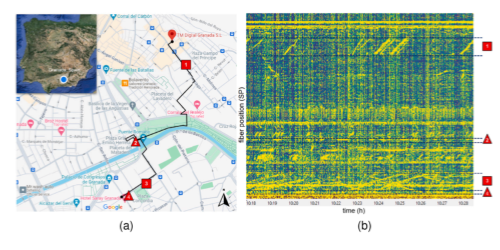
Figure 2: (a) DAS optical fibre path (b) DAS traffic recording
Our contribution focuses on the application of ASCA (ANOVA-Simultaneous Component Analysis) [3] to DAS signals recorded at different locations in Granada. ASCA is a combination of ANOVA and Principal Component Analysis (PCA) with great capabilities for statistical inference and exploratory data analysis of complex data with a high number of variables. Given the large volume of data and the complexity of the signals, we consider ASCA a suitable methodology to interpret and understand the underlying factors that explain the differences between traffic-related events. Recent works have studied the modelling of spatio-temporal signals with ASCA [4]
Through this approach, we expect not only to support the development of future monitoring systems, but also to develop knowledge and expertise about the structure of DAS data and the patterns present in these signals. Thanks to the interpretability of the analysis, this work is not limited to urban traffic applications, but can also be extended to other domains relevant to geosciences, such as structural health monitoring, seismic analysis, or risk surveillance in critical infrastructures.
[1] I. Fakhruzi, M. Titos, C. Benítez & L. García, “Urban traffic monitoring through Distributed Acoustic Sensing: trial analysis of a potent monitoring tool”.
[2] I. Fakhruzi, M. Titos, C. Benítez & L. García, “Distributed Acoustic Sensing for Urban Traffic Monitoring: Spatio-Temporal Attention in Recurrent Neural Networks”. arXiv:2603.13903, 2026.
[3] Smilde, A. K. et al. (2005). ANOVA-simultaneous component analysis (ASCA): a new tool for analyzing designed metabolomics data. Bioinformatics, 21(13), 3043-3048.
[4] Vallejo-España et al. (2026) Modeling cyclostationarity in time series using ASCA arXiv:2603.05065
This work is part of the MuSTARD project (Multi-scale Spatio-Temporal Analysis of Research Data, https://codas.ugr.es/mustard/en/), funded by grant PID2023-1523010B-IOO from the Spanish Agencia Estatal de Investigación and the European Regional Development Fund.
How to cite: Fernández Carrascosa, L., García Sánchez, J., Fakhruzi, I., Camacho, J., and García, L.: Monitoring urban traffic with Distributed Acoustic Sensing and ANOVA Simultaneous Component Analysis, Galileo conference: Fibre Optic Sensing in Geosciences, Aussois, France, 31 Aug–4 Sep 2026, GC14-FibreOptic-49, 2026.
Smart cities aim to improve the quality of life of their residents through more efficient management of urban services and infrastructures. In this context, urban traffic monitoring helps improve mobility, reduce congestion, and optimize the management of urban infrastructures. Distributed Acoustic Sensing (DAS) is a particularly attractive technology for urban traffic monitoring in smart cities, since it can take advantage of optical fiber infrastructures already deployed in many urban environments and requires little maintenance. DAS detects vibrations along optical fiber cables generated by external disturbances, such as nearby traffic. With proper feature extraction, these DAS signals can be analyzed to locate events in both time and space, as well as to distinguish between different types of traffic, such as cars, buses, or environmental noise, as illustrated in Fig. 1
Figure 1: Signal labeled by traffic event type
Previous works in Granada (Fig. 2) have explored the use of DAS combined with exploratory data analysis methods to establish a methodological basis for urban traffic monitoring [1]. More recently, neural network-based approaches have also been proposed to automatically recognize traffic events, moving towards real-time monitoring systems without the need for manual labeling of the signals [2].
Figure 2: (a) DAS optical fibre path (b) DAS traffic recording
Our contribution focuses on the application of ASCA (ANOVA-Simultaneous Component Analysis) [3] to DAS signals recorded at different locations in Granada. ASCA is a combination of ANOVA and Principal Component Analysis (PCA) with great capabilities for statistical inference and exploratory data analysis of complex data with a high number of variables. Given the large volume of data and the complexity of the signals, we consider ASCA a suitable methodology to interpret and understand the underlying factors that explain the differences between traffic-related events. Recent works have studied the modelling of spatio-temporal signals with ASCA [4]
Through this approach, we expect not only to support the development of future monitoring systems, but also to develop knowledge and expertise about the structure of DAS data and the patterns present in these signals. Thanks to the interpretability of the analysis, this work is not limited to urban traffic applications, but can also be extended to other domains relevant to geosciences, such as structural health monitoring, seismic analysis, or risk surveillance in critical infrastructures.
[1] I. Fakhruzi, M. Titos, C. Benítez & L. García, “Urban traffic monitoring through Distributed Acoustic Sensing: trial analysis of a potent monitoring tool”.
[2] I. Fakhruzi, M. Titos, C. Benítez & L. García, “Distributed Acoustic Sensing for Urban Traffic Monitoring: Spatio-Temporal Attention in Recurrent Neural Networks”. arXiv:2603.13903, 2026.
[3] Smilde, A. K. et al. (2005). ANOVA-simultaneous component analysis (ASCA): a new tool for analyzing designed metabolomics data. Bioinformatics, 21(13), 3043-3048.
[4] Vallejo-España et al. (2026) Modeling cyclostationarity in time series using ASCA arXiv:2603.05065
This work is part of the MuSTARD project (Multi-scale Spatio-Temporal Analysis of Research Data, https://codas.ugr.es/mustard/en/), funded by grant PID2023-1523010B-IOO from the Spanish Agencia Estatal de Investigación and the European Regional Development Fund.
How to cite: Fernández Carrascosa, L., García Sánchez, J., Fakhruzi, I., Camacho, J., and García, L.: Monitoring urban traffic with Distributed Acoustic Sensing and ANOVA Simultaneous Component Analysis, Galileo conference: Fibre Optic Sensing in Geosciences, Aussois, France, 31 Aug–4 Sep 2026, GC14-FibreOptic-49, 2026.
GC14-FibreOptic-22 | ECS | Orals | Session 5
GEOPSY-DAS: An Interactive Plugin for Fast Visualization and Integration of Distributed Acoustic Sensing (DAS) in Ambient Vibration ProcessingLuc Moutote, Marc Whatelet, and Philippe Guéguen
Since its release in 2005, the open-source Geopsy software has become a well-established tool for analyzing ambient vibrations and characterizing seismic sites through its user-friendly and efficient graphical interface. Although it was originally designed for standard sensors such as geophones and nodal arrays, Geopsy is evolving to keep pace with the increasing popularity of Distributed Acoustic Sensing (DAS).
We introduces a new Geopsy plugin specifically designed to handle the large, high-density datasets produced by fiber optic sensing. Our aim is to provide Geopsy users with a Graphical User Interface that is free from heavy coding requirements and allows seismologists to easily visualize and process massive DAS data streams, specifically while on the field. Users can quickly scroll through thousands of channels and multiple files simultaneously, enabling immediate quality control and preliminary analysis right after acquisition. It eliminates complex and heavy scripting to handle DAS datasets while maintaining high compatibility with existing Geopsy processing tools.
Geopsy-DAS includes an intuitive Geo-referencing module to easily map DAS channels to physical coordinates using sparse reference points. Specific features, such as tap tests, fiber symmetries or traffic can be pinpointed directly from the graphical trace display and Geo-referenced to refine the fiber path geometry. Once the channels have been set, the data can be easily processed with usual Geospy modules (filters, spectrograms, correlations, H/V, F-K, MASW, etc.) and take advantage of Geopsy powerful low-level processing capabilities. The plug-in also offers intuitive channel selection, enabling specific signal features to be tracked and extracted from large datasets across multiple files for a dedicated processing.
We demonstrate Geopsy-DAS in an experiment conducted in Grenoble, France, involving 12 km of 'dark fiber' running under a tramway line and across the city. Despite having almost no prior knowledge of the cable's path or the quality of its coupling, we successfully mapped its geometry. We identified and monitored various urban structures along the fiber, including several bridges, and captured their vibration response (damping, spatial coherence, etc.). It demonstrates the efficiency of the Geopsy GUI in handling DAS data for monitoring structural integrity and site characterization in noisy, complex environments, while maintaining high computing performance and a user-friendly interface.
How to cite: Moutote, L., Whatelet, M., and Guéguen, P.: GEOPSY-DAS: An Interactive Plugin for Fast Visualization and Integration of Distributed Acoustic Sensing (DAS) in Ambient Vibration Processing, Galileo conference: Fibre Optic Sensing in Geosciences, Aussois, France, 31 Aug–4 Sep 2026, GC14-FibreOptic-22, 2026.
Since its release in 2005, the open-source Geopsy software has become a well-established tool for analyzing ambient vibrations and characterizing seismic sites through its user-friendly and efficient graphical interface. Although it was originally designed for standard sensors such as geophones and nodal arrays, Geopsy is evolving to keep pace with the increasing popularity of Distributed Acoustic Sensing (DAS).
We introduces a new Geopsy plugin specifically designed to handle the large, high-density datasets produced by fiber optic sensing. Our aim is to provide Geopsy users with a Graphical User Interface that is free from heavy coding requirements and allows seismologists to easily visualize and process massive DAS data streams, specifically while on the field. Users can quickly scroll through thousands of channels and multiple files simultaneously, enabling immediate quality control and preliminary analysis right after acquisition. It eliminates complex and heavy scripting to handle DAS datasets while maintaining high compatibility with existing Geopsy processing tools.
Geopsy-DAS includes an intuitive Geo-referencing module to easily map DAS channels to physical coordinates using sparse reference points. Specific features, such as tap tests, fiber symmetries or traffic can be pinpointed directly from the graphical trace display and Geo-referenced to refine the fiber path geometry. Once the channels have been set, the data can be easily processed with usual Geospy modules (filters, spectrograms, correlations, H/V, F-K, MASW, etc.) and take advantage of Geopsy powerful low-level processing capabilities. The plug-in also offers intuitive channel selection, enabling specific signal features to be tracked and extracted from large datasets across multiple files for a dedicated processing.
We demonstrate Geopsy-DAS in an experiment conducted in Grenoble, France, involving 12 km of 'dark fiber' running under a tramway line and across the city. Despite having almost no prior knowledge of the cable's path or the quality of its coupling, we successfully mapped its geometry. We identified and monitored various urban structures along the fiber, including several bridges, and captured their vibration response (damping, spatial coherence, etc.). It demonstrates the efficiency of the Geopsy GUI in handling DAS data for monitoring structural integrity and site characterization in noisy, complex environments, while maintaining high computing performance and a user-friendly interface.
How to cite: Moutote, L., Whatelet, M., and Guéguen, P.: GEOPSY-DAS: An Interactive Plugin for Fast Visualization and Integration of Distributed Acoustic Sensing (DAS) in Ambient Vibration Processing, Galileo conference: Fibre Optic Sensing in Geosciences, Aussois, France, 31 Aug–4 Sep 2026, GC14-FibreOptic-22, 2026.
GC14-FibreOptic-78 | Posters | Session 5
Geophysical Imaging and Monitoring of Tailings Storage Facilities: A Case Study at the Trident Copper Mine, Zambia, within the MOSMIN ProjectChristopher Wollin, Rahmantara Trichandi, Veronica Rodriguez Tribaldos, Christian Haberland, Trond Ryberg, Charlotte Krawczyk, and Moritz Kirsch
Industrial mining operations create substantial amounts of residuals known as tailings or waste rocks. Their deposition creates amongst the largest human-made structures in the world both in spatial extent and mass. Their physical stability is not self-evident and tailings dam failures have been regularly documented throughout the world. In order to mitigate environmental and societal risks, stringent regulatory frameworks have been established, e.g. through the Global Industry Standard on Tailings Management (GISTM) in 2020 introduced by The United Nations Environment Programme (UNEP) , which mandates the implementation of monitoring concepts that manage risks throughout the lifecycle of a tailings facility. The EU-funded initiative MOSMIN (Multiscale observation services for mining-related deposits) addresses this key goal by establishing comprehensive monitoring solutions of mining-related deposits. The project combines (remote) Earth observation technologies with ground-based geophysical measurements to produce vertically integrated datasets which are subsequently analysed through advanced computational techniques, including machine learning algorithms, to characterise the spatio-temporal dynamics governing deposition and containment of tailings.
This contribution focuses on fiber-optics-based passive seismic techniques used in MOSMIN to analyse ambient ground vibrations and generate spatially resolved shear-wave velocity models of tailings dams. The ambient noise tomography (ANT) aims at characterizing and monitoring their internal material properties across time and at different scales, resolutions and depths of investigation. We present results from a field campaign at the First Quantum Sentinel copper mine in Kalumbila, Zambia, during which passive seismic data was semi-continuously recorded with a network of passive sensors and a fibre-optic cable for almost a year. The mine’s tailings dam was equipped with 30 autonomous seismic sensors and a 7 km-long, trenched fiber-optic cable installed parallel to the dam structure and interrogated by a commercial Distributed Acoustic Sensing (DAS) system, recording continuous strain-rate data along the cable. The collected seismic data analysed here comprises 9 months of strain-rate recordings across 1.5 km of optic fiber.
To investigate the temporal stability of the ambient seismic wavefield as required for subsurface monitoring purposes, we characterize how it is influenced by ongoing mining activity over weeks to months. We do so by calculating the strain-rate root-mean-square (RMS) in different frequency bands across the entire recording period of the DAS campaign. Further, we discuss the feasibility of retrieving high-resolution velocity profiles of the dam across space and time using Multi-channel Analysis of Surface Waves (MASW). One important aspect is the selection of recording periods with favourable noise conditions. We investigate different strategies for the selective stacking of several thousands of virtual-shot gathers obtained from cross-correlations of 30 s-long time windows. Results show that the MASW workflow is strongly influenced by the influx of anthropogenic noise created by the mining activity during the day time.
Our case study works towards establishing and implementing fibre-optics-based passive seismic surveys, adapted to site-specific requirements, as a scalable, non-invasive framework for geotechnical monitoring of active TSFs. Joint analysis of passive seismic models with satellite-derived surface deformation or spectral information offers potential for improved understanding of surface–subsurface interactions in and along tailings dams.
How to cite: Wollin, C., Trichandi, R., Rodriguez Tribaldos, V., Haberland, C., Ryberg, T., Krawczyk, C., and Kirsch, M.: Geophysical Imaging and Monitoring of Tailings Storage Facilities: A Case Study at the Trident Copper Mine, Zambia, within the MOSMIN Project, Galileo conference: Fibre Optic Sensing in Geosciences, Aussois, France, 31 Aug–4 Sep 2026, GC14-FibreOptic-78, 2026.
Industrial mining operations create substantial amounts of residuals known as tailings or waste rocks. Their deposition creates amongst the largest human-made structures in the world both in spatial extent and mass. Their physical stability is not self-evident and tailings dam failures have been regularly documented throughout the world. In order to mitigate environmental and societal risks, stringent regulatory frameworks have been established, e.g. through the Global Industry Standard on Tailings Management (GISTM) in 2020 introduced by The United Nations Environment Programme (UNEP) , which mandates the implementation of monitoring concepts that manage risks throughout the lifecycle of a tailings facility. The EU-funded initiative MOSMIN (Multiscale observation services for mining-related deposits) addresses this key goal by establishing comprehensive monitoring solutions of mining-related deposits. The project combines (remote) Earth observation technologies with ground-based geophysical measurements to produce vertically integrated datasets which are subsequently analysed through advanced computational techniques, including machine learning algorithms, to characterise the spatio-temporal dynamics governing deposition and containment of tailings.
This contribution focuses on fiber-optics-based passive seismic techniques used in MOSMIN to analyse ambient ground vibrations and generate spatially resolved shear-wave velocity models of tailings dams. The ambient noise tomography (ANT) aims at characterizing and monitoring their internal material properties across time and at different scales, resolutions and depths of investigation. We present results from a field campaign at the First Quantum Sentinel copper mine in Kalumbila, Zambia, during which passive seismic data was semi-continuously recorded with a network of passive sensors and a fibre-optic cable for almost a year. The mine’s tailings dam was equipped with 30 autonomous seismic sensors and a 7 km-long, trenched fiber-optic cable installed parallel to the dam structure and interrogated by a commercial Distributed Acoustic Sensing (DAS) system, recording continuous strain-rate data along the cable. The collected seismic data analysed here comprises 9 months of strain-rate recordings across 1.5 km of optic fiber.
To investigate the temporal stability of the ambient seismic wavefield as required for subsurface monitoring purposes, we characterize how it is influenced by ongoing mining activity over weeks to months. We do so by calculating the strain-rate root-mean-square (RMS) in different frequency bands across the entire recording period of the DAS campaign. Further, we discuss the feasibility of retrieving high-resolution velocity profiles of the dam across space and time using Multi-channel Analysis of Surface Waves (MASW). One important aspect is the selection of recording periods with favourable noise conditions. We investigate different strategies for the selective stacking of several thousands of virtual-shot gathers obtained from cross-correlations of 30 s-long time windows. Results show that the MASW workflow is strongly influenced by the influx of anthropogenic noise created by the mining activity during the day time.
Our case study works towards establishing and implementing fibre-optics-based passive seismic surveys, adapted to site-specific requirements, as a scalable, non-invasive framework for geotechnical monitoring of active TSFs. Joint analysis of passive seismic models with satellite-derived surface deformation or spectral information offers potential for improved understanding of surface–subsurface interactions in and along tailings dams.
How to cite: Wollin, C., Trichandi, R., Rodriguez Tribaldos, V., Haberland, C., Ryberg, T., Krawczyk, C., and Kirsch, M.: Geophysical Imaging and Monitoring of Tailings Storage Facilities: A Case Study at the Trident Copper Mine, Zambia, within the MOSMIN Project, Galileo conference: Fibre Optic Sensing in Geosciences, Aussois, France, 31 Aug–4 Sep 2026, GC14-FibreOptic-78, 2026.
GC14-FibreOptic-108 | ECS | Posters | Session 5
Distributed Acoustic Sensing as a Tool for Geotechnical Monitoring Using Seismic Waves Generated by Train Traffic in Northern BrazilTiago Borges da Silva, George Sand França, and Marcos Futai
The structural assessment of extended railway systems presents persistent challenges for operators responsible for maintaining safety and serviceability across hundreds of kilometers of track and associated infrastructure. Conventional inspection methods offer limited spatial coverage and are poorly suited to detecting geotechnical anomalies at early stages, particularly in complex geological settings. Distributed Acoustic Sensing addresses these limitations by converting optical fiber cables into dense seismic arrays capable of recording ground motion at thousands of points simultaneously, enabling continuous and spatially comprehensive monitoring along entire railway corridors, including the potential reuse of existing telecommunication fiber networks already installed alongside many rail lines.
This study was carried out along one of the longest and most operationally demanding freight railways in northern Brazil, a corridor dedicated to the transport of iron ore in large volumes and to passenger service over extensive distances. Much of the existing distributed sensing literature has focused on high-speed passenger trains as seismic sources. Here, the operative trains are ore freight consists reaching lengths on the order of 3.3 km traveling at speeds between approximately 15 and 30 km/h, alongside shorter maintenance trains, representing a substantially different excitation regime that requires adapted analysis strategies.
An optical fiber approximately one kilometer long was installed parallel to an active section of the railway. Data were acquired during multiple train passages under normal service conditions, capturing the seismic wavefield generated by each transit. Spectral analysis of the recorded signals revealed meaningful variations in the frequency content and energy distribution of surface waves along the fiber, providing evidence of lateral heterogeneities in the mechanical properties of the foundation materials.
The monitored section encompasses a tunnel where geotechnical conditions are of particular concern. Within the tunnel, sandstone and banded iron formation units occur in direct contact alongside basalt dikes, forming a geologically heterogeneous rock mass with quality classifications ranging. The spatial mapping of subsurface stiffness derived from this dataset proved capable of distinguishing zones where support conditions differed from those observed in adjacent sections, pointing to areas of potential concern for long term performance. These observations align with geotechnical expectations regarding the role of differential mechanical behavior across geological contacts in the progressive degradation of tunnel foundations.
Beyond the technical findings, this work contributes to the broader discussion of how fiber optic sensing networks can be integrated into monitoring programs for critical railway infrastructure. The scalability of distributed sensing, the relatively low operational cost of using trains in regular service as seismic sources, and the potential for nearly continuous data acquisition position this approach as a practical option for geotechnical surveillance in complex geological environments. Remaining challenges related to signal coupling and wavefield interpretation in heterogeneous rock masses are discussed in the context of future system development.
How to cite: Borges da Silva, T., Sand França, G., and Futai, M.: Distributed Acoustic Sensing as a Tool for Geotechnical Monitoring Using Seismic Waves Generated by Train Traffic in Northern Brazil, Galileo conference: Fibre Optic Sensing in Geosciences, Aussois, France, 31 Aug–4 Sep 2026, GC14-FibreOptic-108, 2026.
The structural assessment of extended railway systems presents persistent challenges for operators responsible for maintaining safety and serviceability across hundreds of kilometers of track and associated infrastructure. Conventional inspection methods offer limited spatial coverage and are poorly suited to detecting geotechnical anomalies at early stages, particularly in complex geological settings. Distributed Acoustic Sensing addresses these limitations by converting optical fiber cables into dense seismic arrays capable of recording ground motion at thousands of points simultaneously, enabling continuous and spatially comprehensive monitoring along entire railway corridors, including the potential reuse of existing telecommunication fiber networks already installed alongside many rail lines.
This study was carried out along one of the longest and most operationally demanding freight railways in northern Brazil, a corridor dedicated to the transport of iron ore in large volumes and to passenger service over extensive distances. Much of the existing distributed sensing literature has focused on high-speed passenger trains as seismic sources. Here, the operative trains are ore freight consists reaching lengths on the order of 3.3 km traveling at speeds between approximately 15 and 30 km/h, alongside shorter maintenance trains, representing a substantially different excitation regime that requires adapted analysis strategies.
An optical fiber approximately one kilometer long was installed parallel to an active section of the railway. Data were acquired during multiple train passages under normal service conditions, capturing the seismic wavefield generated by each transit. Spectral analysis of the recorded signals revealed meaningful variations in the frequency content and energy distribution of surface waves along the fiber, providing evidence of lateral heterogeneities in the mechanical properties of the foundation materials.
The monitored section encompasses a tunnel where geotechnical conditions are of particular concern. Within the tunnel, sandstone and banded iron formation units occur in direct contact alongside basalt dikes, forming a geologically heterogeneous rock mass with quality classifications ranging. The spatial mapping of subsurface stiffness derived from this dataset proved capable of distinguishing zones where support conditions differed from those observed in adjacent sections, pointing to areas of potential concern for long term performance. These observations align with geotechnical expectations regarding the role of differential mechanical behavior across geological contacts in the progressive degradation of tunnel foundations.
Beyond the technical findings, this work contributes to the broader discussion of how fiber optic sensing networks can be integrated into monitoring programs for critical railway infrastructure. The scalability of distributed sensing, the relatively low operational cost of using trains in regular service as seismic sources, and the potential for nearly continuous data acquisition position this approach as a practical option for geotechnical surveillance in complex geological environments. Remaining challenges related to signal coupling and wavefield interpretation in heterogeneous rock masses are discussed in the context of future system development.
How to cite: Borges da Silva, T., Sand França, G., and Futai, M.: Distributed Acoustic Sensing as a Tool for Geotechnical Monitoring Using Seismic Waves Generated by Train Traffic in Northern Brazil, Galileo conference: Fibre Optic Sensing in Geosciences, Aussois, France, 31 Aug–4 Sep 2026, GC14-FibreOptic-108, 2026.
GC14-FibreOptic-2 | ECS | Orals | Session 5
Urban Subsurface Imaging with DAS: From Seismic Wavefields to Quasi-Static DeformationLe Tang, Etienne Bertrand, Eléonore Stutzmann, Luis Fabian Bonilla Hidalgo, Shoaib Ayjaz Mohammed, Céline Gélis, Sebastien Hok, Maximilien Lehujeur, Donatienne Leparoux, Gautier Gugole, and Olivier Durand
Distributed Acoustic Sensing (DAS) is an emerging technology that transforms fiber-optic cables into dense arrays of vibration sensors, offering significant potential for subsurface exploration in urban environments. DAS enables the recording of broadband ground vibrations generated by human activity, including both high-frequency seismic wavefields (>1 Hz) and low-frequency quasi-static deformations (<1 Hz). However, effectively exploiting these signals and leveraging the dense spatial sampling of DAS in complex and highly heterogeneous urban subsurface environments, still remains a major challenge. In this study, we propose two novel approaches for local structural imaging based on seismic surface waves and quasi-static deformation. The first method uses high-frequency surface waves and a gradient-based amplitude estimation technique to achieve local structural imaging using only two DAS channels. Under the assumption of laterally heterogeneous JWKB theory, the ratio of the first-order temporal derivative to the spatial derivative of the surface-wave strain rate is used to estimate the local phase velocity. This approach allows adjacent DAS channels to resolve local one-dimensional velocity structures. The performance of this method is validated through numerical simulations and field experiments. The second method focuses on low-frequency quasi-static strain-rate signals induced by vehicle loading, enabling local structural imaging using a single DAS channel. A Markov Chain Monte Carlo (MCMC) inversion framework is used to investigate the depth sensitivity of quasi-static strain signals. Synthetic results indicate that the quasi-static strain field generated by a typical passenger vehicle can resolve subsurface structures at depths from 0 to10 m. Furthermore, field experiments conducted near a highway show that the derived two-dimensional velocity model is consistent with results obtained from conventional surface-wave inversion methods, confirming the robustness and applicability of the proposed approach. Looking ahead, the widespread deployment of urban fiber-optic communication networks provides an unprecedented opportunity to record broadband vibration signals from diverse sources, enabling large-scale urban subsurface imaging. These methods have promising applications in urban infrastructure design and hazard assessment.
How to cite: Tang, L., Bertrand, E., Stutzmann, E., Bonilla Hidalgo, L. F., Mohammed, S. A., Gélis, C., Hok, S., Lehujeur, M., Leparoux, D., Gugole, G., and Durand, O.: Urban Subsurface Imaging with DAS: From Seismic Wavefields to Quasi-Static Deformation, Galileo conference: Fibre Optic Sensing in Geosciences, Aussois, France, 31 Aug–4 Sep 2026, GC14-FibreOptic-2, 2026.
Distributed Acoustic Sensing (DAS) is an emerging technology that transforms fiber-optic cables into dense arrays of vibration sensors, offering significant potential for subsurface exploration in urban environments. DAS enables the recording of broadband ground vibrations generated by human activity, including both high-frequency seismic wavefields (>1 Hz) and low-frequency quasi-static deformations (<1 Hz). However, effectively exploiting these signals and leveraging the dense spatial sampling of DAS in complex and highly heterogeneous urban subsurface environments, still remains a major challenge. In this study, we propose two novel approaches for local structural imaging based on seismic surface waves and quasi-static deformation. The first method uses high-frequency surface waves and a gradient-based amplitude estimation technique to achieve local structural imaging using only two DAS channels. Under the assumption of laterally heterogeneous JWKB theory, the ratio of the first-order temporal derivative to the spatial derivative of the surface-wave strain rate is used to estimate the local phase velocity. This approach allows adjacent DAS channels to resolve local one-dimensional velocity structures. The performance of this method is validated through numerical simulations and field experiments. The second method focuses on low-frequency quasi-static strain-rate signals induced by vehicle loading, enabling local structural imaging using a single DAS channel. A Markov Chain Monte Carlo (MCMC) inversion framework is used to investigate the depth sensitivity of quasi-static strain signals. Synthetic results indicate that the quasi-static strain field generated by a typical passenger vehicle can resolve subsurface structures at depths from 0 to10 m. Furthermore, field experiments conducted near a highway show that the derived two-dimensional velocity model is consistent with results obtained from conventional surface-wave inversion methods, confirming the robustness and applicability of the proposed approach. Looking ahead, the widespread deployment of urban fiber-optic communication networks provides an unprecedented opportunity to record broadband vibration signals from diverse sources, enabling large-scale urban subsurface imaging. These methods have promising applications in urban infrastructure design and hazard assessment.
How to cite: Tang, L., Bertrand, E., Stutzmann, E., Bonilla Hidalgo, L. F., Mohammed, S. A., Gélis, C., Hok, S., Lehujeur, M., Leparoux, D., Gugole, G., and Durand, O.: Urban Subsurface Imaging with DAS: From Seismic Wavefields to Quasi-Static Deformation, Galileo conference: Fibre Optic Sensing in Geosciences, Aussois, France, 31 Aug–4 Sep 2026, GC14-FibreOptic-2, 2026.
GC14-FibreOptic-62 | ECS | Orals | Session 5
Distributed Strain Sensing on a Dublin Telecom Fibre: The Luas Tram Network as a Moving Calibration SourceBruna Chagas de Melo, Christopher J. Bean, and Colm Browning
Rapid urban growth in Dublin is placing increasing pressure on transport, construction, and environmental management, creating a need for high-resolution observations of how the city operates at both surface and subsurface levels. This study presents progress from a project exploring the use of existing telecommunication infrastructure as a large-scale urban sensing platform through Distributed Strain Sensing (DSS), which converts optical fibres into dense seismic arrays by measuring strain-rate perturbations from ground vibrations.
A pilot deployment was carried out on a dark ~80 km fibre ring crossing Dublin city centre, residential neighbourhoods, surface tram lines, and a tunnel. A FEBUS-A1 interrogator was installed at a data centre in Dublin's north side and operated for 23 days. The most stable configuration recorded ~50 km of fibre at 500 Hz sampling and 20 m gauge length over a continuous 10-day period. The array captured clear signatures of moving vehicles and rail activity. Signal quality degrades beyond ~30 km from the interrogator, reflecting attenuation, coupling, and urban noise effects typical of long fibre links.
Now we aim to use the Luas tram network as a calibrated moving load to extract quantitative information from the DSS data. The fibre intersects the Luas Red Line over a ~1.5 km section, where the uniform fleet of Alstom Citadis 401 trams (40.8 m, 3 bogies, ~41 t tare weight) provides a recurring, well-characterised seismic source. The signal also enables refined georeferencing of channel locations: tram stops are clearly identified as ~1-minute gaps in the spatio-temporal record, providing fixed spatial anchors along the fibre. Because the trams follow a fixed schedule with known geometry, they are ideal for validating the quasi-static response of buried telecom fibre to vehicular loading, characterising fibre–ground coupling along the section, and developing a workflow to estimate tram weight — and by extension passenger load — from the quasi-static strain amplitude. We plan to follow the processing pipeline — event detection, speed estimation from spatial-temporal moveout, channel-by-channel coupling correction, and absolute calibration anchored on the known tare weight — and discuss the physical assumptions underpinning weight retrieval from fibre in telecom ducts rather than bonded to the ground. Beyond passenger-load tracking, this approach establishes the Luas as an in-situ calibration standard transferable to other vehicles and fibre sections, opening a route toward distributed weight-in-motion monitoring across urban environments.
How to cite: Chagas de Melo, B., Bean, C. J., and Browning, C.: Distributed Strain Sensing on a Dublin Telecom Fibre: The Luas Tram Network as a Moving Calibration Source, Galileo conference: Fibre Optic Sensing in Geosciences, Aussois, France, 31 Aug–4 Sep 2026, GC14-FibreOptic-62, 2026.
Rapid urban growth in Dublin is placing increasing pressure on transport, construction, and environmental management, creating a need for high-resolution observations of how the city operates at both surface and subsurface levels. This study presents progress from a project exploring the use of existing telecommunication infrastructure as a large-scale urban sensing platform through Distributed Strain Sensing (DSS), which converts optical fibres into dense seismic arrays by measuring strain-rate perturbations from ground vibrations.
A pilot deployment was carried out on a dark ~80 km fibre ring crossing Dublin city centre, residential neighbourhoods, surface tram lines, and a tunnel. A FEBUS-A1 interrogator was installed at a data centre in Dublin's north side and operated for 23 days. The most stable configuration recorded ~50 km of fibre at 500 Hz sampling and 20 m gauge length over a continuous 10-day period. The array captured clear signatures of moving vehicles and rail activity. Signal quality degrades beyond ~30 km from the interrogator, reflecting attenuation, coupling, and urban noise effects typical of long fibre links.
Now we aim to use the Luas tram network as a calibrated moving load to extract quantitative information from the DSS data. The fibre intersects the Luas Red Line over a ~1.5 km section, where the uniform fleet of Alstom Citadis 401 trams (40.8 m, 3 bogies, ~41 t tare weight) provides a recurring, well-characterised seismic source. The signal also enables refined georeferencing of channel locations: tram stops are clearly identified as ~1-minute gaps in the spatio-temporal record, providing fixed spatial anchors along the fibre. Because the trams follow a fixed schedule with known geometry, they are ideal for validating the quasi-static response of buried telecom fibre to vehicular loading, characterising fibre–ground coupling along the section, and developing a workflow to estimate tram weight — and by extension passenger load — from the quasi-static strain amplitude. We plan to follow the processing pipeline — event detection, speed estimation from spatial-temporal moveout, channel-by-channel coupling correction, and absolute calibration anchored on the known tare weight — and discuss the physical assumptions underpinning weight retrieval from fibre in telecom ducts rather than bonded to the ground. Beyond passenger-load tracking, this approach establishes the Luas as an in-situ calibration standard transferable to other vehicles and fibre sections, opening a route toward distributed weight-in-motion monitoring across urban environments.
How to cite: Chagas de Melo, B., Bean, C. J., and Browning, C.: Distributed Strain Sensing on a Dublin Telecom Fibre: The Luas Tram Network as a Moving Calibration Source, Galileo conference: Fibre Optic Sensing in Geosciences, Aussois, France, 31 Aug–4 Sep 2026, GC14-FibreOptic-62, 2026.
GC14-FibreOptic-19 | ECS | Orals | Session 5
Toward large scale assessment of railway site conditions using brodaband resonance frequencies from DAS DATAJoseph Grand, Luis-Fabian Bonilla, Eleonore Stutzmann, Baldrik Faure, Tarik Hammi, and Gabriel Papaiz
The modern French railway network is equipped with optical fibers dedicated to telecommunication purposes, among which some remain unused. These so-called dark fibers can be exploited using Distributed Acoustic Sensing technology (DAS) to provide an effective tool for rapid assessment and long-term monitoring of site conditions along railway tracks. We present a methodology applied to a 19 km long DAS array operating under normal railway traffic conditions, highlighting the capability to perform continuous spatial analysis at kilometer scale with measurements every 4.9 meters. Despite the limited coupling associated with the on-conduit installation, corresponding to the standard operational conditions without any modification to the existing infrastructure, time windows selected before and after train passages allow the extraction of the resonance frequencies at each DAS channel, overcoming the low signal-to-noise ratio of the installation setup. Variations of resonance frequencies along the railway reflect changes in near surface soil conditions, related either to shear wave velocity or to variation in impedance contrast depth, with rapid spatial variation observed in karstic areas over only a few tens of meters. The novelty of this work lies in the use of resonance frequencies as a stable and repeatable site parameter derived from DAS data on a large scale. While this information does not quantify site amplification, it provides direct information on the frequency ranges that may be preferentially amplified. This makes them well suited for long term monitoring and for tracking temporal or spatial changes in site conditions under linear infrastructures, and for supporting future strategies to manage infrastructure evolution and time dependent variability. Seasonal variations of these resonance frequencies have been observed, further supporting this method as an effective tool for continuous site monitoring.
How to cite: Grand, J., Bonilla, L.-F., Stutzmann, E., Faure, B., Hammi, T., and Papaiz, G.: Toward large scale assessment of railway site conditions using brodaband resonance frequencies from DAS DATA , Galileo conference: Fibre Optic Sensing in Geosciences, Aussois, France, 31 Aug–4 Sep 2026, GC14-FibreOptic-19, 2026.
The modern French railway network is equipped with optical fibers dedicated to telecommunication purposes, among which some remain unused. These so-called dark fibers can be exploited using Distributed Acoustic Sensing technology (DAS) to provide an effective tool for rapid assessment and long-term monitoring of site conditions along railway tracks. We present a methodology applied to a 19 km long DAS array operating under normal railway traffic conditions, highlighting the capability to perform continuous spatial analysis at kilometer scale with measurements every 4.9 meters. Despite the limited coupling associated with the on-conduit installation, corresponding to the standard operational conditions without any modification to the existing infrastructure, time windows selected before and after train passages allow the extraction of the resonance frequencies at each DAS channel, overcoming the low signal-to-noise ratio of the installation setup. Variations of resonance frequencies along the railway reflect changes in near surface soil conditions, related either to shear wave velocity or to variation in impedance contrast depth, with rapid spatial variation observed in karstic areas over only a few tens of meters. The novelty of this work lies in the use of resonance frequencies as a stable and repeatable site parameter derived from DAS data on a large scale. While this information does not quantify site amplification, it provides direct information on the frequency ranges that may be preferentially amplified. This makes them well suited for long term monitoring and for tracking temporal or spatial changes in site conditions under linear infrastructures, and for supporting future strategies to manage infrastructure evolution and time dependent variability. Seasonal variations of these resonance frequencies have been observed, further supporting this method as an effective tool for continuous site monitoring.
How to cite: Grand, J., Bonilla, L.-F., Stutzmann, E., Faure, B., Hammi, T., and Papaiz, G.: Toward large scale assessment of railway site conditions using brodaband resonance frequencies from DAS DATA , Galileo conference: Fibre Optic Sensing in Geosciences, Aussois, France, 31 Aug–4 Sep 2026, GC14-FibreOptic-19, 2026.
GC14-FibreOptic-65 | Orals | Session 5
Fibre-Optic Wind Monitoring of Overhead Powerlines for Smart and Resilient Power GridsAndreas Wuestefeld, Christiane Duscha, Boris Adum, and Bjørn Egil Nygaard
Dynamic Line Rating (DLR) is a method employed by grid operators to maximise electrical use of powerlines. This requires detailed knowledge of conditions of the powerlines themselves, and also environmental conditions at high spatio-temporal resolution. Wind is particularly interesting as it both cools the conductor and induces conductor motion. Under certain conditions, wind excitation can lead to large-amplitude instabilities such as conductor galloping which can cause damage to the power line. Recent advances in distributed fibre-optic sensing (DFOS), particularly Distributed Acoustic Sensing (DAS) enables continuous monitoring of conductor movement over hundreds of kilometres of optical ground wire (OPGW) or phase conductors equipped with optical fibres, offering unprecedented spatial resolution for infrastructure monitoring.
In this contribution, we present a methodology to exploit conductor vibration measurements obtained via DAS to infer wind velocities and detect incipient galloping events. These measurements thus provide actionable environmental information for transmission grid operation.
A key processing step is the extraction of harmonic components from the vibration spectra. Aeolian vibrations and galloping manifest in distinct frequency bands and modal structures. By performing automated spectral peak detection and tracking of harmonic modes, we derive robust features that are sensitive to wind speed via Strouhal-type relationships, while also capturing changes in mechanical boundary conditions. We present here first results of two installation on OPGWs (15km and 55km) the mountains of central Norway during the winter of 2025/2026.
Furthermore, we demonstrate that galloping events can be identified through the emergence of low-frequency, high-amplitude oscillations with characteristic harmonic signatures. Real-time monitoring of these spectral features enables early warning of critical events, supporting proactive grid operation and risk mitigation. The ability to monitor such phenomena continuously along entire transmission corridors represents a significant advancement compared to point-based sensor systems.
By improving the estimate of wind conditions and enabling early detection of extreme loading events, this methodology directly supports Dynamic Line Rating and more efficient utilisation of existing transmission infrastructure. This contributes to the energy transition by increasing grid capacity, facilitating renewable integration, and enhancing the resilience of critical energy systems without the need for extensive new construction.
How to cite: Wuestefeld, A., Duscha, C., Adum, B., and Nygaard, B. E.: Fibre-Optic Wind Monitoring of Overhead Powerlines for Smart and Resilient Power Grids, Galileo conference: Fibre Optic Sensing in Geosciences, Aussois, France, 31 Aug–4 Sep 2026, GC14-FibreOptic-65, 2026.
Dynamic Line Rating (DLR) is a method employed by grid operators to maximise electrical use of powerlines. This requires detailed knowledge of conditions of the powerlines themselves, and also environmental conditions at high spatio-temporal resolution. Wind is particularly interesting as it both cools the conductor and induces conductor motion. Under certain conditions, wind excitation can lead to large-amplitude instabilities such as conductor galloping which can cause damage to the power line. Recent advances in distributed fibre-optic sensing (DFOS), particularly Distributed Acoustic Sensing (DAS) enables continuous monitoring of conductor movement over hundreds of kilometres of optical ground wire (OPGW) or phase conductors equipped with optical fibres, offering unprecedented spatial resolution for infrastructure monitoring.
In this contribution, we present a methodology to exploit conductor vibration measurements obtained via DAS to infer wind velocities and detect incipient galloping events. These measurements thus provide actionable environmental information for transmission grid operation.
A key processing step is the extraction of harmonic components from the vibration spectra. Aeolian vibrations and galloping manifest in distinct frequency bands and modal structures. By performing automated spectral peak detection and tracking of harmonic modes, we derive robust features that are sensitive to wind speed via Strouhal-type relationships, while also capturing changes in mechanical boundary conditions. We present here first results of two installation on OPGWs (15km and 55km) the mountains of central Norway during the winter of 2025/2026.
Furthermore, we demonstrate that galloping events can be identified through the emergence of low-frequency, high-amplitude oscillations with characteristic harmonic signatures. Real-time monitoring of these spectral features enables early warning of critical events, supporting proactive grid operation and risk mitigation. The ability to monitor such phenomena continuously along entire transmission corridors represents a significant advancement compared to point-based sensor systems.
By improving the estimate of wind conditions and enabling early detection of extreme loading events, this methodology directly supports Dynamic Line Rating and more efficient utilisation of existing transmission infrastructure. This contributes to the energy transition by increasing grid capacity, facilitating renewable integration, and enhancing the resilience of critical energy systems without the need for extensive new construction.
How to cite: Wuestefeld, A., Duscha, C., Adum, B., and Nygaard, B. E.: Fibre-Optic Wind Monitoring of Overhead Powerlines for Smart and Resilient Power Grids, Galileo conference: Fibre Optic Sensing in Geosciences, Aussois, France, 31 Aug–4 Sep 2026, GC14-FibreOptic-65, 2026.
GC14-FibreOptic-42 | Orals | Session 5
Detection and Tracking of Aircraft Using the NORFOX Distributed Acoustic Sensing ArrayAlan Baird
Distributed Acoustic Sensing (DAS) enables dense, continuous measurements of dynamic strain and is increasingly used to monitor anthropogenic activity. Aircraft generate clear acoustic signals that can be recorded by such arrays, with Doppler frequency shifts providing a direct observable of source motion. Previous seismic and acoustic studies of aircraft have typically relied on sparse sensor networks or single-point measurements, limiting the ability to resolve source–receiver geometry and extract trajectory information. Here we exploit the two-dimensional, multi-arm geometry of the NORFOX fibre array in Norway to track aircraft signals across spatially distributed sensors, providing improved constraints on aircraft kinematics.
We focus on helicopter fly-bys and selected fixed-wing aircraft. For helicopters flying at altitudes of a few hundred metres, we extract Doppler signatures from time–frequency representations of the DAS data and validate these against ADS-B flight records. The observed frequency shifts are consistent with expected aircraft motion, and analysis of the Doppler shifts allows estimation of aircraft speed and source frequency; the latter is related to rotor dynamics and can be used to discriminate between aircraft types. The shape of the Doppler curves, including their slope and temporal extent, is diagnostic of the aircraft's distance at closest approach, providing geometric constraints on the source–receiver configuration. The dense spatial sampling of NORFOX enables these signatures to be tracked across multiple fibre arms, enabling estimation of aircraft trajectories directly from the DAS observations.
For jets, the source frequencies typically exceed the 62.5 Hz Nyquist frequency of the DAS recordings, and Doppler harmonics are therefore not resolved. Nevertheless, coherent lower-frequency arrivals can still be observed, even at cruising altitudes, and analysing their propagation across the array yields time-varying back-azimuth and apparent slowness estimates, providing directional constraints on source motion.
Together, these results demonstrate that array-based DAS deployments can meaningfully enhance aircraft detection and tracking using existing fibre infrastructure. The NORFOX geometry illustrates how fibre layout determines the quality of kinematic information recoverable from such observations.
How to cite: Baird, A.: Detection and Tracking of Aircraft Using the NORFOX Distributed Acoustic Sensing Array, Galileo conference: Fibre Optic Sensing in Geosciences, Aussois, France, 31 Aug–4 Sep 2026, GC14-FibreOptic-42, 2026.
Distributed Acoustic Sensing (DAS) enables dense, continuous measurements of dynamic strain and is increasingly used to monitor anthropogenic activity. Aircraft generate clear acoustic signals that can be recorded by such arrays, with Doppler frequency shifts providing a direct observable of source motion. Previous seismic and acoustic studies of aircraft have typically relied on sparse sensor networks or single-point measurements, limiting the ability to resolve source–receiver geometry and extract trajectory information. Here we exploit the two-dimensional, multi-arm geometry of the NORFOX fibre array in Norway to track aircraft signals across spatially distributed sensors, providing improved constraints on aircraft kinematics.
We focus on helicopter fly-bys and selected fixed-wing aircraft. For helicopters flying at altitudes of a few hundred metres, we extract Doppler signatures from time–frequency representations of the DAS data and validate these against ADS-B flight records. The observed frequency shifts are consistent with expected aircraft motion, and analysis of the Doppler shifts allows estimation of aircraft speed and source frequency; the latter is related to rotor dynamics and can be used to discriminate between aircraft types. The shape of the Doppler curves, including their slope and temporal extent, is diagnostic of the aircraft's distance at closest approach, providing geometric constraints on the source–receiver configuration. The dense spatial sampling of NORFOX enables these signatures to be tracked across multiple fibre arms, enabling estimation of aircraft trajectories directly from the DAS observations.
For jets, the source frequencies typically exceed the 62.5 Hz Nyquist frequency of the DAS recordings, and Doppler harmonics are therefore not resolved. Nevertheless, coherent lower-frequency arrivals can still be observed, even at cruising altitudes, and analysing their propagation across the array yields time-varying back-azimuth and apparent slowness estimates, providing directional constraints on source motion.
Together, these results demonstrate that array-based DAS deployments can meaningfully enhance aircraft detection and tracking using existing fibre infrastructure. The NORFOX geometry illustrates how fibre layout determines the quality of kinematic information recoverable from such observations.
How to cite: Baird, A.: Detection and Tracking of Aircraft Using the NORFOX Distributed Acoustic Sensing Array, Galileo conference: Fibre Optic Sensing in Geosciences, Aussois, France, 31 Aug–4 Sep 2026, GC14-FibreOptic-42, 2026.
GC14-FibreOptic-71 | ECS | Orals | Session 5
DAS vs. Interferometric Monitoring on an Urban Fiber Network: Field Validation in the Tuff Cliff of PitiglianoAndrea Madaschi, Marco Brunero, and Pierpaolo Boffi
The widespread deployment of optical fiber networks in urban areas by telecommunications operators opens a significant opportunity to transform existing metropolitan area network (MAN) infrastructures into large-scale distributed sensing systems. Beyond their primary communication function, buried fiber-optic cables can act as pervasive sensors for monitoring human activities, natural events, and geoscience-related processes, enabling a cost-effective and non-invasive approach to urban and environmental surveillance. In this context, Distributed Acoustic Sensing (DAS) has emerged as a highly promising technology for detecting and localizing perturbations with high resolution. Despite its remarkable potential, DAS also presents important limitations that can hinder large-scale and long-term deployment in real operational MAN scenarios. In particular, the DAS cost remains relatively high, and the technology requires significant expertise for system configuration, signal interpretation, and maintenance. Moreover, DAS generates an enormous amount of data, creating substantial challenges in terms of storage and data management, especially when continuous monitoring is required. In contrast, interferometric fiber sensing approaches represent an attractive alternative. Although they do not provide the spatial localization capability typical of DAS, they can achieve comparable sensitivity while offering major advantages in terms of reduced system complexity, lower cost, and significantly lighter data handling requirements. These characteristics make interferometric solutions particularly suitable for practical deployments where early warning is more important than precise distributed localization. Their simplified architecture can therefore facilitate the exploitation of in-service urban fiber networks as sensing assets, extending monitoring capabilities to a broader range of users and use cases.
This work presents a direct comparison between these two sensing paradigms through a real field trial carried out on an operational MAN fiber network deployed by the Italian operator OPEN FIBER in the town of Pitigliano, Italy. Pitigliano is an ancient medieval village built on a tuff cliff, a geomorphological setting of high historical and environmental value but also potentially exposed to instability phenomena. In the experiment, an already installed telecom fiber-optic cable buried beneath an unpaved road running along the tuff ridge was exploited as a sensing element to monitor both anthropogenic activities, such as pedestrians and passing vehicles, and potentially dangerous events, such as falling rocks or trees. In perspective, the same sensing infrastructure may also support the observation of possible variations affecting the stability of the tuff cliff itself, thus contributing to geoscientific monitoring and risk mitigation. The entire monitoring system was remotely operated from a service room located at the Municipality of Pitigliano, demonstrating the feasibility of centralized and fully remote management of urban fiber sensing infrastructures. Several comparative measurements obtained with both DAS and a low-cost interferometric system provided by COHAERENTIA (www.cohaerentia.com) are presented and discussed. The results show useful insight into the capabilities of sensing technologies for future smart-city, civil protection, and geoscience applications based on existing telecom fiber networks.
How to cite: Madaschi, A., Brunero, M., and Boffi, P.: DAS vs. Interferometric Monitoring on an Urban Fiber Network: Field Validation in the Tuff Cliff of Pitigliano, Galileo conference: Fibre Optic Sensing in Geosciences, Aussois, France, 31 Aug–4 Sep 2026, GC14-FibreOptic-71, 2026.
The widespread deployment of optical fiber networks in urban areas by telecommunications operators opens a significant opportunity to transform existing metropolitan area network (MAN) infrastructures into large-scale distributed sensing systems. Beyond their primary communication function, buried fiber-optic cables can act as pervasive sensors for monitoring human activities, natural events, and geoscience-related processes, enabling a cost-effective and non-invasive approach to urban and environmental surveillance. In this context, Distributed Acoustic Sensing (DAS) has emerged as a highly promising technology for detecting and localizing perturbations with high resolution. Despite its remarkable potential, DAS also presents important limitations that can hinder large-scale and long-term deployment in real operational MAN scenarios. In particular, the DAS cost remains relatively high, and the technology requires significant expertise for system configuration, signal interpretation, and maintenance. Moreover, DAS generates an enormous amount of data, creating substantial challenges in terms of storage and data management, especially when continuous monitoring is required. In contrast, interferometric fiber sensing approaches represent an attractive alternative. Although they do not provide the spatial localization capability typical of DAS, they can achieve comparable sensitivity while offering major advantages in terms of reduced system complexity, lower cost, and significantly lighter data handling requirements. These characteristics make interferometric solutions particularly suitable for practical deployments where early warning is more important than precise distributed localization. Their simplified architecture can therefore facilitate the exploitation of in-service urban fiber networks as sensing assets, extending monitoring capabilities to a broader range of users and use cases.
This work presents a direct comparison between these two sensing paradigms through a real field trial carried out on an operational MAN fiber network deployed by the Italian operator OPEN FIBER in the town of Pitigliano, Italy. Pitigliano is an ancient medieval village built on a tuff cliff, a geomorphological setting of high historical and environmental value but also potentially exposed to instability phenomena. In the experiment, an already installed telecom fiber-optic cable buried beneath an unpaved road running along the tuff ridge was exploited as a sensing element to monitor both anthropogenic activities, such as pedestrians and passing vehicles, and potentially dangerous events, such as falling rocks or trees. In perspective, the same sensing infrastructure may also support the observation of possible variations affecting the stability of the tuff cliff itself, thus contributing to geoscientific monitoring and risk mitigation. The entire monitoring system was remotely operated from a service room located at the Municipality of Pitigliano, demonstrating the feasibility of centralized and fully remote management of urban fiber sensing infrastructures. Several comparative measurements obtained with both DAS and a low-cost interferometric system provided by COHAERENTIA (www.cohaerentia.com) are presented and discussed. The results show useful insight into the capabilities of sensing technologies for future smart-city, civil protection, and geoscience applications based on existing telecom fiber networks.
How to cite: Madaschi, A., Brunero, M., and Boffi, P.: DAS vs. Interferometric Monitoring on an Urban Fiber Network: Field Validation in the Tuff Cliff of Pitigliano, Galileo conference: Fibre Optic Sensing in Geosciences, Aussois, France, 31 Aug–4 Sep 2026, GC14-FibreOptic-71, 2026.